

'7 minutes of terror': University of Michigan scientists have stake in rover's risky Mars landing
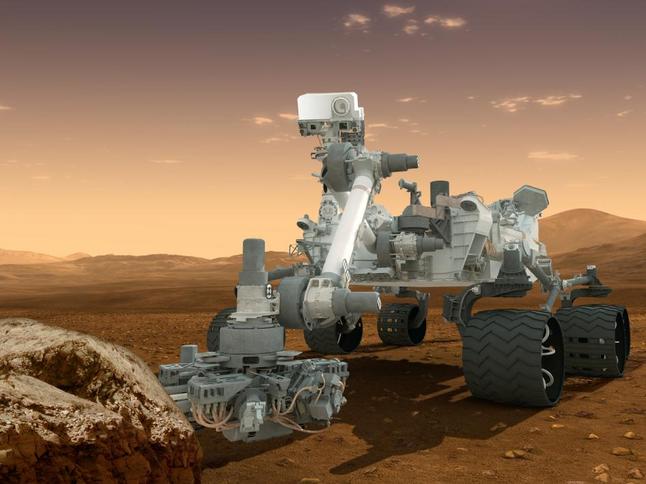
This artist's concept features NASA's Mars Science Laboratory Curiosity rover, a mobile robot for investigating Mars' past or present ability to sustain microbial life.
NASA
The $2.5 billion "Curiosity" rover mission was designed and orchestrated by a team of more than 1,000 scientists, including two University of Michigan planetary scientists: Sushil Atreya and Nilton Renno.

The area where NASA's Curiosity rover will land
NASA
The rover will land using a rocket-powered "sky crane," a method never before attempted.
To celebrate the landing, and the two U-M professors that helped make it happen, U-M's engineering department is hosting a late-night landing party. From 11:30 p.m. Sunday to 2 a.m. Monday in the space research building on North Campus, attendees can join engineering faculty and watch the NASA live stream of the landing.
NASA plans to live broadcast the landing in public areas across the nation, including Times Square in New York City.
The question the rover is meant to answer is simple: Has there ever been life on Mars? The mission, however, isn't quite as straightforward.
"This is a rather complex mission which is designed to address this big question about the potential of microbial life on Mars, primarily in the past, but possibly even now; today," Atreya said.
The rover was launched inside the capsule tip of an Atlas V rocket in November. Its eight-and-a-half-month journey has been monitored by NASA, whose scientists spent more than 10 years designing the rover and planning its landing.
When the capsule is 78 miles above Mars' surface, it will be traveling at 13,000 miles per hour and be heated to a level of 1,600 degrees Fahrenheit because of the friction of the craft with the Red Planet's atmosphere.
By the time it's a mile from Mars' surface, Curiosity will be traveling at 200 mph.
When the capsule reaches 60 feet above the planet's surface, and slows to 2 mph, a mechanism NASA is calling a "sky crane" will lower the rover to the ground using tethers.
It will be the first time NASA has landed a rover without using a parachute for the full descent.
"The landing itself is risky," explained Atreya. "This is the kind of thing that has never been attempted."
The rover weighs roughly one ton and is the size of a small car. It's powered by plutonium and contains dozens of mechanisms meant to measure everything from the methane in the atmosphere to the presence of organic material in sand. Both methane and organics could indicate the presence of living organisms.
The plutonium could power Curiosity for well more than 100 years, although NASA's nominal mission is planned for 680 days.
Below is a University of Michigan video showing an overview of the Mars Science Laboratory mission, including the "7 minutes of terror" that NASA coined to describe the unprecedented landing plan designed for the mission.
Kellie Woodhouse covers higher education for AnnArbor.com. Reach her at kelliewoodhouse@annarbor.com or 734-623-4602 and follow her on twitter.
Comments
bugmenot
Sun, Aug 5, 2012 : 3:12 a.m.
How about a technical description of the contribution by the two planetary scientists?
Nicole Casal Moore
Mon, Aug 6, 2012 : 1:21 a.m.
Bugmenot, if you're interested in those types of details, you might be interested in this story from U-Mich. Michigan scientists bring special expertise to Mars mission: http://ns.umich.edu/new/releases/20067
Dog Guy
Sun, Aug 5, 2012 : 12:49 a.m.
Mission control staff may experience seven minutes of apprehension. The pathetic fallacy allows Mars Rover Curiosity to experience seven minutes of terror. "You can think of it as hearing the star scream as it gets devoured, if you like," Miller said of the phenomenon in a media release.
Ann English
Sat, Aug 4, 2012 : 11:39 p.m.
100 Earth years equal 53.1878 Martian years. 680 Earth days are just under a Martian year of 687 days.
Pete
Sat, Aug 4, 2012 : 8:46 p.m.
Anyone who has 10 years of their professional life invested in a project that will succeed or fail depending on seven very iffy minutes is entitled to call them minutes of terror. The rest of us will just be watching to see if our money has been well-spent. (And I do think a successful landing will be a sign of money well-spent.)
LXIX
Sat, Aug 4, 2012 : 7:07 p.m.
I am glad that NASA/UM have a viable space program that wasn't privatized. That is, run by private companies while still being funded by your waning government monies. Space resources will empower the 'newer world order'. That said, it still belongs to all mankind and having any kind of U.S. presence up there is a worthy government investment in your future security.
LXIX
Sat, Aug 4, 2012 : 10:26 p.m.
Oh man.... Just because the DoD contracts out work to for-profit companies, few americans except maybe Rumsfield would want the DoD or its space program to be privatized. Why? NASA is an easier target and your own lucrative space wealth is now up for grabs. I admire Elon Musk. He helped start PayPal, Tesla, and now SpaceX. While an entrepreneural yank at heart, Musk is originally from South Africa. His SpaceX interest is to make money - not necessarily what is best for you S.A. If you are a U.S. citizen, NASA did once work in your best interest. Even while contracting the Shuttle out to companies like Rockwell. Corporate tweet atributed to Elon Musk - "Huge appreciation for @nasa, without whom we could not even have started, let alone reached this far."
djacks24
Sat, Aug 4, 2012 : 8:12 p.m.
Looks like privatization isn't such a bad thing. Do you really think we built the most technologically advanced Military without contracting out to private companies to develop to our land, air, and water superiority equipment? We contract these tasks out just like NASA has contracted SpaceX Just wow?
djacks24
Sat, Aug 4, 2012 : 8:04 p.m.
"Under the Commercial Crew Integrated Capability (CCiCap) initiative's base period, SpaceX will make the final modifications necessary to prepare Dragon to safely transport astronauts into space. These include: Seats for seven astronauts. The most technically advanced launch escape system ever developed, with powered abort possibilities from launch pad to orbit. SpaceX will demonstrate that Dragon will be able to escape a launch-pad emergency by firing integrated SuperDraco engines to carry the spacecraft safely to the ocean. SpaceX will also conduct an in-flight abort test that allows Dragon to escape at the moment of maximum aerodynamic drag, again by firing the SuperDraco thrusters to carry the spacecraft a safe distance from the rocket. A breakthrough propulsive landing system for gentle ground touchdowns on legs. Refinements and rigorous testing of essential aspects of Dragon's design, including life-support systems and an advanced cockpit design complete with modern human interfaces. SpaceX will perform stringent safety and mission-assurance analyses to demonstrate that all these systems meet NASA requirements. With a minimal number of stage separations, all-liquid rocket engines that can be throttled and turned off in an emergency, engine-out capability during ascent, and powered abort capability all the way to orbit, the Falcon 9-Dragon combination will be the safest spacecraft ever developed." Source: http://www.spacex.com/press.php?page=20120803
djacks24
Sat, Aug 4, 2012 : 8:03 p.m.
"Hawthorne, CA – Space Exploration Technologies (SpaceX) today won a $440 million contract with NASA to develop the successor to the Space Shuttle and transport American astronauts into space. "This is a decisive milestone in human spaceflight and sets an exciting course for the next phase of American space exploration," said SpaceX CEO and Chief Designer Elon Musk. "SpaceX, along with our partners at NASA, will continue to push the boundaries of space technology to develop the safest, most advanced crew vehicle ever flown." SpaceX expects to undertake its first manned flight by 2015 – a timetable that capitalizes on the proven success of the company's Falcon 9 rocket and Dragon spacecraft combination. While Dragon is initially being used to transport cargo to the International Space Station, both Dragon and Falcon 9 were designed from the beginning to carry crew."
Greggy_D
Sat, Aug 4, 2012 : 5:24 p.m.
As much as I want to see this succeed, the landing sequence is a Rube Goldberg design. Far too complicated and far too much to go wrong.
Rudra N Rebbapragada
Sat, Aug 4, 2012 : 5:02 p.m.
The seven minutes of terror is an anticipated event; the fate of man landing on Mars. The future missions to Mars may use a similar technique to place man on Mars. Indeed, the Michigan Connection is a wonderful thing to read about and I wish them success and will watch this show. I have a personal interest in this mission which concerns the discovery of Life on Mars. In my expectation, planet Earth is the only place in this vast universe that is the home for living things and Earth could be an original object, one of its own kind of celestial object. This originality of Earth is related to its unique rotational spin and the seasons in Mars are different as it has a different rotational spin axis.
NoPC
Sat, Aug 4, 2012 : 4:31 p.m.
This is why I've been trying to convince my son to attend U-M Engineering School!
Kellie Woodhouse
Sat, Aug 4, 2012 : 11:48 a.m.
Readers: This story has been corrected to note that the rover was launched using an Atlas V rocket. Thanks for reading!
Paul Taylor
Sat, Aug 4, 2012 : 11:32 a.m.
Correction: the launch vehicle was an Atlas V, not a shuttle.
Kellie Woodhouse
Sat, Aug 4, 2012 : 11:41 a.m.
Thanks Paul, I'm changing the term to space laboratory. Thanks for reading.
Harm
Sat, Aug 4, 2012 : 11:05 a.m.
I'm satisfied that the term is appropriate here. Go, Curiosity!
Craig Lounsbury
Sun, Aug 5, 2012 : 2:17 a.m.
"Craig, you really need to find something to occupy your time besides nitpicking anything that is posted on this website. ' what do you know about me and how I spend my time? What you evidently don't know is a good chunk of my posts are pretty benign. " The amount of knowledge we could gain off of this mission could reveal some of the most significant scientific breakthroughs and understanding than we've ever known." I agree. What does that have to do with the use of the word terror? "They can call the landing sequence whatever they please with what could be gained from this mission." Interesting thought. I think I could come up with dozens of completely unacceptable titles. But Ann Arbor.com would delete them all.
djacks24
Sat, Aug 4, 2012 : 5:18 p.m.
"But its hard for me to equate what these scientists may feel as that 2.5 billlion dollar machine lands with what folks must feel as gun a gun man wreaks havoc in a movie theater or an IED explodes killing and maiming." This article is full of holes and fails to mention some important points as to why it is "seven minutes of terror". Like, for instance, this never attempted before landing is going be done as we temporarily lose communications (for seven minutes) with Curiosity. I suggest going to NASA's website for a full and accurate description of whats going to take place and what is at stake. As far as being politically correct about just about everything these days, we have to add how we use the word terror now? The word terror or terrifying has been used to loosely describe just about every roller coaster ride or Halloween fun house ever made, but you're really going to be politically correct about how we name an unmanned Mars landing? Craig, you really need to find something to occupy your time besides nitpicking anything that is posted on this website. The amount of knowledge we could gain off of this mission could reveal some of the most significant scientific breakthroughs and understanding than we've ever known. They can call the landing sequence whatever they please with what could be gained from this mission.
Craig Lounsbury
Sat, Aug 4, 2012 : 11:48 a.m.
certainly it could fly grammatically. But its hard for me to equate what these scientists may feel as that 2.5 billlion dollar machine lands with what folks must feel as gun a gun man wreaks havoc in a movie theater or an IED explodes killing and maiming. There is enough life and death terror in the world without using the term to describe "nerve racking". Again, my opinion, and I respect yours.
Craig Lounsbury
Sat, Aug 4, 2012 : 10:48 a.m.
I think the word 'terror" should be reserved for events that truly are. JMO.
djacks24
Sat, Aug 4, 2012 : 5:21 p.m.
Someone needs to get a life, or is it not politically correct to use that term now?
ViSHa
Sat, Aug 4, 2012 : 2:32 p.m.
Funny, I was thinking the same thing. Tense, maybe?
Major
Sat, Aug 4, 2012 : 1:42 p.m.
Terror implies an intense fear that is somewhat prolonged and may refer to imagined or future dangers.. I would say it is a very descriptive term for what will be felt by many. Any other words used would be unprintable....here anyway.