

This Week's Web Picks: Tiny beauty, abbreviated wisdom and the webcam as starship
Editor’s note: This is the next installment of a weekly column by Paul Wiener designed to point readers to cool or useful websites.
Screen, size, sight. Sight unseen. A middling computer or digital camera screen displays more than 3 million pixels per square inch. Each pixel represents a visible "point" of light; the more pixels the crisper the image. Or so you'd think.
A camera screen might be 6 square inches; an iPad 45, a computer screen 400. Though 3 million satisfy most needs, everybody wants more pixels, as if eyes could count light. But how many pixels do you need to see beauty?
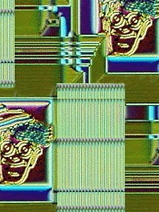
Waldo etched onto a microchip
A micron is a millionth of a meter. A picture etched onto a tiny computer chip might be 80 microns — 1/500th of an inch! How do they do that? Engineers have been teasing us with these hidden micro-drawings for years. You can see hundreds of them on The Silicon Zoo, one of many sub-sites at Molecular Expressions, which houses thousands of microscopic images, from chemical structures to DNA to birthstones, and beer.
How about a Smurf on a Siemens circuit? Many implausible images (like fragrances) are made possible by filters, stains or specialized lighting. The animate world is represented as well: feathers, butterfly wing scales and microorganisms are here, and for technophiles there are many links about the processes and cameras that make photomicrography possible and ever-expanding. There are some sights so fine they make pixels seem as broad as fingerpaint.
Like most people on the planet, you've probably suppressed the urge to read all of Nietzsche, or Kierkegaard, or Aristotle if it couldn't be done in half an hour, if only because it was impossible. But it's not impossible. It is an opportunity the resume-free Glyn Hughes of Lancashire, England has labored to provide all us hurried seekers. In 500 to 2,000 words, Hughes summarizes, extracts, abridges or re-states the basics of many of philosophy's canonical books and treatises.
Do you need Hegel's Philosophy of History? Not a problem. Popper's The Logic of Scientific Discovery? Why not. Plato's Republic? Of course. These are readable essays; sometimes they're simply thoughts listed. Each entry has a brief introduction as well as a very very squashed version of the summary short enough for a pre-teen's attention span.
There are also links to Wikipedia entries, to full-text works, if they're available (most are), and to Amazon UK, just in case you want to double check Hughes' accuracy or his compulsive tendency to make thinkers sound intelligible. He insists that no copyright applies to his words, so don't bother to ask. But if you quote SqP, well, you're on your own at a dissertation defense. One of the aphorisms he quotes is, not-so-oddly, cautionary: "Beware of all enterprises that require new clothes" (Thoreau).
This is a tricky one. It has a reputation, but it's not the website's fault. It's what you'd expect given the random strangers from around the world it lets you see and talk to in real time. Who they are and what you see is the fun, or the turn-off. Contact starts, and often ends, abruptly.
When I first started using the internet, I thought one of its coolest features would be the way it expands communication with all kinds of people. And that was before webcams. Sitting in a room at home I could talk to someone from Turkey, or Boise, or Algeria, Scotland, Flagstaff, Russia, Klamath Falls, Austin, the Ivory Coast, Taiwan, Ironwood or Oklahoma City, if they were online and of a mind to chat. I quickly found that, despite the global village we inhabit, such innocent, curious chats are hard to come by. But if you kept trying, they were possible.
Chatroulette is a simple web program that hooks your webcam up to all the other webcams plugged into the site, and at your command, randomly cycles you through as many of them as you can tolerate. Suddenly, you see who's on the other end of a world, and you can speak to them. Usually.
At any moment you or they can end the connection and move on, which is what usually happens. Most of the users are young (under 30), and, since the site is anonymous, user-controlled and safe, some users are desperately exhibitionistic. Others are giggly students in dorms, or insomniacs; some just stare, or mug, or gesture, or are just curious like you. Many look puzzled and don't even know what they're looking for. Who can blame them?
Don't be put off by the jerks; this site deserves much more than their presence. It may take 30 tries, but you can usually find a few shy, friendly people who will talk (sometimes in broken English) about himself, her life, share a joke, an interest, a link, or simple surprise and pleasure in connecting with another strange soul 5,000 miles away who appreciates a nod and a smile. Unlike Facebook, Chatroulette makes no demands and restores respect for privacy.
(Correction: last week I mistakenly said that Daniel Tammet learned Finnish in a week and proved it on the radio. I meant Icelandic.)
Paul Wiener of Ann Arbor was a librarian for 32 years at Stony Brook University, in Long Island, N.Y., where he managed the English Literature, Art and Film Collections. He may be reached at pwiener@gmail.com.
Comments
noreaster
Mon, May 14, 2012 : 1:33 p.m.
My calculations show 80 microns is more like 1/300 of an inch, a bit larger than the 1/500 stated. Might want to check your numbers before you present them...
noreaster
Mon, May 14, 2012 : 1:29 p.m.
Mr. Wiener, please don't confuse pixels with pixels per square inch, neither of which is as useful as pixels per inch. Middling computer and camera screens are nowhere near 3 million pixels total, let alone 3 million pixels per square inch. A full HD display, seen only on top end computers, is 1920 x 1080 pixels or about 2 million total. For a 16" x 9" display that would be 14,400 pixels per square inch, a far cry from 3 million. Much more useful is knowing pixels per (linear) inch, which is near 100 for most displays. The best displays are around 300 pixels per inch, as seen on only the latest smartphones.
Paul Wiener
Mon, May 14, 2012 : 2:19 p.m.
I appreciate the correction. In trying to indicate how small pixels are I may have been confused by varying descriptions of their size and scale, especially in discussions of camera technology. Your clarification doesn't diminish the art of etching microchips, but it will help readers understand that even a larger scale of tiny is still awfully small.
DBH
Sat, May 12, 2012 : 5:03 p.m.
I really like the Squashed Philosophers. Thanks!
PattyinYpsi
Sat, May 12, 2012 : 3:04 p.m.
So nice to have you back, Paul! And this week's suggestions did not disappoint. The Silicon Zoo on the Molecular Expressions site may be the nerdiest--in a good way!--site on the Internet, being filled with tiny depictions of such gods of nerd culture as "The Simpsons" and Scott Adams. But the images themselves are delightful and often amazing--the aspen leaf, for example, of which 25 billion of this doodle would be required to comprise a real aspen leaf. I love knowing that the small worlds within our laptops contain these secret artistic expressions created by engineers.