

Thousands take advantage of free electronics recycling on Consumer Electronics Day
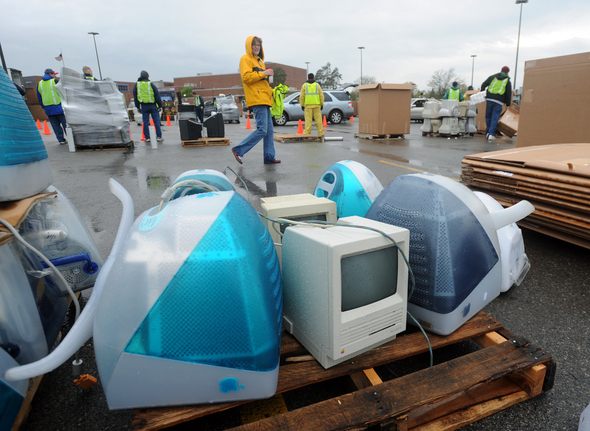
A volunteer walks past a pile of old Apple Macintosh computers in the Pioneer High School parking lot during Saturday's free e-Waste Recyling event, which ran from 9 a.m. to 3 p.m. The event gave locals the chance to dispose of old electronic devices in an eco-friendly manner. Everything gathered at the event was loaded onto tractor trailers where it was to be shipped to Chicago and recycled.
Lon Horwedel | AnnArbor.com
Yesterday’s high-tech gadgets are today’s trash.
That was plain on Saturday when hundreds of cars queued up in the parking lot at Pioneer High School over several hours as people dropped off old monitors, computers, TVs and other electronics to be recycled.
The University of Michigan organized the Consumer Electronics Day and gave residents in the area a chance to dump their old electronics in an environmentally responsible manner. Best of all, it was free.
The annual event is co-sponsored by Apple and the university. Apple pays for the vehicles to haul away the equipment and the recycling costs, while the university pays for advertising and other organizational details.
The recycling program is part of an agreement, formerly called Climate Savers, that U-M has with Apple.
Recycling electronics isn’t cheap. Taking items such as computer monitors to a recycling facility can cost roughly $40, said Andy Berki, the manager of the university’s Office of Campus Sustainability.
Businesses and schools are required by law to recycle their electronic equipment.
And for the everyday consumer, tossing out a TV or computer in the trash is not an environmentally responsible option. Most of these items have a warning on them stating that they can not be thrown out as garbage because they contain components that are not safe in landfills.
The university had a separate collection day for businesses and schools so that they could get residents in and out quickly for Saturday’s Consumer Electronics Day. Volunteers aimed at getting residents through the line within five minutes. They needed to work quickly as more 2,800 people came to take advantage of the service.
Once the electronics are dropped off, they are sent to a facility in the United States where they are taken apart. The plastic gets turned into items such as fencing, the circuit boards are used to make other circuit boards, and the glass is ground down and may end up in asphalt to make roads.
The service became an extension of the university’s own recycling program. It was started four years ago and has become very popular as more people find too many old or worn out electronics taking up space.
“It's been a huge hit,” Berki said.
Comments
Seasoned Cit
Sun, Apr 25, 2010 : 2:23 p.m.
Agree!... They did a great job...and by evening you'd never know that it ever happened. This weekend however I discovered that the ReCycling Center on Ellsworth now has a $3 fee to drop off items, even cardboard which the City will take for free (and soon give me "points") if I bundle it and put it out on my curb. Is Recycle A2 trying to discourage folks driving to their Drop-off so as to save fuel or are they being undercut by the City and the new recycle plan? What's next.. pay the Red Cross when you donate Blood?
kenUM
Sun, Apr 25, 2010 : 11:12 a.m.
Saldoggy is right! This was a well oiled machine and ran smoothly!! The volunteers were great and very friendly. As I stated earlier, I am pleased that this event takes place as you do not fathom all of the room saved from landfills and the subsequent pollution that is created by this stuff getting dumped!! Again, KUDOS to the Ann Arbor Public Schools, U-M and the many volunteers of this project!!
Ann Dwyer
Sat, Apr 24, 2010 : 10:18 p.m.
@David K- It was formerly known as Climate Savers. The program has since changed and no longer has a formal name.
David K
Sat, Apr 24, 2010 : 9:55 p.m.
The umich.edu climatesavers page lists Cisco, Dell & Sun as corporate sponsors, not Apple so I am confused. It's great to see so many of the community recycling in a responsible manner, but unfortunately recycling is not as environmentally friendly as reusing if the electronic item still works and is less than 5 years old. Except for storage products like hard drives, the energy efficiency gain from newer equipment doesn't offset the energy cost of material recovery, transportation, and manufacturing a new item. Check out www.InternetHelpers.org to see how a local intiative will be reusing and conditioning computers and technology to help and train low income seniors on using the Internet. Donors can get a tax deduction too!
Saldoggy
Sat, Apr 24, 2010 : 9:55 p.m.
I was in and out in less than three minutes...very well organized. Many thanks to Apple, UM and all of the volunteers!!
Liz Margolis
Sat, Apr 24, 2010 : 9:35 p.m.
This is a wonderful event for the community. It was started five years ago by the Ann Arbor Public Schools in partnership with Apple. The U of M came on board last year. We are pleased that the U of M joined this recycling event and look foward to many more years helping this community recycle e-waste.