

Three Democrats from Washtenaw County seeking 18th District state Senate seat
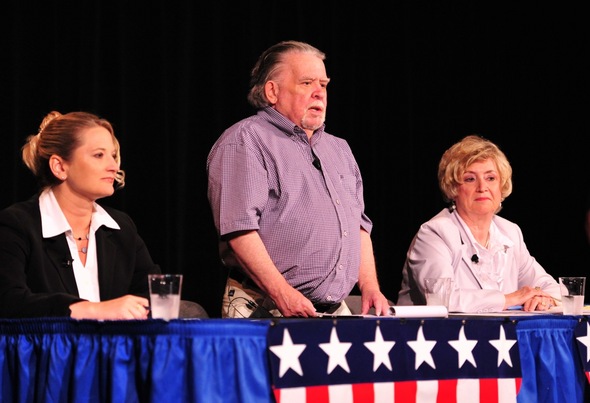
Scio Township resident Thomas Partridge, a candidate for 18th District state Senate, took on state Reps. Rebekah Warren, left, and Pam Byrnes Wednesday night in a debate hosted by the League of Women Voters of the Ann Arbor Area.
Ryan J. Stanton | AnnArbor.com
Three Democrats vying for the 18th District state Senate seat made known their plans Wednesday night for turning around Michigan's economy, each vowing to work across party lines and take steps to reform state government.
State Reps. Rebekah Warren, D-Ann Arbor, and Pam Byrnes, D-Lyndon Township, are seeking support from voters in the Aug. 3 primary to make the move to Lansing's upper chamber.
They also face Scio Township Democrat Thomas Patridge, an active advocate for civil liberties and mass transit who is known for regularly speaking before the Ann Arbor City Council, Washtenaw County Board of Commissioners and Ann Arbor Transportation Authority board.
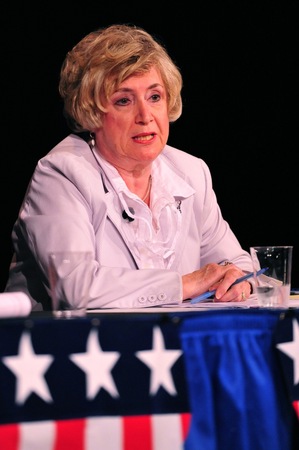
Byrnes described herself as a job creator Wednesday night. As one example, she cited her work on Michigan's cottage food bill, which will allow people to sell jams and jellies at farmers markets.
Ryan J. Stanton | AnnArbor.com
Wednesday's candidate debate was hosted by the League of Women Voters of the Ann Arbor Area and was taped inside CTN's television studios for rebroadcast.
Candidates answered a series of questions that touched on environmental issues, tax reform, term limits, job creation, infrastructure, legislative redistricting and their strengths.
The winner of the Democratic primary will face off against either John Hochstetler or Gary Wellings, who are vying for the Republican nomination in the 18th District.
The seat currently belongs to Liz Brater, D-Ann Arbor, who is term-limited.
Warren said Michigan needs serious reform and argued her record stands out above Byrnes in that regard.
"We need real reforms that really get to the structural deficit that Michigan is facing," she said. "We need real reforms that last past the 5 o'clock news headline. We need the kind of reforms that are going to put Michigan back on the path to prosperity and not leave a single individual behind."
Byrnes, House speaker pro tempore, highlighted her work as chairwoman of the House Transportation Committee and as a member of the state Transportation Funding Task Force.
"This is an area that I have led the charge that we need to have stable funding for our roads, for our bridges and our public transportation system," she said, lamenting the fact that the state has let its infrastructure deteriorate.
"What company wants to locate in a state where the roads are crumbling, the bridges are closed and people can't get to work?" she said.
Byrnes and Warren agreed the money coming from the state's current gas tax and vehicle registration fees isn't getting the job done.
"We have a very old transportation funding formula," Warren said. "It has not been updated in a long time, and it doesn't reflect our transportation needs today. We have a formula that says no more than 10 percent of our funds collected can go to public transit."
Partridge said he wants to increase access to buses and paratransit services for seniors and people with disabilities. He also supports a graduated income tax on businesses and individuals.
Partridge described himself at the start of the debate as a progressive Christian Democrat. He said he also is a father, a grandfather and a dedicated advocate for vulnerable residents.
He vowed to put forward an agenda to unite Washtenaw County with transportation programs, road improvements and access to affordable housing, education, health care and jobs.
Byrnes, who joined the House in 2005, said she has been active in the community, serving on the board of Child and Family Services and as chairwoman of the Ypsilanti Central Business Community, among other groups. She also founded the Western Washtenaw Democratic Club.
"I've been living and working in this community for 35 years," she said. "I worked my way through law school and, as a single mom, I became an advocate for families, children and victims of domestic violence. I ran my own law practice for many years, taught at Eastern Michigan University ... and was the first woman road commissioner in Washtenaw County."
Byrnes said she believes she's the most qualified candidate to represent Washtenaw County in the state Senate due to the extent of her experience, her accessibility to constituents and ability to get the job done.
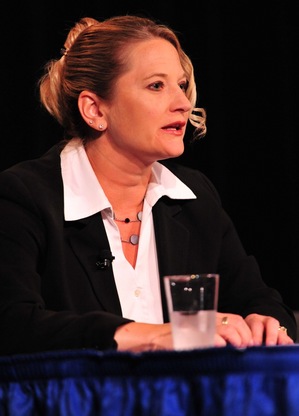
Warren used an analogy to described her thoughts on term limits. "Would you want a brand-new heart surgeon to be the one who did your heart surgery?" she said.
Ryan J. Stanton | AnnArbor.com
"You need a legislator who focuses on creating job opportunities in Washtenaw County and in Michigan," she said. "We need a legislator who can work across party lines to move Michigan forward."
Warren, who joined the House in 2007, said she came to Ann Arbor like many others to attend the University of Michigan and ended up finding a home.
"For the last 20 years, I have worked to make our community a great place to live, work and visit," she said. "I spent seven years working in the trenches of the pro-choice movement and 10 years in Lansing as a legislative staffer and a legislator."
Warren said she has worked diligently in the House to provide leadership on a number of issues critical to Michigan's future. She has served as chair of the Great Lakes and Environment Committee, co-chair of the Legislative Biotechnology Caucus and chair of the Pro-Choice Caucus.
"We worked across party lines to enact the Great Lakes Compact, an international treaty that protects our Great Lakes from diversions out of the basin," she said. "When funding cuts threatened our 30-year-old wetlands protection act, I again reached across the aisle and across the dome to find a compromise."
"We've done a lot that we can be proud of but there's plenty more to do," she added. "We have a constant threat from invasive species, everything from plants and mussels to invasive species like Asian carp."
Byrnes said protecting the state's natural resources is a priority of hers as well.
"We have just passed a resolution for a constitutional ban against drilling under the Great Lakes," she said of legislation that came out of Warren's committee. "It's very important that we do protect our water, and I will continue my efforts to maintain the controls that we do have."
Partridge said he would include in his agenda more affirmative protections for the state's water supply and wetlands. He said he would balance that with a greater attention to funding and advancing the causes of what he called "people services," including housing for the homeless, affordable housing, transportation services, and universal access to education for everyone with an "18th District Promise" for all students to enable them to attend college.
Partridge said he's an advocate of tax reform. He said he supports a constitutional convention that would rewrite the ability of the state and local governments to have fair and equitable ability to raise taxes. He also said he supports eliminating property taxes for the middle class and lower-income individuals.
"Michigan has a pretty antiquated tax system," said Warren, who also supports a graduated income tax. "We have a lot of work to do to bring our tax system into the 21st Century. Michigan is one of just a handful of states that still relies on property taxes heavily as we do. Property used to be a very serious indicator of wealth. If you ask anybody who owns property now ... it tends to be people's biggest indicator of debt."
Warren and Byrnes agreed on expanding the sales tax on services. Byrnes said it could provide more stability to the state's school aid fund.
The two also agreed term limits in the Legislature have had a negative impact.
"I think you see a lot less folks willing to trust each other and work together because it is a very fast process — six years at most in the House and eight years at most in the Senate," Warren said, noting the state is still a $43 billion enterprise and requires leaders with experience.
"I don't think it's a very good form of governance for the state of Michigan, and I think it does not serve the citizens well of this state," Byrnes said of term limits. "It takes several years to get acclimated and by the time you hit the ground running, you are out of office, so there's constantly a revolving door."
Byrnes pointed out what will happen later this year: The state will see 30 out of 38 senators replaced, and at least half of the House. Along with a new governor, new attorney general and new secretary of state, Byrnes said, Michigan will have a brand-new government.
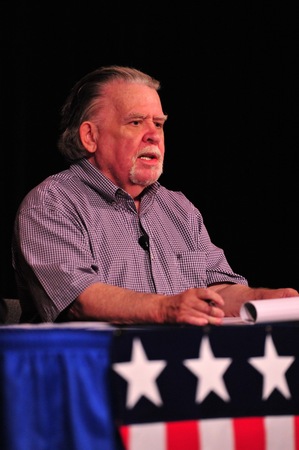
Partridge said he would push for a compact among governments of the Midwestern states to take on the challenge of job creation and providing vital services.
Ryan J. Stanton | AnnArbor.com
Partridge said he thinks term limits are healthy but would like to see them expanded so legislators can serve longer terms.
Warren and Byrnes both said they have worked to create jobs during their time in the Legislature. Warren offered two examples, one of which was legislation that provided for the permitting of 3,500 new acres of cranberry bogs in Michigan.
"Which means 1,000 jobs in construction of those bogs, $150 million of investment, 383 permanent ongoing jobs and about $30 million of new agricultural investment in the state of Michigan," Warren said.
Her other example was her support for the state's renewable portfolio standard, which she said has resulted in auto factories building gear boxes for wind turbines.
Byrnes highlighted her work in support of a second bridge span linking Michigan with Canada, which could bring 10,000 jobs during construction and lead to some permanent jobs. She said she also shepherded through the aerotropolis legislation, which will combine the Willow Run and Detroit Metropolitan airports.
"And recently I have introduced legislation that's passed through the House to add information technology to the 21st Century strategic jobs fund, which will allow more high-tech and software companies to hire new people," she said.
Partridge said in his closing comments that it's time for change.
"The current legislator, including the current representatives representing Washtenaw County in the Legislature, have not achieved the results that the residents of Washtenaw County ... need and urgently require," he said. "That's why I'm putting myself forward."
Byrnes, who has been endorsed by the building trades, local first responders and small business owners, vowed to keep fighting for seniors, solving problems and reforming government.
"I believe that a leader must lead by example in these difficult times and that's why I voted to reduced legislative pay by 10 percent, to eliminate legislative retirement benefits and to dock pay of legislators who don't show up for work," she said. "I believe that every citizen in Michigan should be treated equally and fairly and that's why I sponsored legislation to repeal the ban on same-sex marriage and to end wage discrimination by calling for fair and equal pay."
Warren said it's no secret that times are tough in Michigan, but she believes the state's economy can be rebuilt with the right people in office. Warren said her record has led to support for her campaign from the Michigan Education Association, Michigan Federation of Teachers, AFL-CIO, Clean Water Action, Michigan Nurses Association and UAW.
"We have challenges right now and I want to go to the Senate to help find the solutions," she said, vowing that if elected to the state Senate, she will remain committed to the values that first drew her to public service: "healthy families, a clean environment and strong public schools."
Ryan J. Stanton covers government and politics for AnnArbor.com. Reach him at ryanstanton@annarbor.com or 734-623-2529.
Comments
Mick52
Fri, Jul 9, 2010 : 1:19 p.m.
Good post Insidethehall. Yup Husker I am with your 2nd paragraph. I like to see efficiency and effectiveness in my govt. The service tax was tried once before, recently and was quickly recalled w/public outrage. I do not think new taxes are appropriate. I wonder often how much tax the state looses from people who work in areas where tips are the main source of income, that would be unpopular with those folks, but fair to us all that we are all taxed equally. So I think a 1 to 1.5% in the income tax, perhaps presented as temporary is easier to get done, if the people trust Lansing. Also we might do what Ohio does, give cities/counties the ability to raise the sales tax in their boundaries if the local folks agree. Local govt provides most of the service that makes you QOL better but with a runaway spending fed that is driving up everything, voters tend to vote down a lot of tax requests.
Veracity
Thu, Jul 8, 2010 : 7:21 p.m.
CORRECTION: In my previous comment I mistakenly referred to Thomas Partridge instead of John Hochstetler. I apologize to Mr. Partridge.
Veracity
Thu, Jul 8, 2010 : 7:14 p.m.
InsideTheHall: The UAW was formed in 1935 and this is what Wikipedia says about the organization: "During the 1950s and 1960s, UAW members became one of the best paid groups of industrial workers in the country placing them solidly in the middle class of American society[citation needed]. By the end of this period, changes in the global economy, competition from European and Japanese automobile makers, and management decisions at the U.S. automakers had already started to significantly reduce the profits of the major auto makers and set the stage for the drastic changes in the 1970s." Blaming Rebekah Warren and Pam Byrnes for the excesses of auto industries' contracts with the UAW is unjustified as both legislators were either not born at the time or young children. By the time they became legislators foreign auto companies had already set up shops in states which allowed non-union employment and had cheaper standards of living. Please explain how Rebekah Warren and Pam Byrnes "clung to the MEA skirt" and how that led to poor educational performance of Michigan students. Exactly what did you wish them to do that will have resulted in higher academic achievement? As far as supporting the candidacy of Thomas Partridge, other than operating a successful farm what attributes will he bring to the state legislature? What bills would he like to introduce that will raise Michigan's economy, produce plentiful jobs and improve education?
InsideTheHall
Thu, Jul 8, 2010 : 4:02 p.m.
Veracity: Oh my my. They had nothing to do with globalization? Perhaps that is true but they stood watch as the auto industry migrated to the Southern US. They stood watch as Michigan fell to the bottom 10 for business attractiveness as they clung to the UAW skirt. They stood watch as student test scores plummeted yet they clung to MEA skirt. Warren and Byrnes are in office because they suckled at the union bosom and what exactly did that do to benefit the good hard working folk of Michigan? I'm supporting the Republican German Farmer who has worked with his hands without a union card in his back pocket to provide a living for his family.
Veracity
Thu, Jul 8, 2010 : 2:18 p.m.
None of the candidates had anything to do with selling of inflated mortgages to unqualified borrowers or creating securitized mortgages, CDOs and CDSs which finally led to our financial crisis. None of the candidates are responsible for the globalization of manufacturing or the shift from a consumer (spending) economy to a savings (thrift) economy. Nor should the candidates be blamed for not resolving the financial crisis and not providing a million jobs in Michigan. If you wish to "kick out the incumbents" please make sure that their replacements have the capabilities and the defined ideas that will get us out of the economic doldrums. I do not believe that any of the three candidates for state senate seat have cures for our problems. However, at least two of them have knowledge and experience that should be helpful. And looking at other candidates who will be vying for the office in November I see no one who assuredly will be more effective.
Ryan J. Stanton
Thu, Jul 8, 2010 : 1:37 p.m.
Please note we've now posted the GOP side of the 18th District race here: http://www.annarbor.com/news/republicans-with-common-quest-seek-18th-district-state-senate-seat-in-washtenaw-county/
Husker7
Thu, Jul 8, 2010 : 12:57 p.m.
@Mick - I'm glad to have a more comprehensive view on your thoughts on taxes. Your first couple of sentences were unclear but by the end I think I got the gist of it... Correct me if I'm wrong, but you believe in income tax increases over an expansion into a service tax? I just think the sales tax has run its course and that we should be expanding to tax services, which is where the majority of revenue is coming from now... And something the candidates addressed with their statements above. I mean, I'm all for tax increases of any kind, as long as it comes with government efficiency... And ridding non-essential services extends to government itself, that's why I think Pam Byrnes' statement that said she voted to dock the pay of legislators who don't show up to work proves her as the more efficient candidate, there's nothing about Rebekah's view on that, I'm not sure how she voted - but that's not something she emphasized... @Robert M. and @David Cahill - How silly to be talking about yard signs... Let's not be ridiculous. Rebekah Warren's yard signs are GOP red, does that mean she's a Republican...? Get over yourselves, anyone that knows Pam Byrnes knows she's a Democrat.
Barb
Thu, Jul 8, 2010 : 10:26 a.m.
@Walker101 "Warren: Spent 7 years in trenches for the PRO-Choice movement, how did that effect economy other than reduce population. I guess if you have less people that helps." Not sure what that has to do with anything - either you'll vote for ProChoice candidate or you won't - but if you understand much about the State's economic issues, you'd know having less people does not actually help anyone. Other than that, your statement makes perfect sense.
Top Cat
Thu, Jul 8, 2010 : 10:23 a.m.
@leaguebus. You conveniently excluded the names Reagan and Obama. I wonder why. Anyway, your comment was completely irrelevant to the article.
Mick52
Thu, Jul 8, 2010 : 10:21 a.m.
Yes Edward, I would if I agreed with the candidates. I prefer moderates with education, good sense and the ability to research what is appropriate rather than to agree to inappropriate so that I would gain the support of any body with a political agenda. To me, its what is best for Michigan, not what is best for me. Thanks for the good luck charm you have bestowed on me. To Husker, I did not say I would oppose tax increases I said all three of these people do. I oppose gas tax increases because the feds want to do that too. Of all things you buy, the one thing with the most price volatility is gasoline. Many uncontrollable factors can impact the price of gas, so I prefer not to see taxes add to the spike. I do not like the idea of a graduated tax, but I think Michigan's income tax rate should be raised. I do however, require very careful investigation into what we are spending money on and I oppose continuing what we have been doing. I rank public services as essential and non essential. I understand that we all have our own opinions on "essential." Some may rank leaf pickup as more essential than fire departments. Well this is America. I think unions are inappropriate in public service, but I promote strong worker protection laws because unfortunately we have bad management in too many areas. I would rather have a good boss than a union. If you have a lousy boss you unionize. The state should take the lead and put requirements on municipalities on essential services: how many police officers and fire fighters are necessary based on a formula that takes size, population, and structure data to determine numbers and public safety pay and benefits should be roughly standard. Ditto with schools and teachers and other "essentials" determined at the state level. I believe this because so many municipalities have screwed up so much. When you leave these decision with people who are unprofessional and uneducated you get million dollar fountains, greenspace, outside your city borders, and so much park land you cant take care of it, and contract agreements that put you in budget fail. Thus I would have to issue with raising income taxes by 1-2%, but not to "fit" our shifting economy. I prefer wise spending and saving. Its fairly obvious what we have done in the past has caused our problems. We need a shift, not just poor money into what we have been doing. Maybe someday at Michigan rallies we wont be chanting "We're number 48, we're number 48, we're number 48, we're number 48...."
David Cahill
Thu, Jul 8, 2010 : 10:20 a.m.
I'm for Rebekah Warren. Her signs say she's a Democrat.
Husker7
Thu, Jul 8, 2010 : 9:48 a.m.
@Awakened - I understood your sarcasm, so feel comfort that at least one person can appreciate your humor... @Mick52 - Expanding taxes to fit our shifting economy is a smart choice, I'm not sure how you can argue that our government can provide its services with underfunding and a lacking revenue...
leaguebus
Thu, Jul 8, 2010 : 9:41 a.m.
Yes, Top Cat, those pesky tax and spend Democrats are going to bankrupt the state! The only people that know how to create jobs are the Republicans. Oh, by the way, if you look at job creation by Presidential term, all the Democrats since FDR have consistently created a large number of jobs. The lowest percentage of payroll expansion per President belongs to both Bush Presidents and Gerald Ford. The highest payroll expansion belongs to Clinton, Johnson, and Truman. (Wall Street Journal) It looks like we have three good candidates for 18th District Senate. Please vote in the primaries!
Mick52
Thu, Jul 8, 2010 : 9:19 a.m.
Why anyone would vote for a current legislator responsible for the mess we are in to continue is beyond comprehension. All three promote raising taxes. One likes to use the word "reform." Term limits was a reform, but, please, enough. With any of these three, I see no chance of anything improving. Ms. Warren: Wind turbines? Out here at the western end of Dist 18, we found out nope, won't work here, not enough wind. No proof yet the renewable energy industry will be viable. The renewable energy portfolio has drawn criticism already, it forces you to pay for it. If this folly, renewable energy, had any chance of profitability, it would be funded by investors, not by taxes or mandated charges by a failed state government. So anyone promoting this should not be in public service. Ms. Byrnes wanted to raise gas tax, just what we need and opposed a funding idea to improve our state parks that has proven very successful in another state. Seems like the right people to be in office is anyone other than who has been in office, but Mr. Partridge does not impress me either. I do not like term limits either, but when you allow direct voter initiatives you are going to get stupid results more than half the time. Voter initiatives are very bad government. Indirect initiatives I am okay with. Look at the list of states that allow direct initiatives and then consider how they are doing economically.
InsideTheHall
Thu, Jul 8, 2010 : 9 a.m.
Well, this is like three blind mice. More taxes, more government, more nanny state style politics. Folks the state brings in less than half the revenue it used to becasue the Democratic state leadership (including Warren and Byrnes) contributed to the crash and burn in the Great Lakes State. Population is contracting, jobs are fleeing, and the DEMS just keep on smoking the pipe and passing it on.
Awakened
Thu, Jul 8, 2010 : 8:58 a.m.
Well, Veracity. To take this discussion to a somewhat more substantive level... I don't believe that the State (or Federal) government can do anything to create jobs except get out of our pockets. Leave the money in the hands of the producers and consumers. Let us make our own finacial choices. Purchases, investments, and neccesary expenditures for our local governments and schools. I'll vote for a candidate who wants to move the State that way. If there ever is one. Barring that, I may run, once I meet the residency requirement.
walker101
Thu, Jul 8, 2010 : 8:57 a.m.
Byrnes: Increase taxes, real reforms? No solutions.Byrnes pointed out what will happen later this year: The state will see 30 out of 38 senators replaced, and at least half of the House. Along with a new governor, new attorney general and new secretary of state, Byrnes said, Michigan will have a brand-new government. Maybe they'll be replaced with Independents? Democrats don't have a chance. Warren: Spent 7 years in trenches for the PRO-Choice movement, how did that effect economy other than reduce population. I guess if you have less people that helps. Warren and Byrnes agreed on EXPANDING the sales tax on services. Let's see does that mean more like increasing or just making it bigger? Why not just say INCREASE TAXES, Our tax system is antiquated, when did the new one come out? Partridge said he thinks term limits are healthy but would like to see them expanded so legislators can serve longer terms. I guess maybe that wouldn't be healthy? Oh wait,"people services," means more tax money from the working class, yet he supports eliminating property taxes for the middle class and lower-income individuals. Where will the revenue come from if he does that? From the working people to support those who don't? Good Luck!
Veracity
Thu, Jul 8, 2010 : 8:49 a.m.
Awakened:...... and I can find no humor in this economy.
Veracity
Thu, Jul 8, 2010 : 8:45 a.m.
Marshall Applewhite: Can you list examples of the "non-leach variety candidates with private sector experience" that would be acceptable to you? Why is private practice legal and legislative experience not useful for a legislative job? Please share with us your fail-proof plan for creating non-subsidized jobs?
Awakened
Thu, Jul 8, 2010 : 8:44 a.m.
Sorry, Veracity. It was a joke. Clearly I am not an expert on how poorly humor translates by text sometimes.
Veracity
Thu, Jul 8, 2010 : 8:22 a.m.
Top Cat: We, the citizens in the 18th district, are the constituency. If you were in office how would you expand jobs? We need constructive criticism and meaningful solutions. Wolverine3660: Why? Awakened: Oh, really? And how did you become an expert on "the logic and soundness of Ann Arbor's political philosophy"? For one thing, what is Ann Arbor's political philosophy? Barb: and how exactly does "Rebekah" Warren have it going? I wish that those leaving comments would provide substance.
Marshall Applewhite
Thu, Jul 8, 2010 : 8:09 a.m.
After reading this, I have serious doubts as to whether any of these candidates actually knows how to create a non-subsidized job. It's alright that Pam Byrnes has operated her own law practice, but we need to elect more of the non-leach variety candidates with private sector experience.
Barb
Thu, Jul 8, 2010 : 8:04 a.m.
Rebakah Warren has it going on. Although I like Pam Byrnes a lot too. Nice to see so many choices.
Awakened
Thu, Jul 8, 2010 : 7:57 a.m.
I think Partridge best reflects the logic and soundness of Ann Arbor's political philosophy.
Wolverine3660
Thu, Jul 8, 2010 : 7:50 a.m.
Pam Byrnes is the best choice amongst the three running.
Top Cat
Thu, Jul 8, 2010 : 7:38 a.m.
They are all out to further pick the pocket of anyone that works for a living to support their constituencies, i.e. public employee unions and tax consumers. Their examples of "job creation" are laughable. Thankfully we are guaranteed that at least two of them will lose.