

To the rescue: Church collects unsold food from U-M football and basketball games for Food Gatherers
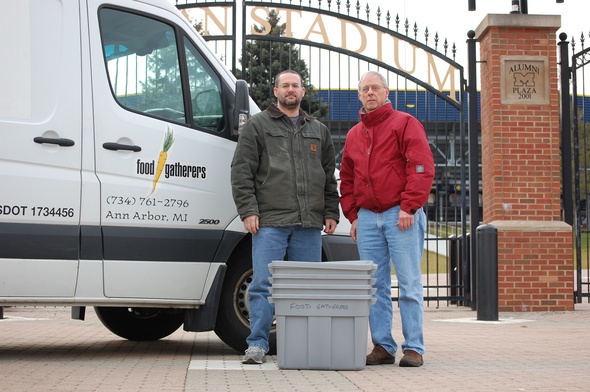
Food Gatherers Director of Operations John Reed, left, stands with volunteer Don Redding, who coordinated the food rescue operation, outside Michigan Stadium with the tubs they used to collect and transport the food. Members of First Presbyterian Church of Ann Arbor help collect unsold food after University of Michigan football games to give to Food Gatherers.
Janet Miller | For AnnArbor.com
But a new food rescue effort by a local church has changed that, collecting more than 10,400 pounds of leftover food from Michigan Stadium this past fall and given to Food Gatherers, which distributes eight tons of food a day to soup kitchens and community pantries around Washtenaw County. A similar post-game food rescue effort will be held at U-M Big Ten basketball games at Crisler Arena.
It’s especially welcome, said Mary H. Schlitt, director of development for Food Gatherers, because the food is high in protein, something that is in short supply and expensive to purchase.
When a member of First Presbyterian Church of Ann Arbor commented on the volume of food that was tossed out after each U-M football game, where the church ran one of the dozens of concession stands, Don Redding decided to look into it.
“It was being thrown out, literally, in trash bags,” Redding said.
He contacted the U-M and Sodexo Inc., its food service provider for athletic events. He also connected with Papa Johns, a subcontractor for pizza.
By the first football game, Redding had organized a small corps of church volunteers who distributed plastic tubs to each of the roughly 45 concession stands that circle the stadium. The plan was to pick them up and load them on to a refrigerated Food Gathers truck when the game was over.
They hit pay dirt on the first game.
Because of thunder and lightning, the game was eventually canceled, leaving 2,500 individual pizzas along with hot dogs, bratwurst and soft pretzels unsold, Redding said. It was the largest food rescue of the season.
Because the food is prepared in a commercial kitchen, Food Gatherers can accept it, Schlitt said. It also helps that the pizzas are individually sized and ready to be eaten.
“You don’t need a kitchen to prepare them,” she said.
The football and now basketball food rescue adds two more food sources to the more than 300 different food sources, including restaurants and grocery stores.
It comes at a time when the amount of rescued food is dropping as restaurants and food stores have grown savvy about eliminating overages.
“Food stores are better at reducing their back ends,” Schlitt said. “Walmart, for instance, now has just-in-time delivery for their fruits and vegetables. Grocers are getting better and better at ordering.”
That means Food Gatherers must purchase more food, seeing a 33 percent increase in food spending over the past three years, she said.
But demand is rising with the weak economy. The post-game food rescue “opens up a whole new food source,” Schlitt said. “No one had ever connected the dots before. Don was able to connect the dots. We need more of that.”
The rescued football food has been delivered to Ozone House, SOS Community Services and Metropolitan Baptist Church food pantry in Ypsilanti, among other locations. Sodexo has donated to Food Gatherers from other locations before beginning the stadium food relationship.
Comments
moveon2011
Wed, Dec 28, 2011 : 6:04 p.m.
So WHo get the Charity write off..Food gathers or the CHURCH?
tim
Wed, Dec 28, 2011 : 11:13 a.m.
Sounds like UM football is a good way to get hot food because the games end before dinner in most cases and the food doesn't have to be stored.
moveon2011
Tue, Dec 27, 2011 : 9:08 p.m.
YEAH great job......NOW that GOVERNOR SYNDER cut FOODSTAMPS/SNAP 3 TIMES this year is it not nice we have Agency that .CARE... Now just give all homeless a tent and pot to p in TheIG picture of Michigan taken care of Michiganders ..spare me the crumbs from the rIch mans table....
15crown00
Tue, Dec 27, 2011 : 6:57 p.m.
i once worked for a company that threw away dated products all the time.What a waste!it's pretty common knowledge that u can actually use most dated products safely 2-5 days after the sell date.
15crown00
Tue, Dec 27, 2011 : 6:53 p.m.
that is an absolutely wonderful thng to do.Good Thinking!
Billy Bob Schwartz
Tue, Dec 27, 2011 : 6:08 p.m.
This is a great story. The part that is inspiring to me is to see that someone saw a problem, interpreted it as an opportunity, and did what was needed to bring it about. What a wonderful thing to take food that is going to be wasted and getting it to those who can use it but right now can't afford it. What America needs a lot of these days is people not whining and complaining all the time, but rather doing something to make things better. This is great.
eileen spring
Tue, Dec 27, 2011 : 5:46 p.m.
Food Gatherers enjoys a great relationship with Busch's as well as 300 food donors. For a list of businesses donating food to us regularly, please visit our website:<a href="http://www.annarbor.com/news/to-the-rescue-church-organizes-to-donate-unsold-food-from-u-m-football-and-basketball-games-to-food/">http://www.annarbor.com/news/to-the-rescue-church-organizes-to-donate-unsold-food-from-u-m-football-and-basketball-games-to-food/</a>
Go Blue
Tue, Dec 27, 2011 : 5:32 p.m.
Excellent work. What are the chances of anyone out there knowing how to accomplish getting all the food (prepackaged in the deli area and more) from Busch's stores? Probably other stores as well. I often shopped at Busch's stores late in the day and on many occasions saw the employees piling food into a shopping cart to be tossed out - something about freshness expiration dates. I tried but wasn't successful in getting the food to an agency that would use it immediately - meaning Busch's said no to the inquiry. Anyone have any suggestions on how to get the food saved and into the hands of an agency as opposed to into a dumpster and adding more to our ever growing trash piles? There are so many venues out there where leftover food is simply tossed out and it truly is shameful. A little effort goes a long way and lack of interest of some of the places tossing the food is beyond disappointing.
lt1234
Tue, Dec 27, 2011 : 5:02 p.m.
I love to see this report on the top of the web site. Great for the community. Keep up the good work. Really sick and tired of the many, many useless and non-value added "news" recently.
Sallyxyz
Tue, Dec 27, 2011 : 4:30 p.m.
Very good effort, but let's hope that the food banks are also taking in fresh fruit and vegetables and not only hot dogs and pizza, which are better than nothing at all, but of very little nutritional value other than high fat content. These are snack foods. Excellent effort, however, and much better than throwing it out.
Sparty
Wed, Dec 28, 2011 : 5:17 a.m.
Always some critical of success I guess
Dave Mohler
Tue, Dec 27, 2011 : 4:20 p.m.
"Lightening?" Are you sure?
Jen Eyer
Tue, Dec 27, 2011 : 8:07 p.m.
Thank you. That has been corrected.
Billy Bob Schwartz
Tue, Dec 27, 2011 : 6:03 p.m.
Beats the heck out of darkening, but as I remember, that's pretty much what happened...darkening.
a2ta
Tue, Dec 27, 2011 : 2:14 p.m.
Our church has donated prepared food to Safe House in the past. Also, Staples house on Packard has acepted baked cookies. Check those 2 out for those cookies.
JenM
Tue, Dec 27, 2011 : 1:53 p.m.
This makes me want to run right over there after a game and help load up some containers! How satisfying - wonderful work. This holiday season our children wondered if we couldn't share our overload of homemade cookies and candies with the food bank, but alas, they were not baked in a commercial kitchen. This is my understanding - does anyone know if there is a charity that can accept such items?
Pete Johnson
Tue, Dec 27, 2011 : 1:13 p.m.
That is absolutely awesome!!! great job, hopefully this is just the tip of the iceberg.
Carole
Tue, Dec 27, 2011 : 1:01 p.m.
Hip, hip hooray. Congratulations to Food Gatherings and other helpers. This will help so many. And, indeed, we do seem to be a nation of waste, and glad to hear it is getting less so.
jinxplayer
Tue, Dec 27, 2011 : 11:47 a.m.
Fantastic work!