

Ford Presidential Library archivist talks first ladies at Kempf House lecture
Donna Lehman's interest in American first ladies dates back to the age of 9 when she read her very first book, "Abigail Adams."
Knowledge and experience have since taught Lehman, an archivist with the Gerald Ford Presidential Library since 1996, that her first book and indeed most accounts of the lives of first ladies were little more than hagiographies.
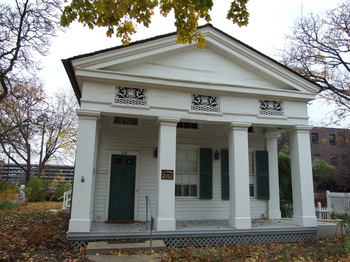
Ann Arbor's Kempf House Museum is hosting a Wednesday noontime lecture series. The spring lectures will continue through April 21.
James Dickson | AnnArbor.com
It wasn't until the 1980s, when Betty Boyd Caroli came onto the scene and brought an academic touch to the study of first ladies that the women started getting their due.
Lehman, using the framework Caroli established, was the lecturer at the Kempf House Museum's Wednesday noon lecture series.Â
Lehman's talk today: "America's First Ladies, a Personal Perspective," leads off the 2010 spring series. March is Women's History Month.
First ladies, Lehman explained, "reflect the status of American women and their times, while helping shape expectations of what women can properly do."
From the days of Martha Washington through the era of Hillary Clinton - Lehman said Laura Bush and Michelle Obama are too "current" to be analyzed in historical terms - the role of first lady has evolved from social secretary to ersatz policy advisor to national role models, and everywhere in-between.
The president of the United States holds two major roles: head of state and head of government, Lehman said. The earliest first ladies were more likely to assist their husbands by arranging and hosting dinner parties than to assist in policy matters.
That has changed over time. By the early 20th century, when President Woodrow Wilson fell sick, his wife, Edith, served as a gatekeeper of sorts. History will debate her exact role in running the country while Wilson was incapacitated, but her statement at the time - "I decide what's important for him to see" - indicates a major, policy-shifting one.
And you can't talk policy-shifting first ladies without discussing Eleanor Roosevelt, whom Lehman put in a class of her own. Roosevelt, who played equal parts wife and advisor to her husband and provided a template for the outspoken first lady long before Hillary Clinton was even born.
After FDR died, his successor, Harry Truman, named Eleanor as a U.S. delegate to the United Nations Commission on Human Rights. Roosevelt was part of the team that drafted the Universal Declaration of Human Rights, something she later named as her greatest accomplishment.
While Jackie Kennedy didn't take the interest in policy that Eleanor Roosevelt did, she helped convert the White House from an exclusive, private residence to a museum patronized by millions of visitors each year.
The first family still occupies the White House, but its museum aspect allows many people who'll never have the political connections to attend a policy briefing or a state dinner to get a taste of what life is like at 1600 Pennsylvania Avenue.
As bold as Eleanor Roosevelt was, even she didn't do what Betty Ford did in contradicting her husband as first lady, Lehman said. In 1975, Ford appeared on "60 Minutes" to lend her support to the Equal Rights Amendment, teenage sex, and to the controversial Roe v. Wade Supreme Court decision, which gave abortion constitutional protection.
Ford's decision increased her own popularity but her attitudes put her husband, U.S. President and University of Michigan graduate Gerald Ford, in a tough position among his fellow Republicans.
As first lady, Betty Ford raised awareness for breast cancer, which she was diagnosed with early on the job. After leaving the White House, Ford went on to establish a clinic to treat addiction to drugs and alcohol.
Every first lady since Ford has run the show at some level. Nancy Reagan was notorious for "suggesting" personnel choices to her husband and establishing the "Just Say No" campaign. Barbara Bush and her daughter-in-law Laura both emphasized literacy. Hillary Clinton was so involved in President Bill Clinton's politics that she earned the "Billary" moniker.Â
One point Lehman stressed to the two-dozen community members in attendance is that first ladies set precedents - they don't establish traditions. So, while there wouldn't have been a Hillary Clinton without an Eleanor Roosevelt, first ladies still have the prerogative to lead, or remain in the background as they wish.
The Kempf House Museum hosts Wednesday noontime lectures in the fall and spring, charging admission of $2 for the general public and $1 for members.
Other lectures this spring include U-M professor Rick Hall's "An Uncorrupt Congress?" on March 24 and U-M sports historian John U. Bacon's "The Bo I Know," on April 7. The spring lecture series will wrap up on April 21.
James David Dickson can be reached at JamesDickson@AnnArbor.com.
Comments
Ryan Munson
Wed, Mar 3, 2010 : 7:30 p.m.
Check out American Experience: "Dolley Madison--The Story of America's 'first First Lady'" on PBS. http://www.pbs.org/wgbh/americanexperience/dolley/