

U-M officials say campus-wide smoking ban making some progress in breaking cycle of addiction
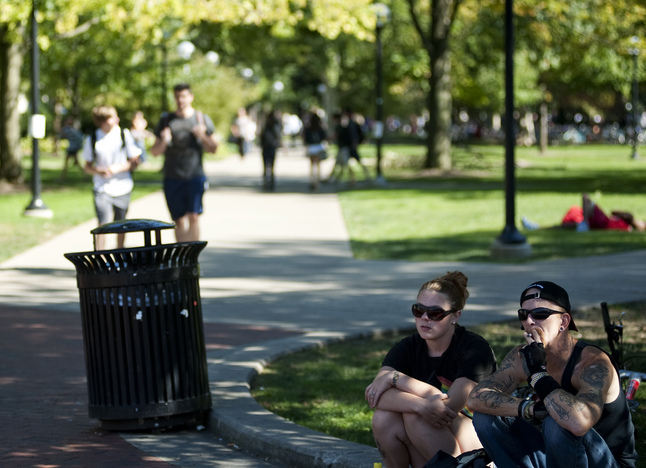
A pedestrian smokes a cigarette on the edge of the Michigan campus Tuesday.
Daniel Brenner I AnnArbor.com
Administrators formally launched the policy in July 2011 with a slew of signs and informational marketing to let faculty, staff, students and visitors know campus was not a place to light up.
Wednesday afternoon, the campus will be host to federal officials as they announce the nationwide launch of a tobacco-free college campus initiative.
A quick survey of U-M’s main campus at the beginning of the second academic year with the smoking ban in effect reveals ashtrays and other disposal containers have disappeared from sidewalks, but cigarette butts have not.
It’s legal for students and staff to smoke on the curbs of public streets - but most students have interpreted the ban to mean the edge of campus.
Tuesday afternoon at the south end of the Diag where it meets South University, smokers congregated at the same spot near a trash can to finish their cigarettes if they were walking on to campus, or to light up if they were leaving.
Marina Haque, 18, a sophomore biology major, said when the smoking ban was first put into effect on campus when she started attending U-M, "no smoking" signs were everywhere.
This year is different.
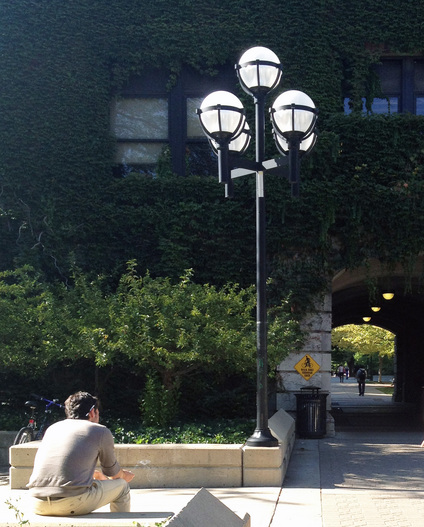
A man smokes a cigarette Tuesday afternoon on the south end of the Diag on University of Michigan's central campus.
Amy Biolchini | AnnArbor.com
The ban hasn't changed very much in terms of student behavior, Ali said.
"I wouldn't know if there was a ban," said Aamina Ali, 19, a sophomore business major.
Often non-students that visit the campus and travel across it act as though the smoking ban doesn't apply to them, Ali said.
About 12.3 percent of Washtenaw County adults smoke, and 20 percent describe themselves as former smokers, according to a 2010 survey by Washtenaw County Public Health.
The same survey found that one-quarter of Washtenaw County adults that smoke are students.
Lena Matthias Gray, smoke-free environment coordinator for MHealthy, said the university is working on another campaign to remind those who live, work and pass through U-M’s campus that there’s a smoking ban in effect.
There are "hot spots" around the campus where smokers still flock that are known to both the administrators and students - mainly outside of university libraries.
“If a student has been studying for a long time and they’re a smoker, some of the students will challenge the policy and go around the side of the building,” said Dr. Robert Winfield, U-M’s chief health officer who helped create the no-smoking policy.

Robert Winfield
Courtesy of U-M
Surveys conducted by the university in 2007 and 2009 revealed that about 14 percent of undergraduate students admitted to having a cigarette in the past month, Winfield said.
In 2011, that percentage had dropped to 9.2, Winfield said.
Among faculty and staff, Winfield said the university’s surveys also have indicated a behavior change.
“We’ve seen a lesser but significant decrease in those that are smoking,” Winfield said.
As a part of the tobacco-free campus initiative, U-M now offers free smoking cessation services for students, including free over-the-counter generic nicotine patches and gum.
For faculty and staff, U-M offers free counseling as well as $100 incentives if an employee attempts to quit, Winfield said. Employees can receive generic nicotine patches, lozenges and gum for a $5 co-pay, and can receive other nicotine-replacement drugs on their benefits plan.
About 265 employees have taken advantage of the smoking cessation services offered by U-M, said Teresa Herzog Mourad, manager of tobacco consultation and alcohol management for MHealthy.
“A lot of people have to quit several times, and we really want to support those folks with replacement products and other ways to cope with stress,” Herzog Mourad said.
Simply having a no-smoking policy in the workplace has proven to lower the rate of tobacco use in general, and the campus policy has meant some employees have decided to quit altogether, Herzog Mourad said.
Though tickets are not used to enforce the policy, students do receive warnings and reprimands should complaints be made about their activity.
Winfield said he knows of one instance where a student who had been smoking on campus was brought into the office of student conflict resolution to deal with the problem, and certain situations where supervisors have spoken to staff members about their smoking habits.
The goal of the policy is to help people quit through education and support, Herzog Mourad said.
Electronic cigarettes are not banned on campus, but are at the U-M Health System, which has a slightly stricter version of the tobacco-free policy in place. UMHS employees cannot arrive to work smelling like cigarette smoke.
John Calvin, 30, of Ypsilanti, was visiting U-M's campus Tuesday afternoon to greet his girlfriend after work. Sitting in the grass under a shady tree on campus along North University Avenue, Calvin said he can't stand the smell of cigarette smoke.
Though he supports the campus-wide ban, Calvin speculated on measuring the effectiveness of the order on an individual's health.
The kind of addiction to smoking found in individuals that are career-smokers isn't something that can be stopped with a simple ban, Calvin said.
In addition to campus libraries, along State Street and on U-M's North Campus, people feel more free to smoke, said Andy Chang, 19, a sophomore computer science major at U-M.
Chang stopped for a smoke Tuesday afternoon at the south end of the Diag, where he borrowed a lighter from a woman who was smoking while sitting on a nearby wall.
The area on the edge of campus is another popular spot where people stop to smoke -- ironically, many times taking a seat on a bench right in front of a "no smoking" sign that has been posted by the university.
When it comes to the ban itself, nobody really cares, Chang said.
Living in a university residence hall as a freshman, Chang said he received a warning from his resident assistant after someone complained about him smoking outside of his dorm.
The warning meant he had to write an essay on the subject, but it didn't end up deterring him from smoking. The ban is just as symbolic as having to be 21 to drink, Chang said.
At home in Hong Kong, Chang said smoking is discouraged in a different way: Cigarettes are too expensive to smoke incessantly there.
While on campus, Chang said he tries to find less crowded places to light up, but noted it was an addiction.
"We have the urge," he said.
Amy Biolchini covers Washtenaw County, health and environmental issues for AnnArbor.com. Reach her at (734) 623-2552, amybiolchini@annarbor.com or on Twitter.
Comments
jns131
Sat, Sep 15, 2012 : 3:07 p.m.
Just remember this UM, you can smoke on the sidewalk and put out the but. This is public property not UM property. Even though I quit years ago? The idea of a good long drag would be wonderful. But nope, not for the price Michigan charges you to smoke.
Go Blue
Fri, Sep 14, 2012 : 12:31 a.m.
For all the infinite wisdom and well intentions the smoking ban came with, there is a pretty nasty downside. No smoking indoors, all smokers outdoors. Smokers are going to smoke irregardless and now there is an overabundance of cigarette butts all over. Sidewalks, private property, streets, you name it, cigarette butts are everywhere. So thank you for the brillant idea that has now created a rather unpleasant side affect. Maybe our government can deal with that next.
bobslowson
Thu, Sep 13, 2012 : 1:13 p.m.
Alcohol on campus is a far more destructive force than tobacco. When there are nightly 2 AM fights on city streets...how long before the campus goes "dry"?
motorcycleminer
Thu, Sep 13, 2012 : noon
Thank you Mr. Orwell, The all powerfull nanny state is alive and well......
treetowncartel
Thu, Sep 13, 2012 : 3:45 a.m.
Hve you been to a tailgate on the U of M golf course delately?
a2citizen
Thu, Sep 13, 2012 : 5:14 a.m.
No, I walk to the games. But alcohol is illegal on public school property. Have you been to the Pioneer High School parking lot on a football Saturday lately?
Chase Ingersoll
Thu, Sep 13, 2012 : 12:34 a.m.
Saw the movie "Bill W." at the Michigan Theater last night. In all of the old scenes from the 30s through the 60s everyone was smoking and Bill W. died of emphysema, as did my grandfather who attended meetings the last 15 years of his life. It's one thing to have smoked when people could claim that they didn't know any better, which was also back in the days before cars had seat belts. Today, we all know how bad it is and there are patches, pills, gum, prescriptions and smoking cessation groups. If you can't quit today, then you are really to be more pitied than scorned. Chase Ingersoll
Tom Todd
Wed, Sep 12, 2012 : 11:21 p.m.
People love it when the government tells groups of people how to live as long as they aren't a part of that group. people are lapping it up, America we are no more.
Patricks
Wed, Sep 12, 2012 : 8:40 p.m.
It is interesting, however, the links to the surveys are broken. Citations to the university run surveys would be nice as well.
Tru2Blu76
Wed, Sep 12, 2012 : 7:08 p.m.
"and can receive other nicotine-replacement drugs on their benefits plan." nicotine replacement is the same as any other replacement for harmful drugs - it's just a replacement and in this case, it's actually just substituting one toxic delivery system for another. In other words: nicotine replacement actually caters to the addict. I know some who've "switched" entirely to nicotine gum from cigarettes - they pay a huge premium for the gum and are developing dental problems. Quite a "victory" in this battle against SMOKERS. Nicotine has a known toxicological history, cure the addiction and you've solved the problem. Bans - are useless and have negative "collateral damage" effects when it comes to freedoms and the addict's position in society. Bans are not "general" - they're highly personal. "The kind of addiction to smoking found in individuals that are career-smokers isn't something that can be stopped with a simple ban, Calvin said." ONE mention of this key fact in this long article - which is tacit admission that more effort should be directed toward curing the addiction. Foresight in this case is easy: what bans do is segregate a minority and punish them (even though it also amounts to a death sentence). ALL this talk about bans being effective SLIDES BY the fact that the minority will continue to suffer: personally, employment-wise and ultimately in shortened life spans marked by potentially catastrophic medical bills. Nice cop out for U of M - since they also "claim" the title of biggest and best research university AND constantly advertise for U of M hospital. Sounds more like U of M is recruiting smoking-diseased victims for their cancer ward. Not a pretty picture - and an absolute disgraceful cop-out. There's an old saying which applies to the University of Michigan, it's, DO IT RIGHT... OR DON'T DO IT.
catmi
Thu, Sep 13, 2012 : 1:16 p.m.
I can relate to many, though not all, of your comments. But I agree on the stress to our health system. Also, your final comment.... so what is right in this case? You've pointed out what is wrong but if your final statements is Do it Right or Don't Do It, I feel you should follow your own statement. Otherwise it can seem to devalue much of what you said. If nothing else, so what does help resist the addiction if you say none of those things offered work? Not trying to start a fight here, but I read every word you wrote looking for the answer and I didn't find one.
Tesla
Wed, Sep 12, 2012 : 6:30 p.m.
"U-M officials say campus-wide smoking ban making some progress in breaking cycle of addiction" Are U of M officials going to ban drinking on campus too? I read a lot of articles in the newspaper about abusive drinking and alcoholism at the school but I have never once read an article about some big problem from someone smoking a cigarette. Whats up "U of M officials?"
lugemachine
Fri, Sep 14, 2012 : 12:42 p.m.
Ya lost me, Tru2Blu76. Tesla asked about alcohol abuse "on campus". I simply addressed the issue of alcohol enforcement on campus. I am happy, however, that I inexplicably provided you with an opportunity to LOL.
Tru2Blu76
Wed, Sep 12, 2012 : 8:47 p.m.
Good call, Tesla: but evidently some people don't understand that "banning smoking campus wide" applies ONLY to a tiny patch of Ann Arbor - and that makes U of M absolved of responsibility as "lugemachine" so kindly points out while defeating his own premise. LOL! What U of M isn't being held accountable for is: pushing a new restriction on students & employees - which has just about zero chance of "preventing" anything except minor annoyances to non-smokers. Notice the Gripe-Inflation Factor is going full blast - suddenly having to put up with something that's always been there (in public places) is blown up to become the primary justification for banning smoking (or anything). They argue that this ban will cause some people to stop. Specious arguments don't convince thinking people. "some people" is how many? And what about the remaining ~ 10%, those are the ones proven to be real addictive personalities (many of whom were hooked when smoking was promoted socially as being "cool"). That 10% will still be there regardless of this ban - they'll continue to pay a heavy price, some of which will spill over into insurance costs and related expenses, and many are desperate to quit but can't AND there're NO programs dedicated to help the core addicts quit. Instead: the state collects hundreds of millions of dollars in cigarette taxes - and spends almost none of it on effective programs.
lugemachine
Wed, Sep 12, 2012 : 7:51 p.m.
Drinking on campus (do you mean in the dorms?) follows state law. Even a student of legal drinking age may not host an alcohol party. Walk through the average residence hall on a Friday or Saturday night and you'll find it to be a quiet, unremarkable place. Bars, fraternities, houses and apartments on private property are entirely outside the control of the University.
Ignatz
Wed, Sep 12, 2012 : 6:21 p.m.
The problem that they put their university on our planet. They don't own the outside to the point where they can ban activities that don't affect others.
xmo
Wed, Sep 12, 2012 : 6:07 p.m.
It is really "Nazi Like" to ban a legal activity on campus! If smoking was so bad, the Government would out law it but it doesn't. Its like trying to out law Marijuana, everybody still does it but now you have more people committing crimes.
Rod Johnson
Thu, Sep 13, 2012 : 1:38 a.m.
Godwin, dude.
Macabre Sunset
Wed, Sep 12, 2012 : 6:04 p.m.
It's a drug addiction, just like cocaine. I can see why universities would not want people getting their drug fixes on campus. I'm agnostic on whether drugs should be illegal. But certainly, if you like your nicotine, you can get your drug fix at home, in private.
Macabre Sunset
Wed, Sep 12, 2012 : 7:36 p.m.
When we see crowds of students drinking outside the libraries at all hours, puking everywhere, you can make that comparison.
Tesla
Wed, Sep 12, 2012 : 6:33 p.m.
Then why don't they do something about the student drunks that puke all over this town all weekend.....if they are so anxious to cure addiction like you say.
zeeba
Wed, Sep 12, 2012 : 5:52 p.m.
Big Mother at her worst. I can appreciate a ban on smoking inside university buildings, but outside? I played golf at the U-M course recently and saw that you can't even have a cigar during your round. That's the only type and situation where I still smoke, although only 4-6 times a year. Encouraging a healthier lifestyle is one thing, but mandating it is quite another. University officials need to butt out and mind their own business. You know, overly controlling types suffer high stress and increased mortality as well - maybe we should pass a rule that they just chill out and quit worrying about what other people are doing?
Jojo B
Thu, Sep 13, 2012 : 12:49 p.m.
Yeah, sorry zeeba. I don't want to smell your cigar on the golf course. If you could somehow smoke in a box on the golf course so that none of your fumes would get to me, I'd be happy for you to do that. :) (As an ex-smoker, I remember how oblivious I was to just how much smoke spreads and how everybody can smell you and your soot from a distance.)
GoNavy
Wed, Sep 12, 2012 : 7:32 p.m.
Nobody's mandating your health. You are most certainly welcome to go to your car and smoke yourself like a filet of salmon. However, your "right" to share your pleasures with the rest of us is coming to an end.
bruceae
Wed, Sep 12, 2012 : 5:47 p.m.
This is what I love about U of M. It doesn't matter that this activitiy is perfectly legal outside because they don't like it they think they can just "ban" it. It also doesn't matter that I'm a tax payer and I pay for the place, they know what's right for the rest of us, just ask them. So what's next? Hair dye is bad for you maybe we ban everyone with purple or pink hair?
GoNavy
Wed, Sep 12, 2012 : 7:30 p.m.
Your tax dollars do not empower you to walk rooms with locked doors. They do not entitle you to a free degree. In reality, your tax dollars entitle you to little more than freedom from the tax authorities, assuming you paid as directed. PS Approximately 17% of the University's 2012 operating budget comes in the form of state appropriations. On a per-capita basis, that means we all kicked in $27 or so to the school this year. Hardly a princely sum, considering the "I pay for the place" attitude you've shared with us. Next thing you know you'll want Pizza House to open up its financial books for you after leaving a $10 tip.
mw
Wed, Sep 12, 2012 : 5:44 p.m.
What started, supposedly, as a means of protecting non-smokers from secondhand smoke has been pretty obviously just a paternalistic effort to protect people from themselves all along. How did that kind of prohibitionism get to be part of the University's core mission? For those of you in favor, let me ask--would you support extending the outdoor smoking ban to the city of Ann Arbor as a whole? If not, why not? And why limit the ban to just tobacco? Why not alcohol, too -- and soda & junk food? It looks like these folks disbanded in 1979, but maybe its time to bring them back: http://quod.lib.umich.edu/cgi/f/findaid/findaid-idx?c=bhlead&idno=umich-bhl-86331
trespass
Wed, Sep 12, 2012 : 5:56 p.m.
You ask when this became part of our core mission. It was in 2001 when President Coleman came to U-M and was appointed to the Board of Directors of Johnson and Johnson with the help of votes from the Robert Wood Johnson Foundation. She made a similar policy at the University of Iowa when she was President there.
Tex Treeder
Wed, Sep 12, 2012 : 5:15 p.m.
It's just a matter of time before smoking is illegal completely. As we rely more and more on the government to determine social norms and morals, economic cost and social control become more important. And no, I don't smoke and never have.
Tex Treeder
Thu, Sep 13, 2012 : 12:25 p.m.
Because of course the silent majority is always right. Wasn't that the term that Nixon used in 1972. Seems like a majority voted for him then, too. Didn't work out quite so well. Just because many (or most) of my fellow citizens are in favor of curtailing our civil rights doesn't make them correct.
GoNavy
Wed, Sep 12, 2012 : 7:24 p.m.
PS - behind almost every one of these "government diktats" (as you have indirectly characterized them) are citizens of this city, state and country who have voted to support these measures, either explicitly or implicitly. Your attempts to obfuscate the argument, employing misdirection in order to suggest to readers that a nameless bureaucrat is behind this rather than the general will of society, belies the weakness of your argument. You are simply part of the vocal minority in this case. The silent majority (for whom I'm trying to speak) has no problem electing and supporting officials who establish these sorts of non-smoking policies.
pawky
Wed, Sep 12, 2012 : 4:48 p.m.
Great idea! Smoking destroys the lives of the smokers and is devastating for the loved ones that must deal with their illnesses and early deaths. The 80+ percentage of the population that doesn't smoke must subsidize the health care costs for smokers through our higher health care premiums. It's time that the elementary schools really drive the point home of the dangers of smoking home for the marginal kids who think that it is the cool thing to do.