

U-M president after Obama's speech: Higher ed cuts 'not good for the state'
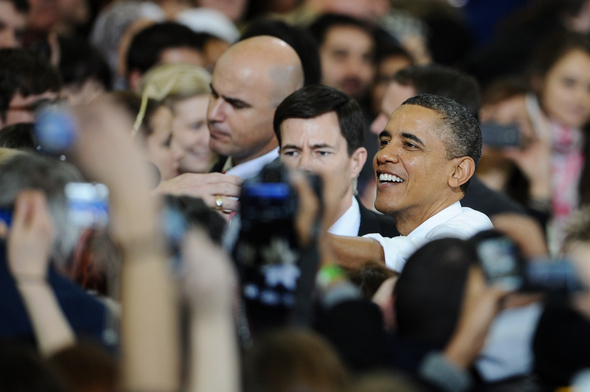
President Obama greets supporters after giving a speech on education at the Al Glick Fieldhouse on Friday morning.
Melanie Maxwell I AnnArbor.com
When President Barack Obama spoke Friday about state governments reinvesting in public universities and skyrocketing college tuition, University of Michigan President Mary Sue Coleman nodded in agreement.
She knows what it's like to face record-low state funding and then raise tuition, increasing the financial burden on students and causing higher education advocates to rally in criticism.
The state cut U-M's budget $47.5 million, or about 15 percent, this year, bringing the state contribution to the university to $269 million, or a record low 17 percent of the general fund. Gov. Rick Snyder blamed the funding cuts on a tough economy and a tight budget year in Lansing.
The cuts, while severe, follow a national trend of states disinvesting in public universities amid a sordid economic climate.
Also this year, U-M increased tuition 6.7 percent, above the state average of 6.5 percent and raising $46.4 million in new revenue.
The increase follows a national trend of tuition rates well outpacing inflation.
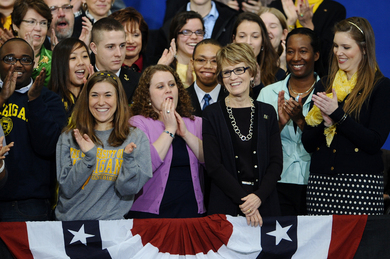
University of Michigan President Mary Sue Coleman smiles as President Obama acknowledges her during a speech at the Al Glick Fieldhouse on Friday morning.
Melanie Maxwell I AnnArbor.com
During a Friday morning speech before a crowd of roughly 4,000 at the Al Glick Fieldhouse in Ann Arbor, Obama said such cuts and tuition increases are not sustainable.
Coleman, at a press conference after the speech, said the university is doing what it can to contain costs and shifted most of the blame to repeated state appropriation cuts.
"Every year: Cut, cut, cut, cut," she said.
"The state is coming back, it’s coming back pretty dramatically and it's going to have to make choices," Coleman said. "We are in the rebound in this state."
That rebound, Coleman asserted, should come hand-in-hand with more money for the state's 15 public universities.
"For the last 10 years, higher education has been cut more dramatically than anything else. And that’s not good for the state," she said. "When we got a more than 15 percent (cut), we really didn’t complain very much because we knew that we had to take our fair share of pain for the state. But now the state is coming back."
Obama on Friday unveiled a number of new initiatives that, if enacted, essentially punish states that don't invest in higher education and public universities that don't keep tuition affordable by reducing the amount of federal money they receive.
One program Obama announced will shift the focus of a formula for nearly $10 billion in college aid from program longevity to affordability and low-income student outreach. Another $1 billion grant program will distribute more money to states that invest aggressively in higher education than states that don't.
“We’ve got to do something to help families and to help students be able to afford this higher education. We’ve all got a responsibility here," Obama said.
"We can't just keep subsidizing skyrocketing tuition," Obama continued. "Others have to do their part, colleges and universities need to do their part to keep costs down as well."
Coleman said that keeping tuition static is not viable without more state funding.
She said the university has cut costs aggressively and that her administrators are still looking for ways to save money.
"I think universities should be challenged," Coleman said.
The school has saved approximately $400 million in health benefit expenses since 2003 by shifting costs to employees. Coleman said that the school has also overhauled much of its space and energy usage to increase efficiency and save money. Faculty at a recent meeting, however, asked U-M Provost Philip Hanlon to defend pay for the school's top administrators and deans.
In his speech, Obama praised U-M for doing "a lot to find savings in your budget."
He did not mention the cost of attending the university, which is $26,810 for in-state upperclassmen and $53,006 for out-of-state upperclassmen. U-M is one of the costliest public universities for non-residents.
Coleman criticized the formula funding model Snyder plans to use this year to determine how much funding each university will receive. The formula essentially applies the same set of metrics to each of the state's 15 public institutions, despite size or focus. The governor has stated that he does not plan to decrease public university funding further next year, Coleman said at a recent faculty meeting. Snyder issues his fiscal 2013 budget in February.
"It can't be just a simple formula. It's more complicated than that," offered Coleman, who Obama's administration appointed as co-chair of the National Advisory Council on Innovation and Entrepreneurship last year.
Obama invited Coleman and other higher education leaders to a roundtable discussion on college affordability on Dec. 5, but Coleman declined, citing a busy schedule. During her interview today, Coleman said an open letter she sent to the president two weeks later asserting the need for a more affordable college education "came at just the right time" when talk about college costs has begun to rise from a simmer to a near-boil.
"He recognizes ... the dramatic disinvestment that the states have made, and one of the most harsh has been in Michigan," Coleman said, adding later that she's "optimistic" that the state can "get us slowly back to where we used to be" in regards to funding.
Kellie Woodhouse covers higher education for AnnArbor.com. Reach her at kelliewoodhouse@annarbor.com or 734-623-4602 and follow her on twitter.
Comments
moveon2011
Sat, Jan 28, 2012 : 7:59 p.m.
Coleman was hired at $ 400,000 so why the increases? Time for the college to OPEN there books ? cut in employees health insurance at U of Michigan,? Well each employees should get there own healthplan! Well how much is the monthly cost? funny the staff gets an increase ...but heaven forbid there are cuts ...time to retire that ruteen... pay they By the HOUR and have them punch a timeclock ..so we know where they are and on time!
Diagenes
Sat, Jan 28, 2012 : 3:50 p.m.
It maybe time to rethink the role of universities in our educational system. Is it cheaper to train accountants at a school like Cleary or Walsh than U of M? Should EMU be the place to train teachers and have U of M drop their education majors? Since U of M and MSU are research institutions maybe they should drop all liberal arts programs and concentrate on math and science programs. Use community colleges to teach basics and universities to teach advanced subjects. There is very little restraint on tuition increases, especially with the feds taking over student loan programs. The universities want to build feifdoms not efficiencies.
Mush Room
Sat, Jan 28, 2012 : 1:45 p.m.
The primary reason tuition rises at all of our 15 universities is the fact that Michigan taxpayers no longer want to fund these schools. Look at the comments to this article. If it was up to just these people, higher education funding in Michigan would go to zero. And it's not just Michigan, nearly every other state is also dis-investing in higher education. Many of these schools are the most sought after schools in the world, yet we dis them. Again, look at the comments here. We've reduced funding to Michigan colleges 15% this year and 30% in the last 10 years. 30 years ago, more than 75% of the cost of educating a Michigan college students was paid by Michigan taxpayers, today, less than 25%. This funding is on it's way to 0%. We need to educate our young. How does this happen if we don't fund our universities?
Lac Court Orilles
Sat, Jan 28, 2012 : 12:13 p.m.
Republican Governor Rick Snyder signed off on cuts to higher education so he could give his friends an 86% tax cut. Knowing what the topic of Obama's speech was, I bet he hid in Grand Rapids to avoid sneers from all of the students who attended the speech. I just hate being oppressed by an all Republican state government. Even monsters justify their reasons for committing crimes.
Diagenes
Sat, Jan 28, 2012 : 3:32 p.m.
Elections have consequences. Conservatives took it from the libs in 2006 and 2008. The monsters on the left justify their crimes as well.
LarryJ
Sat, Jan 28, 2012 : 3:45 a.m.
Let's get a couple of facts straight: 1. Top UM deans & administrators get paid well into 6 digits. Top Wall Street execs are 2 orders of magnitude higher, well into 8 digits. 2. Most of the endowment is for specific purposes--a new building, cancer research, diabetes research . . . It consists of donations by generous donors for specific purposes but rarely for general education.
rulieg
Mon, Jan 30, 2012 : 3:18 p.m.
ah, not quite. you're mixing up endowments. there are "endowments " that donors give for specific things, but 'THE' endowment is not earmarked for anything. "the" endowment is basically the U's savings account. it's ironic that Obama and Coleman don't seem to realize THEY are part of the problem. if the gub-mint is always available to give students more loans, then what reason do the colleges have to keep tuition costs low? none.
a2citizen
Sat, Jan 28, 2012 : 5:09 a.m.
Larry, I agree with your observation about the salaries of deans and Wall Street execs. The difference is that deans & administrators get their money straight from taxpayers. That's where I have a problem.
YpsiGreen
Sat, Jan 28, 2012 : 3:11 a.m.
Just how big is the U's endowment? How many facilities have they built or upgraded? How big are those salaries? "we don't have enough money..." Boohoo. Give. Me. A. Break.
Tru2Blu76
Sat, Jan 28, 2012 : 1:32 a.m.
True story: yesterday I did something I've never done before (46 years as an adult): I took a taxi to pick up something I'd forgotten to buy during an earlier errand. So, right away the taxi driver and I got to talking. It was clear to me he was "not ordinary" but above average intelligence. Young man, early 20s, well spoken. I learned: this fellow had graduated college in 2010 and has been working every since as a taxi driver - to pay off his college loan. NO job in the profession he studied for - even with a master's degree from U of M. Our own daughter: graduated double major in the sciences from U of M. Her true love: teaching. So where's our Ann Arbor born daughter been the last 12 years? She's in California - no teaching jobs in Michigan. And even then, she's had a "typical" experience for teachers - has been forced to move from school to school (where she's earned promotions) because: there's a funding crisis for education. You can multiply these stories 1000s of times. There's no funding for teachers and schools, even though the student population continues to grow. So Obama was wrong on that point: getting a degree (even from Michigan or Harvard) doesn't guarantee a high paying job. Not anymore: the Republicans let a bunch of white collar millionaire crooks bring the U.S. and world economies to their knees. Now the Republicans continue to implement the agenda of white collar millionaire crooks: by cutting public services, including education for today's and tomorrow's kids. Obama is wrong on a 2nd point when he says there's no class warfare: it's the criminal elite against America's entire population. But then... we tax them too much. Hah!!
Diagenes
Sat, Jan 28, 2012 : 3:29 p.m.
Democrats Barney Frank and Christopher Dodd protected Freddie Mac and Sallie Mae from regulation that could have lessened the impact of the housing collapse. Plenty of people on both sides of the aisle were negligent. I do agree that a degree even in nursing or other so called high demand areas do not gaurantee employment in Michigan.
Mike
Fri, Jan 27, 2012 : 10:44 p.m.
It's obvious to me that the administration is underpaid, staff is working for peanuts, and that we can spend our way out of this little inconvenience. How will we ever educate all of the little people so they can have jobs like those at the university? The taxpayers of this state have to pony up; after they pay for new roads, local schools, bailing out Detroit, a new bridge to Canada, bailing out auto companies, bailing out banks, buying groceries, paying a larger share of their health care, paying more for gasoline, bailing out failed alternative energy companies, paying for wage increases and improved benefits for all of our "public servants", paying for lavish parties at the White House, soon to be bailing out social security, paying off our 16 trillion dollar debt, etc...Is it just me or are all of these overeducated, stuffed shirts not in touch with whats going on our here with the average joe?
YpsiGreen
Sat, Jan 28, 2012 : 3:14 a.m.
Don't forget all those rounds of golf that add up.
Outside(:-o)looking in
Fri, Jan 27, 2012 : 10:07 p.m.
Why don't they sell their golf course. That would save some money.
Sparty
Fri, Jan 27, 2012 : 9:51 p.m.
The State cutting higher education 15%, while still receiving the same levels of Federal Higher Education support is hardly fair to the students now is it? So without incentives to keep things on an even-keel, the President is saying keep State higher-education spending at fair levels or federal levels will be adjusted accordingly so that the students don't suffer as a result. Bravo ! Obama 2012.
djahner
Fri, Jan 27, 2012 : 9:44 p.m.
The higher education establishment, similar to other public union employees, are out of touch with reality. The pensions need to be converted to defined-contribution plans. Private companies did this 2 decades ago. Tenure needs to be eliminated. Professors need to get back into the classrooms. Times have changed but public education continues to stick their head in the sand. Public education unions are public enemy #1.
Sparty
Sat, Jan 28, 2012 : 3:59 a.m.
No, with your advanced wisdom, please advise which "stuff" specifically should not be researched ? What advanced research is not of value in your opinion ?
Mike
Fri, Jan 27, 2012 : 10:48 p.m.
@sparty - Some of the stuff that is "researched" is a total waste of time and money which could be spent for the betterment of mankind. It makes jobs for professors that would have a tough time keeping one if it weren't for the "research" money. Do you understand that?
Sparty
Fri, Jan 27, 2012 : 9:57 p.m.
Which Professors are unionized, exactly? Please provide details with facts. I have very specific knowledge so would love to know where you get yours. You do realize that the UofM is a national research university? That means that research is conducted outside of the classroom, most likely in labs, libraries, and other technical facilities. Do you understand that?
javajolt1
Fri, Jan 27, 2012 : 8:13 p.m.
Wait a minute..... Higher Ed cuts are good for the state so long as the colossal behemoth - The University of Michigan - is the one doing the cutting! The assertions of hardship by Mary Sue Coleman and these Universities reek of the worst type of hubris. These quasi-businesses want it both ways: they pay executive salaries that rival the Wall Street businesses they vilify. They accept tax dollars and grants while raising tuition at 10 times the rate of inflation, then claim they are somehow not being supported! Give me a break! How much did UM cost the City of Ann Arbor by taking buildings off the tax rolls? These cash cows need to begin some real self-examination....starting with cuts in their ridiculous budgets and spending. to plead hardship is a complete and utter joke!
a2citizen
Sat, Jan 28, 2012 : 5:16 a.m.
spart, yes i understand the economic value of a research institute. I'm a socialist (seriously).
Sparty
Sat, Jan 28, 2012 : 3:56 a.m.
And how much of the research has economic value or been transferred back to the public good, as in the CDC, NIH, NRC, many other governmental agencies, or advanced research that will? How many students have received grants to continue research, labs to study in, scholarships, etc. Do you understand the economic value of a national research university?
a2citizen
Sat, Jan 28, 2012 : 1:13 a.m.
Sparty, do you realize the U-M receives over a billion dollars a year in federal research funds. All of those jobs are public sector. Not much of an economic miracle if you ask me. More like a redistribution of wealth.
Sparty
Fri, Jan 27, 2012 : 9:46 p.m.
You mean by filling additional buildings with employees who then pay state and federal income taxes? And then presumably either pay rent or mortgages and property taxes? Perhaps buy cars and other goods? Maybe eat out, buy groceries, clothes, etc.? You do realize the UM employs more people than the next largest 24 employers in Washtenaw County combined ? You do realize that if they rented those buildings, instead of buying them, that the rent is considered income to the owners and that is taxable to the State?
a2citizen
Fri, Jan 27, 2012 : 9:36 p.m.
"...they pay executive salaries that rival the Wall Street businesses they vilify..." Maybe the occupy Wall Street crowd should occupy universities.
Diane
Fri, Jan 27, 2012 : 9:17 p.m.
@ Javajolt1 : You stated the truth very well. I couldn't agree more.
a2citizen
Fri, Jan 27, 2012 : 8:03 p.m.
"...President Mary Sue Coleman nodded in agreement..." ...as she calculated in her head how many pennies were in her $570,000 yearly salary.
trespass
Fri, Jan 27, 2012 : 7:50 p.m.
Uncontrolled spending at UM is not good for the state. President Coleman is not getting the message, even from Obama. Maybe our Regents will finally understand that Mary Sue is the aberration.
Michael Christie
Fri, Jan 27, 2012 : 7:26 p.m.
I see how it is. Obama wants to toss a bunch of federal funding to students to lower tuition, so the University doesn't have to spend their luxurious endowments. What a joke! And where will the money come from Obama? We don't have it!!!