

U-M says 'errors' were made and halts book digitization project after copyright questions arise
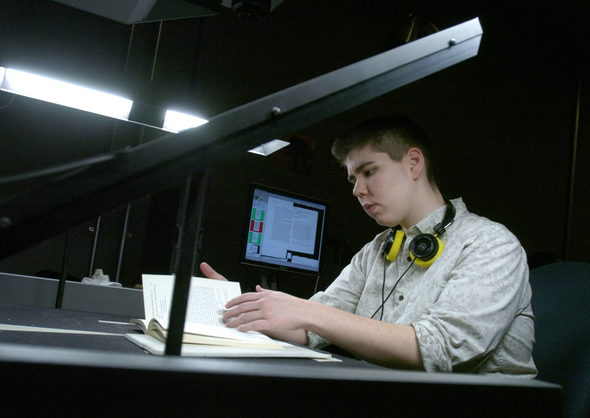
Courtney Mitchel, an electronic imaging technician at the University of Michigan, prepares a book for digital scanning in this 2008 photo.
Ann Arbor News file photo
Before pausing the program, U-M planned to release 27 books on Oct. 13 and an additional 140 books starting in November as a part of the Orphan Works Project. The books would be accessible to anyone —students, faculty and staff— with a U-M login and could be printed or copied at will.
The release is part of U-M’s HathiTrust project, an initiative to digitize the university’s complete library collection.
However, a lawsuit filed by the Authors Guild and two other literary guilds, one Canadian and the other Australian, maintains that many works deemed orphans by U-M have living authors or author relatives that still claim copyright rights but do not know about the digitization project.
Aside from U-M, four other HathiTrust participating schools were named in the lawsuit: The University of California, the University of Wisconsin, Indiana University, and Cornell University.
“Our pilot process is flawed,” the U-M Library said in a statement issued Sept. 16. “Having learned from our mistakes—we are, after all, an educational institution—we have already begun an examination of our procedures to identify the gaps that allowed volumes that are evidently not orphan works to be added to the list.”
Two days after filing the lawsuit, the Guild announced it had discovered a bestselling author of one of the orphaned books who had no knowledge of the Orphans Work Project and who did not wish to participate. According to the Guild’s blog, the author, Jack Salamanca, author of "The Lost Country," is a former professor in the University of Maryland’s English Department with a literary agent, two movie deals and a recently signed E-book deal.
“If HathiTrust's researchers can't locate a bestselling author with a literary agent, an author who’s also a retired professor from a major East Coast university, how are they going to locate authors in other countries?” the Guild asked. “Few of the authors of those books would have had the successes of Jack Salamanca. But countless of them, no doubt, would want to maintain control of their works.”
In a release issued last week, Guild president Scott Turow criticized U-M’s digitization project, saying that it puts copyrighted works needlessly at risk.
“Even if it weren’t for this preposterous, ad-hoc initiative, we’d have a major problem with the digital repository. Authors shouldn’t have to trust their works to a group that’s making up the rules as it goes along,” Turrow said.
Despite admitting to mistakes, the U-M emphasized the legality of the HathiTrust in its statement.
“Once we create a more robust, transparent, and fully documented process, we will proceed with the work,” U-M said in the statement. “We remain as certain as ever that our proposed uses of orphan works are lawful and important to the future of scholarship and the libraries that support it.”
According to U-M Dean of Libraries Paul Courant, the Orphans Work Project is intended to increase the readership of works that are out of print, not to damage their integrity.
“Sharing these orphan works does no economic harm to any person or organization, while not doing so harms scholarship and learning by severely limiting access to 20th century works,” Courrant said in a June release.
Kellie Woodhouse covers higher education for AnnArbor.com. Reach her at kelliewoodhouse@annarbor.com or 734-623-4602 and follow her on twitter.
Comments
Elizabeth Moon
Tue, Sep 20, 2011 : 1:14 a.m.
Dean Courant is wrong when he says that "Sharing these orphan works does no economic harm to any person or organization"--as long as a work is under copyright, the author has an economic interest in any distribution. In present circumstances, "out of print" does not define either out of copyright OR "orphan" status. Writers are already publishing their out of print books online, in ways that not only make their works widely available, but also preserve their rights and bring in income: <a href="http://www.backlistebooks.com/" rel='nofollow'>http://www.backlistebooks.com/</a> is but one example of such a project. Libraries do have a legitimate interest in preserving texts deteriorating because of poor quality paper (much of 20th century popular fiction, for instance) but digitization with wide distribution is not the right answer. First, because digital technology has yet to show the longevity of even high-sulfur content paper. Second, because distribution of multiple copies infringes copyright. There are better ways to preserve aging texts and make them accessible to library patrons, that fit within the traditional understanding of library fair use--in which patrons come to the library and either check out texts that were purchased as individual copies, or view such texts in the library. For instance, fading texts could be scanned and then printed (copy for copy as the library holdings allow) on high-quality paper that will last a century. Current technology makes both scanning and print-on-demand easy. As both a full-time novelist and someone who has benefitted from both public and academic libraries, I'm aware of both sides of this issue. I was taught, in a college library, that copyright should not be infringed by using photocopies instead of buying textbooks...and I think ethics should trump convenience in this case.
Laurel
Mon, Sep 19, 2011 : 9:31 p.m.
While a digital library seems like a great idea in this world that has become highly addicted to the instant gratification of the internet, shouldn't Universities still emphasize the importance of proper and thorough research that can't always be performed via the web? Students are reprimanded or worse for committing copyright infringement for forgetting to cite their sources or for improper citations. Shame on the schools involved in this scandal. Not only should they know better, they have the resources and should lead by better example.
Macabre Sunset
Mon, Sep 19, 2011 : 9:26 p.m.
Stealing is wrong. Hopefully, someone with some moral fiber at the University will take steps to ensure that nothing like this happens again.
Ron Granger
Mon, Sep 19, 2011 : 8:45 p.m.
"Sharing these orphan works does no economic harm to any person or organization" Untrue. These books are available on the used market. "Copying" them, and making the copies freely available, greatly undermines the value of the copies still in circulation. If you bought one of these rare books, you may be in a position where you need to sell it asap because the value will soon greatly diminish. A lot of people can't afford a loss like that.
a2girl
Mon, Sep 19, 2011 : 9:27 p.m.
Except an original copy will probably always be more valuable than the copy that I make by going to the library, checking the book out, and copying it for my own use (and probably causing damage to the binding by doing so). Oh wait, I could have just read it on my kindle/ipad/laptop etc. after I downloaded it from the library. Just another point of view. A greener one at that.
xmo
Mon, Sep 19, 2011 : 8:39 p.m.
Sounds like a Job opening "Once we create a more robust, transparent, and fully documented process, we will proceed with the work," U-M said in the statement"
djm12652
Mon, Sep 19, 2011 : 8:04 p.m.
I also appauld the U's verbiage of "errors, some of them serious"....in our world, the real one, that is often construed as breakin da law...
48104
Mon, Sep 19, 2011 : 10:14 p.m.
What's illegal about listing a title on a list and giving people time to say whether or not they own the copyright? It sounds like the whole thing is working like it was supposed to.
Arborite
Mon, Sep 19, 2011 : 8:29 p.m.
If you say so. I imagine that the "breaking the law" part would happen if the works were actually released. That hadn't happened yet.
djm12652
Mon, Sep 19, 2011 : 8:02 p.m.
What the U of M needs is a law school, and/or a legal department that could clarify these issues well in advance for them.
Hmm
Tue, Sep 20, 2011 : 6:52 p.m.
Yes if only U of M had a law school/legal department. If only...
braggslaw
Mon, Sep 19, 2011 : 5:55 p.m.
Copyright law is fairly simple, except for the "fair use" issues. The free distribution and reproduction of these works is clearly a copyright infringement., as it effects the market for the works. The University needs to know better.....
djm12652
Mon, Sep 19, 2011 : 8:01 p.m.
yeah what he said....
tommy_t
Mon, Sep 19, 2011 : 7:41 p.m.
They thought they where Google.