

University Bank looks to add jobs in Ann Arbor after approval of parking expansion project
University Bank President Stephen Ranzini breathed a sigh of relief this week as the Ann Arbor City Council gave final approval to allow the bank to construct a new parking lot and increase the number of employees allowed on its property.
Increasing the maximum number of employees on the specially zoned site at the Hoover Mansion at 2015 Washtenaw Ave. — from 49 to 59 — creates the potential for 10 additional jobs, and Ranzini is confident the bank will fill those positions sometime in the next 12 months.
Addressing the council on Monday, Ranzini expressed frustration that the approval process, by his measure, began 39 months ago with an original request for 28 parking spots.
The approved plan now allows the bank to construct a 14-space parking lot, though due to other changes being made, it will be a net increase of only 11 spaces.

Stephen Ranzini
"You may know the world-famous Milford Track as New Zealand's top hiking trail — a four-day, spectacular hike up and down two fjords and over a snow-capped mountain range, which my wife and I enjoyed during our honeymoon."
Compared to Ann Arbor's approval process for a small parking lot in a field behind the bank, the Milford Track, in retrospect, seems easy, Ranzini said.
Due to what he called "extensive delays," Ranzini said the bank had to relocate one of its divisions, University Islamic Financial, and eight employees to Farmington Hills.
"This firm brought Ann Arbor a great deal of positive press by being profiled in the New York Times and most other national press because it was a firm serving a diverse community," he said. "And it is a rapidly growing firm and now manages $175 million."
Since the bank signed a long-term lease in Farmington Hills and relocated the employees, "unfortunately these jobs will never come back" to Ann Arbor, Ranzini said.
City Planner Chris Cheng didn't dispute that it took a long time to work through the city's approval process, but he said records show University Bank submitted its original parking lot proposal in December 2009, followed by revised plans in June 2010.
"So it has been around for approximately two years," he said, attributing the delays to the revisions. "It was approximately about six months before each revision to the site plan was reviewed and before it went on to City Council, so there was a little lag there."
Ranzini said he traces the project back 39 months to when University Bank first hired an engineering consultant to work on plans that the bank was required to take to neighbors before submitting a formal proposal to the planning department in December 2009.
Cheng recalled the original staff recommendation when the project went to the Planning Commission in October 2010 was to deny what was then a proposed 24-space parking lot. He said the bank provided revised plans with less impact on the woodland and landmark trees on the property, but it still took a while to come to a consensus.
"Some of the questions that did come up were regarding lighting," he said, expressing confidence that the lighting won't be spilling off site now.
The parking lot layout, as revised, also has been shifted an additional nine feet toward the building, and a continuous six-foot-tall wall is now proposed to be constructed along the eastern and southeastern property lines, screening the parking lot from neighbors.
"They are going beyond the three-foot-tall wall and they've extended it to screen from the neighbors, so there shouldn't be an issue there," Cheng said.
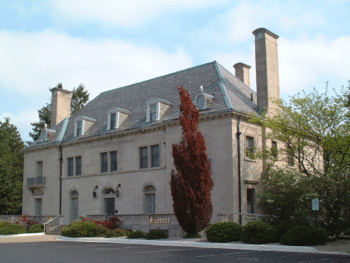
This photo from the Ann Arbor District Library's image gallery shows the 1918 Hoover mansion on Washtenaw Avenue that is now occupied by University Bank.
Photo courtesy of AADL
The bank plans on removing two landmark trees and 19 woodland trees for construction of the screening wall, parking lot and connection drive. Cheng said the bank is going above and beyond to mitigate all of the trees that are being removed.
The original Planned Unit Development zoning for the property was approved in 1978 to allow an adaptive reuse of the site, preserving a residential building that was not protected by historic district designation. The original owner of the 1918-era mansion, Leander J. Hoover, founded the Hoover Steel Ball Company in Ann Arbor in 1913.

One of the cited benefits of allowing the increased parking and employee counts is that it provides incentive for University Bank to stay and continue to maintain the mansion, which once sat vacant and, on at least one occasion, faced possible demolition.
Ranzini said the site of the mansion is 3.4 acres and is worth about $3.6 million. But he said the building, which costs about $200,000 a year to operate, is appraised at just $2 million.
"Office space elsewhere in town is available at much less than that without this large expense of maintaining an expensive building and tying up $2 million," he said.
If the building is not increased in value over time from $2 million to the $3.6 million market value of the property, Ranzini said, some future owner of the property — if University Bank outgrows it — might pursue a different course.
"In fact, if University Bank had not fought an intense legal battle, the building would not be standing today," he added.
University Bank was founded in 1890. Since Ranzini has led an investment group that purchased the bank 23 years ago, it has grown from $35 million in assets under management to $10.3 billion in assets under management. About $87 million of that is in Washtenaw County, according to FDIC reports from June, giving it a 1.4 percent local market share.
"Across our offices, we today have 280 employees, making us the 11th largest bank with headquarters in Michigan," he said. "In the past 90 days, we've hired over 60 more employees, but unfortunately all but five of them were hired at our locations outside Ann Arbor."
Monday's approval came in the form of a 9-0 vote with Council Members Marcia Higgins, D-4th Ward, and Sabra Briere, D-1st Ward, absent.
Council Member Carsten Hohnke, D-5th Ward, said the bank's use of the mansion is a good example of how PUDs can work in Ann Arbor, in this case maintaining a unique property.
Ranzini said the bank has committed to $150,000 in extra amenities and $50,000 in engineering expenses on top of the cost of constructing the 14 parking spaces. That includes a five-foot wide walkway located along the northern property line connecting Washtenaw Avenue to the parking lot, and five new bicycle spaces.
Ryan J. Stanton covers government and politics for AnnArbor.com. Reach him at ryanstanton@annarbor.com or 734-623-2529. You also can follow him on Twitter or subscribe to AnnArbor.com's email newsletters.
Comments
Lets Get Real
Wed, Dec 28, 2011 : 7:23 p.m.
I love it. Only in Ann Arbor would we hear 39 months to get an additional parking lot built. The rich Ann Arbor Hills folks would do ANYTHING to prevent "their" sacred space from being violated by a business - even a non-poluting, non-manufacturing, quiet little bank.that dared to contribute to the historical character of the community by saveing a landmark building. Then on the opposite side of the coin: Only in Ann Arbor would someone get away with calling doing business with Muslims politically correct. This locally owned and operated bank found an underserved, niche market - people who needed, wanted and are willing to pay for lending that conforms with their ability to borrow. That's called a business - recognizing a market segment, providing it with goods and services it needs and wants. Business is conducted to make profit. Businesses that do so, grow and prosper, employ people and contribute to the economy of the community. What a concept. Congratulations University Bank. Too bad all those relocated employees went elsewhere, but glad you have persevered through the red tape and will continue to provide services at Hoover Mansion.
15crown00
Sun, Dec 25, 2011 : 1:42 a.m.
you're still pandering to the Muslims because it's politically correct to do so. you pick 3 or 4 isolated banks as evidence of other 1 religion banks existing.so tell us how many banks are there in the United States and what percentage of them are 1 religion facilities?
Stephen Lange Ranzini
Fri, Dec 23, 2011 : 6:46 p.m.
@15crown00: A well written explanation and his try of how we got involved in this financial service niche market with one of our four divisions of the bank is in the following NY Times article "A Hometown Bank Heeds a Call to Serve Its Islamic Clients": <a href="http://www.nytimes.com/2009/03/07/us/07religion.html?_r=1&th&emc=th" rel='nofollow'>http://www.nytimes.com/2009/03/07/us/07religion.html?_r=1&th&emc=th</a> As noted originally even Christians were prohibited from charging interest on loans. There are actually entire banks, not just divisions of banks, entirely devoted to individual religions. For example, a Christian only bank in Minnesota & a bank for Jews only in New York City. The contracts used in Islamic finance are ancient, & were used by the Jews and documented in the Talmud originally. They are widely used in the U.S. & over $1.5 billion of homes are financed for Muslims in the U.S. using these legal techniques. @jonnya2: the building was bought as an effort to save from destruction an historic Ann Arbor landmark. As I noted in a part of my speech to city council not reported by Ryan, I am a strong advocate for historic preservation and the first project I did when I came to Ann Arbor 17 years ago was to restore the Tuomy Gas Station at the corner of Stadium and Washtenaw & get it placed on the National Register of Historic Landmarks. The key issue with why the parking lot is needed, is that if the parking is not expanded, someone someday after University Bank outgrows the building, will tear the building down & build 12 residential homes on the 3.4 million, and make a bundle. Ann Arbor Hills zoning allows 1/4 acre lots. If the value of the building as an office building isn't enhanced, the financial temptation will be too great. The biggest reason why the value of the building is so low is the inadequate parking. @pjohn3: all of this was for a net increase of 11 parking spots & Ryan is just reporting on my criticisms in my speech to city council Monday night. It is a labor of love for historic pres
smokeblwr
Sat, Dec 24, 2011 : 3:47 a.m.
I always enjoyed the ATM at the Tuomy gas station. I felt it I was getting money from the fanciest ATM in town.
Vivienne Armentrout
Fri, Dec 23, 2011 : 7:11 p.m.
We all owe Mr. Ranzini a big thank you for saving the Hoover Mansiion, which is a significant landmark. Its gracious facade and lawn would be sadly missed from Washtenaw Ave approaching the city. I'd forgotten that the Tuomy gas station was a University Bank branch early in its new life before it became a coffee shop. That is in its small way a landmark too, at the "gateway" of the city on that side. We should all keep in mind that not only do we ourselves enjoy these landmarks, they are a bankable asset to Ann Arbor in making the city more attractive to visitors and potential new businesses and residents.
Stephen Lange Ranzini
Fri, Dec 23, 2011 : 6:59 p.m.
"his try" in line 1 = "history" The last sentence should read, "It is a labor of love for historic preservation of a historic Ann Arbor landmark."
Pjohn3
Fri, Dec 23, 2011 : 3:26 p.m.
Oh my, all this for 14 parking spots? Seems more like a press release from the bank President than a news story. Must've been a slow news day.
Sparty
Fri, Dec 23, 2011 : 4:36 p.m.
And a reflection on the non functioning city government. I'm sure Farmington Hills appreciates it.
A2James
Fri, Dec 23, 2011 : 2:38 p.m.
Does Marcia Higgins EVER attend City Council meetings? I e-mailed her a week ago asking why, and of course she didn't respond. 4th ward: no representation
Sparty
Fri, Dec 23, 2011 : 4:39 p.m.
No, that why we call her the invisible City Council member. There should be a mandate that after a certain number of absences, one must resign and allow the city to conduct a special election in that ward as representation is missing. She never responds to attempts to contact her either.
Ron Granger
Fri, Dec 23, 2011 : 2:06 p.m.
Condolences to the neighbors who now find themselves next to a business, a public business parking lot, and a wall. Let's hope those jobs they might possibly maybe add sometime in the future are worth it.
smokeblwr
Sat, Dec 24, 2011 : 3:44 a.m.
Because nobody causes more late night partying than a bank what with their long hours and such.
PLGreen
Fri, Dec 23, 2011 : 1:49 p.m.
It is beyond me why anyone would want to attempt to save any building in Ann Arbor from the wrecking ball; it will always come back to bite you.
Kafkaland
Fri, Dec 23, 2011 : 1:40 p.m.
Why an Islamic financial unit makes sense? Because many muslims take their religious rules for financial transactions seriously, whereas the vast majority of Christians are perfectly happy to disregard the biblical prohibitions on usury. Remember: most religions consider the greed of the modern banksters a sin.
smokeblwr
Sat, Dec 24, 2011 : 3:43 a.m.
Jesus should be overturning the money changing tables in the Temple of Wall Street.
a2roots
Fri, Dec 23, 2011 : 1:55 p.m.
Think what you will but it is because they refuse to pay interest and Ranzini has figured away around it.
a2grateful
Fri, Dec 23, 2011 : 1:16 p.m.
"You can not say the city had ANYTHING to do with the 15 month lag time. . . " Maybe . . . Unless the owner was working with city staff over this time, incorporating staff comment after comment in revised site plan preparation, prior to submitting to the emperor (no clothes) and his commissions (no clothes).
johnnya2
Fri, Dec 23, 2011 : 1:03 p.m.
"records show University Bank submitted its original parking lot proposal in December 2009, followed by revised plans in June 2010." You can not say the city had ANYTHING to do with the 15 month lag time between your deciding you want more parking spaces to when a proposal was given. There are definite issues when you are adding more parking spaces to a predominantly residential area. If it is so much more financially beneficial to be in a different building for University Bank, they are free to move to them. The building was bought as a showpiece not as a financial investment
Brad
Fri, Dec 23, 2011 : 12:55 p.m.
Ranzini for mayor! Empty the buckets!!
Stephen Lange Ranzini
Fri, Dec 23, 2011 : 6:57 p.m.
@Brad: thanks very much for your kind words. A lot more than 17 *anonymous* people would have to urge me to run for this or any other political office, for me to want to contemplate it seriously.
a2grateful
Fri, Dec 23, 2011 : 12:34 p.m.
@15crown00: Two answers to your four questions: 1) No. 2a through c) Refer to <a href="http://www.universityislamicfinancial.com/inthenews.html" rel='nofollow'>http://www.universityislamicfinancial.com/inthenews.html</a> for answers
15crown00
Fri, Dec 23, 2011 : 2:58 p.m.
So it's all about profit.Is it not a fact though that all the other religions all make his bank profitable without their own separate divisions?so he is pandering and playing politically correct with ONE and ONLY ONE religion?
15crown00
Fri, Dec 23, 2011 : 12:06 p.m.
Two Questions 1) Is this Bill (the Sailor) Martins Bank? 2) What's wIth University Islamic Financial Division? Does it have a Catholic,Baptist,Methodist,Jewish Division etc.,etc.etc. also or are they playing POLITICALLY CORRECT with one and only one religion? Inquiring Minds are Curious. Try not to be Politically Correct yourselves and cut this comment out because it doesn't MEET the GUIDELINES.
a2roots
Fri, Dec 23, 2011 : 1:54 p.m.
No relation to Bill Martin and Bank of Ann Arbor. Something in Islamic faith tht forbids them to pay interest. Ranzini somehow has figured a way around this. Hence the name of the subsidiary.
johnnya2
Fri, Dec 23, 2011 : 1:09 p.m.
The catholic and other religious communities are served by other financial service companies. Why should University Bank be required to work with all of them? There are special needs in every community for companies to work with certain groups. An example would be student housing. Not every student housing landlord does other types of rentals. Is that PC or good business? There are Jewish delis as well. I guess that deli should be required to serve ham in case one of their customers wants it? There are parts of the Muslim faith that would require special needs based on things like interest or possibly prayer. What makes that wrong?
a2grateful
Fri, Dec 23, 2011 : 11:52 a.m.
Congrats to Ranzini and University Bank for persevering the Hieftje folly. This case is just another in the long, feeble tradition of Hieftje bureaucratic nonsense. The new twist is that delay has appearance of possible religious discrimination. 36 months to gain permission to enlarge a parking lot by 14 parking spaces? Large buildings are constructed in less time. This should have been an administrator's desk review and approval, taking no more than 7 days. It's the Hieftje circus and NIMBY show at its very finest! The surrounding locale that gained 60 jobs in the past 90 days thanks you . . .
a2grateful
Fri, Dec 23, 2011 : 1:10 p.m.
This property is a super-low density one, in structure and use, compared to its development potential. It offers extensive green space on its large site. It has been commercial for over 30 years. Its R1B zoning will allow extensive residential redevelopment. Here's another example where NIMBY could equal "Cutting off one's nose to spite their face," much in the manner of City Place.
clownfish
Fri, Dec 23, 2011 : 12:47 p.m.
NIMBYism= democracy/neighbors having an input into their living conditions. This building is in a residential neighborhood, not commercial.