

University of Michigan creates the state's first human embryonic stem cell line
University of Michigan researchers announced today they've created the state’s first human embryonic stem cell line.
The announcement comes just one day before the World Stem Cell Summit begins in Detroit, featuring Sean Morrison, director of the U-M's Center for Stem Cell Biology, as one of dozens of guest speakers.
U-M said the new cell line, known as UM4-6, is the culmination of years of planning and preparation and was made possible by Michigan voters’ November 2008 approval of a state constitutional amendment permitting scientists to derive embryonic stem cell lines using surplus embryos from fertility clinics.
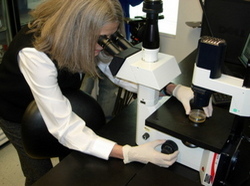
University of Michigan researchers have created the state's first human embryonic stem cell line, the university announced today.
“This historic achievement opens the door on a new era for U-M researchers, one that holds enormous promise for the treatment of many seriously debilitating and life-threatening diseases,” U-M President Mary Sue Coleman said in today's release. “This accomplishment will enable the University of Michigan to take its place among the world’s leaders in every aspect of stem cell research.”
Work on UM4-6 began in May, and detailed characterization of the line was completed in late September. The project was conducted without federal funds, using private gifts to U-M’s Consortium for Stem Cell Therapies and internal U-M resources, according to the university.
With the derivation of UM4-6, U-M joins a select group of fewer than a dozen U.S. universities that have created human embryonic stem cell lines, the release said.
“The real importance of today’s announcement is that the ability to derive new embryonic stem cell lines will allow us to take the next step: disease-specific research that could someday lead to new treatments,” Gary Smith, leader of the derivation project at the U-M Consortium for Stem Cell Therapies, said in the release.
UM4-6 was derived from a cluster of about 30 cells removed from a donated 5-day-old embryo, which was created for reproductive purposes but was no longer needed and was about to be destroyed, the university said.
The consortium will distribute UM4-6 samples to stem cell researchers across campus and to their collaborators statewide. In addition, U-M researchers hope — pending the resolution of a federal court case that seeks to bar federal funding for human embryonic stem cell research -— to submit UM4-6 to the U.S. National Institutes of Health for inclusion in the national registry of human embryonic stem cell lines that are eligible for federal research funding.
A total of five U-M officials will speak at this week's summit, from Monday through Wednesday at the Marriott Renaissance Center in Detroit.
- Read the U-M release for full details on how university researchers created UM4-6.
Comments
Edie Marlowe
Thu, May 26, 2011 : 1:53 p.m.
MI used cars from MI Auto Times lead me to this site. I'm glad I came here, because this debate was very enlightening.
Joe Hood
Tue, Oct 5, 2010 : 8:28 a.m.
@David Briegel You're not arguing about alternatives to embryonic research? If we can use DNA from skin for the same purpose of embryonic research, does your reasoning change any?
David Briegel
Mon, Oct 4, 2010 : 10:53 p.m.
Joe Hood, why aren't you there protesting when those embryos are flushed down the toilet when they are no longer wanted or viable? Not a convenient enough target? And should women have to salvage the ones that nature flushes? Come on, that ideological dog won't hunt! These debates are so silly as these same folks care so little about the actual living human beings who are living in poverty, hungry, homeless, bankrupted, unemployed. Our society has so many unmet needs. Rork, Headline: Science Advances Past Flat Earth Society! U of M, Leaders and Best! u
Joe Hood
Mon, Oct 4, 2010 : 5:55 p.m.
@Dess This isn't about prolonging someone's suffering but the logic of harvesting human beings for the betterment of other human beings. When they extract those 30 cells from that five-day-old embryo, they kill that embryo. If you had the choice, wouldn't you prefer an alternative proven method that has produced the same results without killing another human?
Rork Kuick
Mon, Oct 4, 2010 : 3:15 p.m.
Thanks Joe. I have no doubt there might be other reasons too (suspected accumulating mutations in older cell lines), but wanted someone with actual knowledge to say, and was complaining about the article too ("We are here because we are the best of the best of the best, sir!"). Hmm, those mean people in Madison. I'll mention this when anyone there asks a favor again.
Joe Hood
Mon, Oct 4, 2010 : 2:49 p.m.
@Rork Kuick The financial implications is not having to pay royalties on the lines from University of Wisconsin at Madison
Rork Kuick
Mon, Oct 4, 2010 : 11:50 a.m.
"fantastic news" say many but nobody has said why one more cell line is such fantastic news. How does this open any new doors? Ofcourse many people quoted, as well as us readers, may want this to be taken as fantastic news, but besides the spin can anyone say something interesting. Maybe it really is fantastic, but say why, and get specific.
Ahma
Mon, Oct 4, 2010 : 11:12 a.m.
Obviously all you people that are negative about this new stem cell line of research don't have a family member with a dibilitating disease. You don't have to watch your loved one suffer with the symptoms of the disease. This is great news and gives all that are suffering hope for a cure. I can't imagine how anyone would want to watch their loved one degenerate when there may be help available.I already lost my husband to a rare disease and now my son has a rare ataxia. Just put yourself into my shoes and see if you still think its not necessary to pursure this treatment for the future.
A2K
Mon, Oct 4, 2010 : 11:11 a.m.
This is fantastic news...it's such a joy when reason, fact, and science triumph over superstition and fear.
Sandra Samons
Mon, Oct 4, 2010 : 10:34 a.m.
There is one additional fact that those who oppose this research fail to recognize. Countless 5 day old embryos are simply washed out of womens' bodies on a routine basis. Scientifically uninformed people become emotional without realizing that a 5 day old embryo is not yet a baby. It is a small cluster of cells. It seems to be part of nature's plan that not every fertilized egg results in a baby. When banks discard unused embryos, they are essentially doing what womens' bodies do all the time. So,as others have said, this is not a question of whether the embryo will be saved, but simply a question of whether it will go to waste.
Martha
Mon, Oct 4, 2010 : 10:07 a.m.
I am so glad that this line of research was finally allowed. I trust that it will be used with integrity for the benefit of many, many people.
Forever27
Mon, Oct 4, 2010 : 8:33 a.m.
you all do realize that these stem cells are going to be discarded anyway right? Before you get on your moral soapbox it might help to understand the facts of the situation. Apparently the "potential life" of an embryo that will be destroyed is more important than the thousands of lives (that are actually being lived) that will be saved from this research.
Brad
Mon, Oct 4, 2010 : 7:15 a.m.
A "child" in some parallel, crazy universe somewhere, but here on Earth it was embryonic cells.
K21
Mon, Oct 4, 2010 : 6:53 a.m.
TT are you serious? This is a HUGE accomplishment for the team at UofM. This will undoubtedly open so many doors for research for many diseases (ALS, spinal cord injuries, Parkinson's, etc). This is absolutely fantastic news. It's a great day to be a Michigan Wolverine. Go Blue!
Dess
Mon, Oct 4, 2010 : 12:22 a.m.
Has anyone that speaks out against embryonic stem cell research using about-to-be-destroyed embryos from fertility clinics EVER volunteered their body to implant the embryo into? What 'evil lie'?
TT
Sun, Oct 3, 2010 : 9:22 p.m.
I am sure the surplus child whose life was forfeit will be delighted to learn of this accomplishment and will someday inquire face to face with Ms. Coleman, explanation why his/her death was necessary to fulfill the "future promise" that Ms Coleman so eloquently and arrogantly speaks of. I am sure that when that day comes, and it surely will, that she will be able, with all the grace and dignity of her past high office,to explain to this child why it simply had to be killed for the proposed potential promise of doing possible future good for others who were like him or her self, except of course they were "wanted". The child will no doubt be delighted to learn that his/her death also positioned this great and compassionate university to become one of the elect few to be elevated to this eminent status, and at a minor cost of only one death(we are advised). I would like to be granted the privelege, with your permission, of being there Ms Coleman to hear your answer to these inquiries. Maybe then I will understand why 40 years ago I was terminated from University of Michigan Hospital for refusing to scrub on any of the many illegal abortions performed there every day 5 years BEFORE Rowe v Wade. The evil lie continues......
Joe Hood
Sun, Oct 3, 2010 : 9:19 p.m.
We were all once a five-day-old embryo.
DeeAA
Sun, Oct 3, 2010 : 6:05 p.m.
Yay! Now let's get cranking on a cure for Type 1 diabetes!
David Briegel
Sun, Oct 3, 2010 : 1:28 p.m.
Leaders and Best!!
DagnyJ
Sun, Oct 3, 2010 : 1:25 p.m.
I am so grateful that the voters of Michigan saw the sense in opening up this line of research so that millions of sick and suffering people might be helped.
candygirl
Sun, Oct 3, 2010 : 1:08 p.m.
What wonderful news for those suffering with dibilitating diseases! I wish my dad was still around to see this... it might have brought some hope for him with his own brain disorder that eventually proved fatal. Go U-M for leading the way!!! Go Blue!!!