

University of Michigan student body president seeks restraining order against assistant state attorney general
This story has been updated with a PDF of the PPO application and with details from a police report filed after Armstrong called the police on Shirvell.
University of Michigan student body President Christopher Armstrong is seeking a restraining order against an assistant state attorney general who has been publicly accusing Armstrong of pushing a radical homosexual agenda and showing up at places where Armstrong is, court records show.
Armstrong will go to court next week for a hearing on the personal protection order that would prohibit Andrew Shirvell from contacting him or coming near him.
Judge Nancy Francis denied Armstrong’s request to immediately issue the order, instead setting a hearing for 1:30 p.m. Oct. 4. Armstrong is asking that Shirvell be banned from appearing within Armstrong’s sight, from having e-mail or Facebook contact with Armstrong and to be prohibited from approaching “current or former university students or MSA reps.”
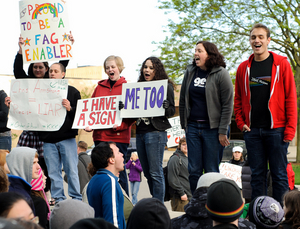
Michigan Student Assembly President Chris Armstrong (right, wearing red) is the target of Michigan Assistant Attorney General Andrew Shirvell at a protest at the Ann Arbor Civic Theatre's May showing of The Laramie Project. Shirvell's sign, reading "Order of Angell = KKK," refers to the once-secret U-M student organization formerly known as Michigamua. - Courtesy Chris Dzombak
Shirvell, an assistant attorney general for the state of Michigan, has been writing a blog accusing Armstrong of pushing a radical homosexual agenda. In addition, he has shown up at various Michigan Student Assembly events to protest Armstrong, including holding signs attacking him that have a rainbow with a swastika drawn on it.
Armstrong is the university's first openly gay student body president.
Armstrong and Shirvell could not be reached for comment today.
Shirvell is prohibited from stepping foot on the U-M campus, university officials confirmed this afternoon. Diane Brown, a campus police spokeswoman, said Shirvell was read a trespass warning on Sept. 14, meaning he is banned from campus.
Brown said the trespass was based on complaints and an investigation involving "potential harassment or stalking or intimidation" of Armstrong by Shirvell. She declined to discuss where police read him the trespass warning.
Police are still investigating Shirvell, and the case has not yet been turned over to prosecutors, Brown said. She said Shirvell is appealing the trespass order, and no date for the appeal hearing has yet been set.
In the personal protection order application filed Sept. 13, Armstrong calls Shirvell "a threat to my own personal safety” and details several instances where Shirvell followed Armstrong’s friends as they partied in various Ann Arbor locations, hoping to confront Armstrong.
Armstrong also writes that Shirvell called Speaker of the House Nancy Pelosi’s office twice over the summer after Armstrong took a job there to lodge complaints against Armstrong.
Armstrong said in court documents that Shirvell showed up at 1:30 a.m. at a house party Armstrong was holding on Sept. 4.
On Sept. 6, Armstrong asked for an escort from the University of Michigan’s Department of Public Safety after Shirvell showed up at Armstrong’s Ann Arbor home. The Ann Arbor Police Department was also called to Armstrong's house that day.
According to a police report, officers responded at 11:27 a.m. to the home on East Madison Street after receiving a report of a trespassing complaint.
Shirvell told officers he was protesting Armstrong because he was "extremely upset" Armstrong joined Order of Angell, which is a senior honorary society at U-M, the report said. Shirvell also told officers he was being "extremely peaceful," walking up and down the sidewalk carrying a sign that displayed a picture of Armstrong and had words on it, expressing the reason for the protest, the report said.
It's unclear what was written on the sign. Shirvell also told officers he is a licensed attorney, had his bar card with him and is "extremely familiar with his rights as a protester," the report said.
According to the report, Armstrong told police he was feeling "somewhat harassed," and had made prior reports to U-M police about similar issues. Police said Shirvell was acting within his constitutional rights.
"He did not threaten anyone or attempt to enter on the property," police spokeswoman Lt. Renee Bush said.
But in his application for a restraining order, Armstrong said Shirvell's actions made him fear for his safety.
“The actions that Mr. Shirvell has taken against me over the past four months have been incredibly distressing,” Armstrong wrote. He added he might feel slightly different if Shirvell was a student, but since he wasn’t, “his actions are concerning and make me feel unsure about my own personal safety.
RELATED CONTENT
“His actions … have been an outright attack on my ability to live my life openly and be honest about who I am," he wrote.
The university administration today reiterated its support for Armstrong.
“The University of Michigan stands behind our community’s value of expecting respect,” Laura Blake Jones, dean of students, said in a press release. “We continue to take the situation very seriously. Many of us have been working behind the scenes on this situation since spring.”
Above all, the university is working to respect Armstrong’s privacy and not let an unwanted situation interfere with his college studies or the ambitious agenda he has set for MSA in the coming year, spokeswoman Kelly Cunningham said in the release.
U-M President Mary Sue Coleman also issued a statement today, saying the university "has called upon others in positions of authority to take all appropriate action to address this situation." A U-M spokesman declined to elaborate on that.
"A high-profile situation involving one of our students is highlighting the importance of values that our institution holds dear," Coleman said in the statement. "An individual has chosen to target the elected president of the U-M student body in a reprehensible manner ... As a community, we must not and will not accept displays of intolerance. We are heartened, but not surprised, by the response of the campus community in supporting Chris. We are impressed with his resiliency and stand by him and the important work he is doing on behalf of all of our students."
Armstrong has not spoken directly about Shirvell, a U-M alumnus, but did read a statement at a recent student assembly.
“I will not back down," he said. "I will not flinch. I will not falter. I will not succumb to any unwarranted attacks. What I will do is I will carry on with the utmost pride and vindication,” the statement said. “I, along with the rest of this assembly, were elected to this body to represent the university. And nothing said about us, or regarding our personal merits, will waive our commitment to serve the student body.”
The U-M Board of Regents also weighed in on the issue indirectly, saying at its meeting earlier this month that the university would provide support to any student who is being attacked by someone outside of the university.
AnnArbor.com News Director Amalie Nash and reporter Lee Higgins contributed to this story.
David Jesse covers higher education for AnnArbor.com. He can be reached at davidjesse@annarbor.com or at 734-623-2534.
Comments
Jeff
Sun, Oct 3, 2010 : 3:24 a.m.
"Mr. Shirvell is over the top with his attacks. He is harmless, though. He is a cyber bully, but nothing ever physical." That's enough right there. We have seen documented cases of suicide that were encouraged or caused by cyber-bullies; we've seen documented cases of suicide because of college-level pranks against gays (see Rutgers). Two questions: how much money would the U of M be liable for, if Shirvell incites someone to kill Armstrong or drives him to the breaking point? How many of the Board of Regents would be personally liable for it? At this point, the Board of Regents could formally ask the Governor to remove Shirvell, solely for financial reasons. He's too dangerous to the "bottom line" to keep on the state payroll. One last point: having a state-paid lawyer (from the AG's office) commenting on his vendetta against a private citizen, publicly, is going to be a stronger action that a private citizen's "Freedom of Speech". Imagine being the target of that vendetta, and wondering if a traffic stop (for a broken light) could end with your arrest and murder in jail, because the Attorney General's office has made it clear that this individual is out of favor?
DeGuyz in Mississippi
Sat, Oct 2, 2010 : 4:03 p.m.
It might be in the best interest of the state to have a mental evaluation on this shirvell fella. After all, his job description deals with matter that are important to the state. He does not deserve anything less for his own safety if nothing else.
DeGuyz in Mississippi
Sat, Oct 2, 2010 : 3:58 p.m.
Documentation is everything Chris...:)
johnnya2
Sat, Oct 2, 2010 : 8:09 a.m.
@michigan face Mike Cox is LYING when he says he can not take action since he is on leave. He can not do anything regarding his employment maybe, but he CAN and should investigate this "private citizen's" criminal behavior. The problem through this whole thing is people care about his job. I don;t care about his job, I want him criminally prosecuted, just like any other private citizen who stalked and videotaped a persons home at 1:30am. Stalking is not protected speech. Cox needs an education about the difference between speech and actions.
michigan face
Fri, Oct 1, 2010 : 3:31 p.m.
Shirvell did more than cyber-bully - check the facts - this is stalking and harrassment at the very least. Cox said today that since Shirvell is on a leave of absence he cannot pursue hearings, etc. until that leave is over! Rick Snyder said today that he would not make a conclusion without understanding more if this was anything more than freedom of speech! Rick Shyster as usual - what's new with this guy.
Ed Kimball
Fri, Oct 1, 2010 : 2:58 p.m.
@Silly Sally: A couple of points of disagreement: First, there's a big difference between an organization like BAMN and similar tactics from a state official, especially one sworn to enforce the law and protect the public. Similarly, there is a difference between students or citizens using an offensive tactic (against right-wing politicians or anyone else) and state officials doing the same. Second, the psych association's opinion may be only an opinion, but it is a medical opinion, not a political one. Medical opinions change as we gain more information, otherwise doctors would still be bleeding us to cure us.
A2ite
Fri, Oct 1, 2010 : 8:54 a.m.
Sadly, self-hatred is often the catalyst for stalking and bullying behavior like this. Anderson Cooper's interview with Shirvell: http://www.cnn.com/2010/US/09/28/michigan.justice.blog/index.html
Silly Sally
Fri, Oct 1, 2010 : 8:50 a.m.
Mr. Shirvell is over the top with his attacks. He is harmless, though. He is a cyber bully, but nothing ever physical. I strongly disagree with his tactics. An interesting not, though, is how so many on this blog seemly were quiet when BAMN did similar antics to Jennifer Gratz over her successful anti-affirmative lawsuit against UM. That must have been much more scary, since BAMN (By Any Means Necessary) is a group of many while Shirvell is a loner. Shirvell's actions are wrong, and rightly condemned, but why the silence when left wing types and groups employ similar tactics? Some on this blog are ignorant: Shirvell knows about UM since he graduated from UM as an undergrad Ave Maria is a fine law school with a high graduation rate and a very high rate of passing the state bar - the best measure of a school. The psyc association's rules are stating a political opinion, not a medical fact. People do not have to agree with it. This same org. until recently called homosexuality a mental illness. Shirvell is a fool with his tactics, but so are many, many others who do similar tactics to right wing politicians who attempt to speak at UM. Be consistent, or shut up.
Duane Collicott
Fri, Oct 1, 2010 : 7:33 a.m.
"AG Cox says that Shirvell is within his rights under the 1st Amendment. That might be fine for a private citizen, but not for a public servant." Ones rights are not reduced when one takes a job with the government. A government employee is also a citizen. I think the guy should be fired, but that has nothing to do with his right to free speech.
ChelseaBob
Fri, Oct 1, 2010 : 5:56 a.m.
Story was a bit light on information in some places. What exactly is the radical gay agenda Shirvell thinks Armstrong has? Can a student body president have a radical gay agenda? Student government doesn't have much real power. It disturbs me to see an assistant AG behaving this way, but was he on his own time, or state time? If on state time, it's easy, he's gone. If on his own, it's a little more difficult. Unless he violates the law, he has rights too. I tried to look at his blog, and he has closed it. Interesting.
johnnya2
Thu, Sep 30, 2010 : 11:14 p.m.
I suggest any person here who wants to prove the point, find out Mike Cox address, and where he works, and every event he goes to and picket, and slander him. Each and every day tell lies about him, and in fact show pictures of him having sex with his mistress (this is not a lie, he admits to it). I would show those pictures to any kids he may have. Show them to his wife, parents, friends, and just say, it is my free speech right. I guarantee you would be arrested. Of course when you are living off your tax payer funded salary (unlike Mr Armstrong) he will end up calling the local police to have you arrested. I think a DOJ investigation into the handling of this case by Mr Cox should be started TODAY. He has failed to investigate a CRIME. Stalking is a CRIME. It is not an annoyance, or silly game. Cox also needs to read up on his SCOTUS case law before thinking this guy has the right to do this.
Monica R-W
Thu, Sep 30, 2010 : 11:09 p.m.
As a former state employee, I have seen MANY employees terminated over "Conduct Unbecoming of an Employee". For instance, if an employee engage in alcoholic beverage drinking off the job. The next day, they come to work (not having 8 hours to burn the liquor out of their system) on mandatory overtime...(with Correctional Officers/State Police)...it can happen. Then the employee is selected for random drug & alcohol testing and they test positive.....terminated..."Conduct Unbecoming of a Employee" is one of the charges. Is it beatable...sometimes, with union help. Either way it is 50/50 and the employee is out of a job, an minimum of 18 months or more. The moral of the above story is that if the State of Michigan can terminate an employee for one to many drinks the night before...(while OFF work...mind you), it is amazing that stalker boy still has a job. Mike Cox needs to DO HIS JOB...and get this "employee" into a disciplinary hearing A.S.A.P. Give this "person" the questionnaire (state employees know exactly what I mean), write the memorandum for the disciplinary hearing/investigation and place this idiot on STOP ORDER (he cannot serve in his position and would be on paid administrative leave) until AFTER the investigation/hearing. Like I stated....as a former state employee and union representative, I saw MANY other former employees terminated for much less. If serious mental issues that is leading to harassment of another individual during non-working hours; does not fit into "Conduct Unbecoming", I do not know what does.
aareader
Thu, Sep 30, 2010 : 10:20 p.m.
Let us see what Mr J. Figer may think about it. Maybe a filing for slander etc. makes sense. Mr Armstrong should give him a call.
SillyTree
Thu, Sep 30, 2010 : 10:15 p.m.
@stunshif "If he had not been making this an issue as he has, Shirvell's name would not even be known!" I think it's the opposite. I don't think we would know who Chris Armstrong is if it wasn't for Shirvell. I've never known who the president of the student council was before. It's just not that big of a position and for somebody (working in a public office) to be making such a big deal out of its leader is disturbing. It is wrong to blame Chris for what is happening to him.
stunhsif
Thu, Sep 30, 2010 : 9:50 p.m.
@sillytree, "As for Armstrong, if you don't care if he's gay, you shouldn't care if he says he's gay. Think of something better." Read my earlier post, my point to Armstrong was, quit making the point that you are gay. No one really cares! I personally don't care if he is gay, if he is bisexual, if he is homosexual or it he is into any other kind of sex. Just do your job and don't make a point of your sexuality. That was my point, period. If he had not been making this an issue as he has, Shirvell's name would not even be known!
stan
Thu, Sep 30, 2010 : 9:41 p.m.
Mike Cox is term-limited. He did not win the Republican nomination for Governor. He won't be on the ballot. He really should remove this psychopath from his job. Also, this has absolutely nothing to do with Snyder.
Matt Cooper
Thu, Sep 30, 2010 : 9:13 p.m.
To the conspiracy theorists: I have a hard time believing, even for a moment, that Mr. Shirvell and Mike Cox are willing to throw away their entire careers in this fashion for the sole purpose of simply 'setting up' a case to test the bounds of hate crime laws. I know neither of these individuals come across as being particularly intelligent, but come on now, let's not go off the deep end.
SillyTree
Thu, Sep 30, 2010 : 9:02 p.m.
@stunshif I believe ERMG suggested that it was impossilbe for Armstrong to have a conversation with Shirvell. He didn't say what your thought process was; he ran through some possibilities. One of them seems to have hit the nail on the head. ERMG said, "Have a rational conversation with someone who is demonstrably an irrational religious zealot?" That covers your idea of a conversation between the two. As for Armstrong, if you don't care if he's gay, you shouldn't care if he says he's gay. Think of something better.
Pika
Thu, Sep 30, 2010 : 8:57 p.m.
We have an election coming up. Time to FIRE Mike Cox. It is that simple.
stunhsif
Thu, Sep 30, 2010 : 8:48 p.m.
" Stunhsif wrote: "Take care of business man to man, don't run to the courts! What??? Are you actually advocating that Armstrong should stalk Shirvell and... do what? Punch him out? Have a rational conversation with someone who is demonstrably an irrational religious zealot? " Mr. Ed, Your conclusion of my thought process is irrational! I am suggesting that Mr. Armstrong pick up a phone, give Shirvell and call and talk things out or meet him face to face to work things out. Armstrong is getting ready to call one of your parties "clown trial attorneys" like Jeff Fieger because his feelings have been hurt. Didn't Jeffrey lose the chance to your "blown away" governer to Jenny? At this point, he might have been a better choice!!!!!!!!!
RobRoy
Thu, Sep 30, 2010 : 7:55 p.m.
As a parent, if ANYONE tried to defame, slander, intimidate, stalk or treat my son the way Shirvell has treated Armstrong, I'd be on his front sidewalk with a bat, not a sign, "marching peacefully." This type of behavior should never be tolerated, much less by a public servant. Seriously, the most disturbing thing about this case, is that this man seems to utilize all his spare time stalking or writing defamatory things about Armstrong. It's folks like this who "lose it" and become dangerous.
Speechless
Thu, Sep 30, 2010 : 7:30 p.m.
To me, the jaw-dropping feature of Shirvell's homophobic expression is its raw intensity. What is it inside his head that's become so twisted that he'll act out openly for all to see, while directing this internal rage at one individual? Shirvell does not appear to recognize or understand his own massive failure to connect with the public through the media or the internet. A member of the State AG legal team has quite determinedly made himself into a poster child for fundamentalist wack-job antics typically associated with Fred Phelps.
Bando
Thu, Sep 30, 2010 : 7:21 p.m.
Fire Shirvell. I find it absolutely disgusting that AG Cox can sit on this AT ALL, not to mention when many are mourning the death of a young man who took his life after being cyber-bullied by bigoted, foolish people.
pbehjatnia
Thu, Sep 30, 2010 : 7:12 p.m.
I hope this guys gets 1. Mental health counseling asap and 2. Permanently disbarred. He is a disgrace to the State of Michigan and to the profession. This is not a free speech issue.
Joshua
Thu, Sep 30, 2010 : 7 p.m.
@Nonenoe - I think you are confusing the names in this article.
David Briegel
Thu, Sep 30, 2010 : 6:47 p.m.
care2comment, we aren't just tolereant. We are sane and civilized. Care to join us?? If only pseudo-Christians would embrace the love of Jesus Christ instead of the biggotted hatred so prevalent amongst the believers! As many have said before, Jesus would be ashamed of all the evil that has been done in his name!!
Joshua
Thu, Sep 30, 2010 : 6:36 p.m.
I'm appalled that the AG has such a poor understanding of the law that he thinks stalking, libel/slander, and personally targeting someone with hate speech is acceptable and falls under free speech. Fire them both and get someone in office that will protect the rights of the people they are supposed to represent.
Jello Biafra
Thu, Sep 30, 2010 : 6:36 p.m.
after seeing Shirvell interviewed on television, me thinks thou doth protest too much.
Dale J Schuster
Thu, Sep 30, 2010 : 6:29 p.m.
Way to go Chris. Shirvell is a menace to society. It is comforting to know that you may soon be rid of this vile, pathetic, creep. It will be even more comforting, if the right thing is done and he gets fired so that none of us will ever have to see or hear him again. You are doing a great standup job. My hat is off to you. Continue to lead and be the awesome person you are. Best of luck to you.
Cash
Thu, Sep 30, 2010 : 6:06 p.m.
@stunshif, Neanderthals did that....a lot of us evolved.
stunhsif
Thu, Sep 30, 2010 : 5:55 p.m.
Agree with BasicBob, quit pushing the fact that you are gay and do your job. Noboby cares and they should not care that you are gay. Take care of business man to man, don't run to the courts!
Olive
Thu, Sep 30, 2010 : 5:54 p.m.
@bedrog - Did you post as Warhol on the Michigan Daily site?
Cash
Thu, Sep 30, 2010 : 5:47 p.m.
a2karen, I'm still laughing at bedrogs' post hours later.
a2karen
Thu, Sep 30, 2010 : 5:40 p.m.
The best comment has got to be: "this shirvell reminds me of the "onion" headline: "anti gay pastor suspiciously well -informed about gays". Thanks @bedrod.
SillyTree
Thu, Sep 30, 2010 : 5:16 p.m.
@care2comment I've complained about falacious arguments before and I have to again. Your reasoning is circular. You are saying that everything should be tolerated including intolerance. Aristotle is shaking his finger at you. Think of something better.
HaeJee
Thu, Sep 30, 2010 : 5:14 p.m.
care2comment: no offense, but you have a bad argument. The graduate student showed discrimination, like Shirvell. Meaning that I support equal rights, above religion.
treetowncartel
Thu, Sep 30, 2010 : 5:12 p.m.
A Care I think Eastern was relying in part on this for their actions, it is the rules promulgated by the board of psychology Michigan Department of Community Health Director's Office Board of Psychology-General Rules (R 338.2501-338.2516) R 338.2515 Prohibited conduct. Rule 15. Prohibited conduct includes, but is not limited to, the following acts or omissions by any individual covered by these rules: (a) Engaging in harassment or unfair discrimination based on age, gender, gender identity, race, ethnicity, culture, national origin, religion,sexual orientation, disability, or socio-economic status, or any basis proscribed by law.
care2comment
Thu, Sep 30, 2010 : 4:58 p.m.
Lets always defend gays and the homosexual agenda at all costs: afterall we are tolerant... afterall.. tolerance is the highest value... and we must pat ourselves on the back as Ann Arborites and UM students for such a display of this greatest of virtues.. Except when it comes to Christians: like the female couseling grad student at EMU who wanted to not be forced into affirming a homosexual lifestlye because it flew in the face of her beliefs.... she is forced to resign from the grad program. We must not tolerate views such as hers.... then it's time to be intolerant.
treetowncartel
Thu, Sep 30, 2010 : 4:57 p.m.
Leann and others posting, please read Ed's post on this topic. as always, he is pretty informative on the subject matter at hand. Shivrell went to U of M for his undergrad. It is not that secret of a society either. I think a lot of Democrats voted for Snyder in the primary knowing they were getting the lesser evil. It is ironic that he got a position in the AG's office, which is pretty hard to get from what I hear upon completion of his law degree. And it is pretty funny that the person who makes the decision about him gettinng the job is the person whose campaing he ran.This is really starting to unravel for the Duck.
HaeJee
Thu, Sep 30, 2010 : 4:40 p.m.
I would love to hear what Snyder thinks abou this topic? My gut feeling is that would support Cox. Why would Shirvell know about a U of M secret group (even if it exists)? He didn't go to law school there. Maybe he heard about it from Cox, when Cox attended law school at Michigan.
Cash
Thu, Sep 30, 2010 : 4:29 p.m.
I wonder if Shrivel was working for the Democratic Party on his off time, if Cox could think of a way to fire him. Gosh, I wonder.
David Briegel
Thu, Sep 30, 2010 : 4:27 p.m.
The silence from candidate Snyder is deafening!! Will A2.com dare to even ask??
David Briegel
Thu, Sep 30, 2010 : 4:25 p.m.
Inspector13, you are right on target!
David Briegel
Thu, Sep 30, 2010 : 4:22 p.m.
Sandra samons and leann, You are both correct. Keep up your vigilance! Cash and Olive, Keep observing and posting.
HaeJee
Thu, Sep 30, 2010 : 4:22 p.m.
Correction: I think the AG election is this year! I wonder if he will have Shirvell be his campaign manager again. This will be much easier to remember to avoid voting for Cox.
HaeJee
Thu, Sep 30, 2010 : 4:18 p.m.
I read online that Shirvell was Cox' campaign manager. Can AA.com confirm?
Sandra Samons
Thu, Sep 30, 2010 : 4:04 p.m.
Finally A2.com reports this story, after CNN did so! Thank you for providing a link to state government. I see no point in contacting Shirvell himself, but this is what I sent to Mike Cox. I encourage others to do the same! Dear Mr. Cox, I saw the CNN interview with Assistant State Attorney General Andrew Shirvell and as a mental health professional I found it deeply disturbing. If this is the kind of thing that falls within your definition of personal rights, then none of us is safe with you at the helm. I implore you to take a more careful look at this situation and act to protect the citizens of this state from people like Shirvell. Please do not wait until someone is hurt. Please keep in mind that even if Shirvell does not personally harm someone, protecting him gives permission for every other unstable person like him to take action, secure in the belief that they will have the protection of Assistant State Attorney General Andrew Shirvell. What a sad state of affairs that he was even elected in the first place!
Macabre Sunset
Thu, Sep 30, 2010 : 3:53 p.m.
This is one of the more bizarre stories I've ever heard. Basically, Shirvell is, ultimately, trading his job and well-being for the "freedom" to express his hatred toward a complete stranger. I don't blame Armstrong for wanting a PPO. I hope he gets it, and that Judge Francis adds a contempt charge for Shirvell if he tries expressing more of that hatred in the courtroom. On the other end of the scale, I hope this isn't a big setup for a lawsuit against the state. Our tax money is already spread thin enough as it is, and it should be clear that Shirvell is off the reservation on his own when it comes to his protest. That may be why Cox can't act - if he does, he's essentially acknowledging the state has a responsibility to control the guy. Maybe Armstrong and Cox could get together (no pun intended) and agree that if Shirvell is fired, Armstrong will limit any lawsuits to Shirvell personally.
julieswhimsies
Thu, Sep 30, 2010 : 3:52 p.m.
Chris Armstrong stands stronG! Good to hear it. Shirvell is one creepy politician. Ugh.
Steve Burling
Thu, Sep 30, 2010 : 3:40 p.m.
@Basic Bob: Got any evidence besides Shirvell's ravings that Armstrong is representing only a minority point of view?
HaeJee
Thu, Sep 30, 2010 : 3:39 p.m.
Cox's election term ends 2011. After his reaction to the Kilpatrick scene and now this.... he won't get my vote. To defend a state employee for harassing someone due to sexual discrimination sickens me. What if it was race issue, it would still be okay? I am wondering if this assistant AG can be sued for slander? My daughter will be heading to college in a few years. When I heard of this story, I thought about how I would feel if my daughter in college was being harassed by the assistant AG. I think it would be very intimidating. Is it just me or is the conservative extremists feeling comfortable in coming out of the closet since the Queen of conservative extremist (Palin) paved the way and got such a following?
michigan face
Thu, Sep 30, 2010 : 3:31 p.m.
Fire Shirvell and hold Cox accountable as well.
Megarz
Thu, Sep 30, 2010 : 3:05 p.m.
This is disgusting. This kid has the right to push any issue he so desires and inimidation and/or stalking(????) to try to get him to stop is so incredibly wrong it makes me sick to my stomach. He was voted in and from what I can tell has large support from the student body. I hope Shirvell gets fired and is never able to show his face in politics EVER again.
Terry
Thu, Sep 30, 2010 : 2:48 p.m.
Do a Google search on "Shirvel" for more delight.
inspector13
Thu, Sep 30, 2010 : 2:47 p.m.
there are several right wing law firms salivating at the chance to bring down hate crime laws protecting gays. shirvell is their martyr.
Barb
Thu, Sep 30, 2010 : 2:46 p.m.
@Neil, you're probably correct but if you watch the legal analyst on CNN (Toobin, who is a former prosecutor) he doesn't think Shirvell could win a lawsuit like that.
Neil Moorman
Thu, Sep 30, 2010 : 2:37 p.m.
After reading portions of the blog and watching Shivell on Anderson Cooper, I would speculate that Cox is taking a cautions approach to removing him. Shirvell seems like the kind that will have a lawsiut for wrongfull termination ready to go as soon as he's handed the box to clean out his desk.
amberherself
Thu, Sep 30, 2010 : 2:35 p.m.
What makes me laugh is that I could potentially get fired for logging on to Facebook one too many times - but a state official running a smear campaign gets to have job security. Fire Shirvell.
Cash
Thu, Sep 30, 2010 : 2:31 p.m.
Can the Attorney General of Michigan be sued for being aware of and allowing an employee to harass a resident of Michigan? Isn't anyone responsible for protecting this young man? Do Washtenaw County residents need to go on campus and stand in a circle around this young man to show our support? Because if that is what it takes, I'm ready. If we do not stand up for this young man, who will? And who will stand up for you if the AG's staff decides they don't like blacks? Catholics? Jews? Arabs? The list goes on. This is frightening.
John of Saline
Thu, Sep 30, 2010 : 2:25 p.m.
Imagine if a police officer conducted such a campaign! Now, a state attorney (or police officer) can express opinions all they want (off the clock). It's the showing-up-at-random-times, you-must-pay-attention-to-me stuff that is really creepy. Plus, I wonder about the guy's on-the-job priorities. Does he make decisions based on the law and the office's policies, or is he constantly thinking "He looks gay" and making decisions that way? If I were his employer, I'd be worried about his being able to keep his private obsession out of his job. I'm glad the U told him to bug off.
Barb
Thu, Sep 30, 2010 : 2:23 p.m.
Oh, and Granholm just said this on Twitter: "If I was still Attorney General and Andrew Shirvell worked for me, he would have already been fired." http://twitter.com/govgranholm
Janis
Thu, Sep 30, 2010 : 2:22 p.m.
Where is Mike Cox in all of this?
Basic Bob
Thu, Sep 30, 2010 : 2:18 p.m.
Shirvell might be obsessed and crazy but Armstrong is behaving poorly as well. Armstrong needs to represent all students of U-M instead of strictly one minority point of view. In this way he can generate the respect he thinks he deserves. Had the student body president been a devout Muslim, Christian, or Jew and pushed his beliefs on the community, he would be under vicious attack from the atheists and anarchists, as well as believers of other religious traditions. To ask for support or empathy is one thing, but to ask for a restraining order is just over the top.
inspector13
Thu, Sep 30, 2010 : 2:17 p.m.
i am of the opinion that shirvell and cox are setting up a test case against hate crime laws. michigan family association was recently kicked out of court over the issue when they tried to challenge it. i think shirvell and cox are setting this up for them. i emailed cox and asked him if he would fight a hate crime enhancement if shirvell did something terrible. i got no reply. i am sick of these right wing christians thinking they can say and do anything they want to people by cloaking themselves in religious freedom. anyone who wants both sides of the story just needs t watch the clip of this guy attacking the kid on cnn. cox should resign as he hired this person, a graduate of the laughably bad law school ave maria, the catholic version of pat robertson's law school. i would love to hear what an fbi profiler thinks of shirvell, it would be quite entertaining.
Matt Cooper
Thu, Sep 30, 2010 : 1:58 p.m.
I saw Mr. Shirvell interviewed on Anderson Cooper's show and in my (not-so-expert) opinion, he has some serious issues. Free speech is one thing, stalking is another. And as for Mike Cox's involvement, yes he can in fact fire Mr. Shirvell, but not for his speech. He can fire him for 'conduct unbecoming a state employee', or some such thing. To say that the State of Michigan is "stuck" with Mr. Shirvell and his insanity is not true at all. Now let's just see if Mike Cox has enough character to do something about it.
Listen
Thu, Sep 30, 2010 : 1:52 p.m.
@Hmm...I believe Shirvell's blog is called Chris Armstrong Watch. The extremist blather therein would be laughable if it weren't so scary because he really thinks there's nothing wrong with what he's doing. And his interview with CNN was pretty unbelievable too. Hard to imagine that this guy will be allowed to keep his position as Asst AG. Cox was even quoted as saying Shirvell's behavior away from work was unacceptable/immature or something along those lines.
Olive
Thu, Sep 30, 2010 : 1:35 p.m.
Although this story is now getting coverage at annarbor.com, I'm disappointed that it took so long. Actually, it hasn't been covered in Michigan very much by any press. Everything that I've read about it in the past few weeks has been from sources outside of Michigan save the Michigan Daily. This is a huge story taking place in our backyard, and it has been ignored. What's with that? This unconscionable intolerance for our gay and lesbian brothers and sisters needs to end. Now. It should have ended eons ago. Thank goodness Cox will be out of office soon. The first thing the new AG needs to do is to clean house if Shirvell isn't already gone. BTW, Shirvell was one of the protesters holding a huge picture of an aborted fetus at the Michigan graduation ceremonies this past year. It's on the Free Press website.
Trepang674
Thu, Sep 30, 2010 : 1:31 p.m.
Sorry for the inapprobriate acronym to get removed..but my point about Granholm wasn't politcally motivated..she is the leader and should be in Cox's business about this. A reluctant leader at best. I'm not a Republican.
Pam
Thu, Sep 30, 2010 : 1:23 p.m.
Sorry my comment was removed. I just put into my own words what just about everyone else is saying. The fact that one individual can denegrate another,accuse them of outrageous things and hold a public job is scarey. Shervill definately needs therapy.Saw him on Anderson Cooper..scarey! Send him down the road..
Atticus F.
Thu, Sep 30, 2010 : 1:06 p.m.
This is clearly a case of a state official abusing his power to promote his own personal oppinion. A state official does not have the right to launch a personal vendetta against a citizen in the name of "free speech".
ann_arbor_guy
Thu, Sep 30, 2010 : 1:03 p.m.
This is completely unacceptable for anyone especially a state employee. Andrew is clearly out of line and not a stable person. He should be under psychiatric care and removed from office. Like someone has stated, this could lead to a much more serious situation. Besides the oblivious how wrong this is for a state employee, this reflects poorly on the State of Michigan. This is yet another reason for employers not to relocate here if we cannot even protect our own citizens from an out of control government employees. This sends a really bad message to the country and the world about Michigan and this should be stopped immediately.
amberherself
Thu, Sep 30, 2010 : 12:57 p.m.
This guy is crazy! I watched the AC interview as well and this man does not come off as stable in any respect. I hope Chris gets his restraining order and Shirvell gets fired. Back in 2005 he also protested NY Pizza Depot restaurant for having a Pride sticker on their door - this man clearly has a problem with the LGBT community. How he can effectively represent Michigan in the AG office is beyond me. http://www.michigandaily.com/content/gay-pride-sticker-sparks-controversy-pizzeria
Zack
Thu, Sep 30, 2010 : 12:55 p.m.
Sorry, protesting outside someone's house and searching the facebook profiles of his friends and their families so he can distory their words isn't free speech. It's stalking and I truly fear for the safety of Chris and Jason, as well as anyone else this guy has targeted in his blog.
Steve Burling
Thu, Sep 30, 2010 : 12:46 p.m.
@Hmm: If you want to see just how out there Shirvell is, read his ravings at http://chris-armstrong-watch.blogspot.com/.
Barb
Thu, Sep 30, 2010 : 12:38 p.m.
If you seek Shirvell's side of things, his blog on the topic is easy to locate.
Hmm
Thu, Sep 30, 2010 : 12:33 p.m.
I'm going to need to hear Shirvell's side of this before passing any kind of judgement. Personally I think it was irresponsible for A2.com to post this article with only one side to the story
Cash
Thu, Sep 30, 2010 : 12:32 p.m.
bedrog, I haven't stopped laughing since I read your post.
Mark
Thu, Sep 30, 2010 : 12:31 p.m.
I believe the Federal AG is now looking into this. So this may take a different path.
David Briegel
Thu, Sep 30, 2010 : 12:30 p.m.
A citizen/student feels compelled to obtain a restraining order against a sworn law enforcement official. That official is no longer eligible for employment as he is unable to fairly uphold the lew and perform his sworn duties. The only remedy is Termination!
Mark
Thu, Sep 30, 2010 : 12:30 p.m.
AG Cox is a conservative right Republican and he will protect Shirvell. He should not continue as AG, nor should Cox be elected to another Public Office. He is bias to certain of the population. another issue is if the Judge is bias tp, since there may be a link between the AG and the judge.
Atticus F.
Thu, Sep 30, 2010 : 12:30 p.m.
This is just more proof of Mike Cox's radical right wing agenda.
bedrog
Thu, Sep 30, 2010 : 12:29 p.m.
for once i agree with everyone on this site. this shirvell reminds me of the "onion" headline: "anti gay pastor suspiciously well -informed about gays".
DeGuyz in Mississippi
Thu, Sep 30, 2010 : 12:27 p.m.
Mr. Armstrong should request a federal order of protection from the Dept. of HLS. This is so close to violating federal stalking laws. It won't take much for Andrew Shirvell to violate federal a law by using the internet to defame another persons character if he hasn't already. Clearly a hate crime by any standard.
denise1inaa
Thu, Sep 30, 2010 : 12:27 p.m.
Shirvell is an embarrassment to the State of Michigan and has too much time on his hands if he is showing up at 1:30 AM outside this student's home. Stalking is exactly what he is doing, I thought that was against the law. He needs to be fired and if AG Cox is not going to do it, we should remember this fact when we go to the voting poles.
Peggy
Thu, Sep 30, 2010 : 12:22 p.m.
Allowing an Assistant Attorney General to publicly state sexually prejudicial statements is like having say a President or Vice President make racial or sexually prejudicial statements. None of that would be tolerated, and rightly so. His (Asst. Attorney Gen) superiors need a reality check. Prejudice has no place in the Attorney General's office at any time. What one comments about "privately" is a warning that this man is unsuitable for his job. Man up folks and get rid of this joker.
melro
Thu, Sep 30, 2010 : 12:19 p.m.
I think the judge should have issued a TRO pending the later hearing. If you've seen this guy on TV he clearly appears deranged. Stalking, cyber stalking and these other things are clearly against the law, and I think Shervill poses a clear and present danger to this student and others. At the very least, the AG should insist he go for a psychiatric evaluation.
Cash
Thu, Sep 30, 2010 : 12:15 p.m.
We are paying this person to work for us. I want to fire him. Now.
Forever27
Thu, Sep 30, 2010 : 12:14 p.m.
@Trepang, you can't honestly be blaming Granholm for this can you? His boss is Mike Cox, a REPUBLICAN. This has nothing to do with partisan politics and everything to do with the danger that this student is in because of an unhealthy obsession that Shrivell has with a person's sexuality.
Barb
Thu, Sep 30, 2010 : 11:57 a.m.
Oh that. My prediction is Cox *will* fire him now that this has become such a big story.
DFSmith
Thu, Sep 30, 2010 : 11:55 a.m.
lets wait till the Court hears all the evidence before judging who is the bad guy in this case.
treetowncartel
Thu, Sep 30, 2010 : 11:53 a.m.
If you want to let any of these State employees/officers know how you feel you can contact them via http://www.state.mi.us/dit/directory.aspx
Ignatz
Thu, Sep 30, 2010 : 11:52 a.m.
AG Cox says that Shirvell is within his rights under the 1st Amendment. That might be fine for a private citizen, but not for a public servant. Can the guy!
annarbor
Thu, Sep 30, 2010 : 11:45 a.m.
"How are they stuck with him?" Mike Cox refuses to fire him. Cox is convinced that Shirvell is completely within his rights to harrass, demean and stalk a young college student that Shirvell claims he never met-
Robert
Thu, Sep 30, 2010 : 11:39 a.m.
I also saw the Interview with Shirvell and feel he has an unhealthy obsession with Armstrong. His comments were disturbing and his views are very distorted. I hope Armstrong gets the restraining order and also hope it doesn't go any farther than words. This is clearly a situation that could escalate and law enforcement will look back and say all the signs were there.
Barb
Thu, Sep 30, 2010 : 11:34 a.m.
How are they stuck with him?
annarbor
Thu, Sep 30, 2010 : 11:28 a.m.
Good for Chris Armstrong! I watched the CNN interview of Shirvell and I found him to be quite disturbing. Sadly, the AG's office is stuck with him.