

U.S. Secretary of Education calls U-M School of Education a "model"
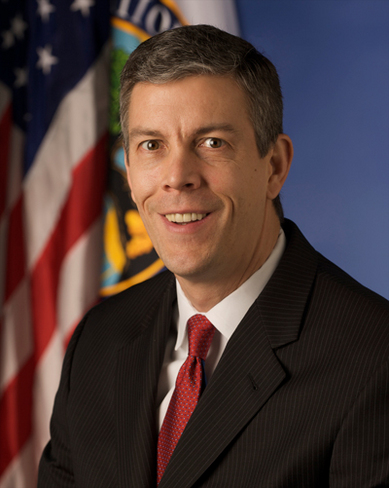
U.S. Secretary of Education Arne Duncan praised the University of Michigan School of Education today for being a national model by “reinventing” how education is taught in college.
“The model you guys are continuing to establish and adjust here has extraordinary national implications,” Duncan said at a panel discussion on Thursday at the School of Education.
Five years ago, the school began changing its curriculum to include more practical applications and field training, and it reduced emphasis on book reading, an overhaul that Duncan says more universities should model.
“We decided teacher education consisted too much of reading about schools,” said Deborah Loewenberg Ball, dean of the School of Education. “You can’t learn to teach by reading. The curriculum needed to be much more about practice.”
The panel, which included Duncan, Ball, five professors, a student and Dedrick Martin, superintendent of Ypsilanti Public Schools, discussed the importance of better equipping new teachers and retaining career educators.
Since becoming secretary of education in January 2009, Duncan has criticized universities and colleges throughout the nation for not adequately preparing educators. U-M, he said at the panel discussion, is one of a handful of schools that is trying to break the mold and emphasize hands-on learning.
“Most of these young teachers don’t feel they are prepared going into the classroom,” Duncan said.
“They got a lot of theory of education, a lot of history of education, a lot of philosophy, but not enough of actually teaching kids,” he continued. “They’ve had professors who have, frankly, been out of the classroom too long.”
Duncan said that about 64 percent of recently graduated educators feel that they are unprepared for the demands of teaching and managing a classroom.
“It’s amazing to me how often we’ve done things a certain way for 10, 20 years and we haven’t adjusted,” Duncan said.
But adjustments aren’t always easy to make, Ball said during an interview after the panel discussion. Her staff is creating a blueprint for other universities that are interested to switching to a more action-based curriculum.
“Every program shouldn’t have to come from scratch,” Ball said. “To take five years, that’s a long time.”
Ball said that she wants to further modify the School of Education by creating mid--program exit requirements. If a student can’t pass an assessment repeatedly, they “wont advance to the second stage of the program. They’ll be gone,” she said.
Students shouldn’t ”exit the program until they know these things,” Ball said. “We wouldn’t say ‘Here, have a plane and if you don’t crash too many planes in the next few years, the we’ll give you your pilot's license.”
Ball said she is hopeful the school will adopt exit requirements “within the next few years.”
With the new curriculum, students work with classrooms starting in their first year in the program.
For example, students in the secondary education tract spend their first semester traveling in groups of four to three schools, spending four weeks at a time in both urban and suburban settings. In the second semester, they travel to two schools, including one exurban middle school and one independent school. Starting in the third semester, students have a more typical student teaching experience where they stay at one school throughout the semester.
The school has ongoing relationships with the Ann Arbor and Detroit school districts and the same teachers in those districts repeatedly work with U-M students, Ball said.
Additionally, the new curriculum includes role-playing to help students with classroom management.
During the discussion, panelists called for a more cohesive approach to teaching educators, saying that standards for educators and students should be level throughout the nation.
“Teacher education should be more systemic, less fragmented and more intensive,” said David K. Cohen, a professor with the schools of education and public policy.
Duncan also said that teacher salaries need a substantial boost to make teaching a desirable profession among college students. He said that starting salaries need to be doubled and that career teachers should make between $130,000 and $140,000 annually.
“The value proposition that were offering to this next generation just doesn’t work,” Duncan said.
Kellie Woodhouse covers higher education for AnnArbor.com. Reach her at kelliewoodhouse@annarbor.com or 734-623-4602.
Comments
Educationfirst
Sat, Sep 10, 2011 : 6:02 p.m.
Arne & U of M both dissed EMU, unfortunate for several reasons. The Chicago schools now offer a year-long grad program to teach classroom management. I don't know if Arne had a role in this, but U of M teaches precious little classroom management. It does offer lots of critical review of student teachers' videotaped teaching, but there is little brilliance or inspired teaching for the students to model, & their exposure to excellent teaching & schools of excellence via readings or videos is minimal. The program is not innovative, sad to say. However, prospective teachers are not from the bottom of their classes; this is inaccurate, & the skills required of a good teacher encompass far more than sheer brain power. For an intro to U of M's Schl. of Ed, watch a video of Deborah L. Ball teaching math.
asdf
Sat, Sep 10, 2011 : 2:48 p.m.
The problem with our teachers is that they come from the bottom of our college classes. Want better teachers? Pay them more so that there is and incentive to become a teacher. As a college student with many recent graduate friends, I can say that my only teacher friends have become teachers as a last resort. Some still teach because they set out to do that, but that is often not the case.
Educationfirst
Sat, Sep 10, 2011 : 6:06 p.m.
It's sad that your friends are choosing teaching as a last resort - sad for them & mostly for their students. Also have skewed your perception of teachers. They are not bottom feeders. Iwish your friends well & hope they find something good for themselves & for others.
KeepingItReal
Fri, Sep 9, 2011 : 1:44 p.m.
I attended the panel discussion yesterday and was very disappointed that Eastern Michigan University was not the chosen site for this part of his tour. Duncan declared that "The model you guys are continuing to establish here has extraordinary national implications," made me chuckle. EMU has a long history of being at the forefront of developing teachers and is known all over the world for this distinguish accomplishment. UM school of education is primarily known for its theory and research approach and it came through loud and clear in each of the panel members presentation. There was only one panel member whom I felt offered something useful. I think the panel would have been better served if there has been students and parents involved. OF cou8rse this may have distracted from UM "extraordinary national implications," approach and injected too much reality.
Educationfirst
Sat, Sep 10, 2011 : 6:08 p.m.
Thank you for your informative & thoughtful comments. Sounds like it was politics as usual. How sad.
pseudo
Fri, Sep 9, 2011 : 1:12 a.m.
For me, this guy is the single most disappointing guy in the administration. Unlike the much maligned healthcare(insurance) and stimulus plans, the data doesn't actually support this guys whatever it is plan(s)-ish whatever it is. Yabber Yabber Yabber no help, no help, no help. no results, no results, no results. Everyone, even Ypsilanti schools, can point to anecdotal successes, this guy is the king of that. But changing schooling in this country as a whole? no results. zip, nadda.
Educationfirst
Sat, Sep 10, 2011 : 6:13 p.m.
At least he started Race to the Top. The race was unfair but did promote excellence, which is more than any previous Sec of Ed has done. I agree with you, however, that he is way too political & WAY too often says "We need to" in response to thoughtful questions. I tell him. Think he listens? : )
Michigan Man
Fri, Sep 9, 2011 : 1:11 a.m.
Be careful with this man. He is the former Superintendent of the Chicago public school system - one of the weakest public school systems in the nation. With the new mayor of Chicago - things in the public schools may finally be changing for the better - just this week schools = not union leadership - are singing on to a longer school day by 90 minutes to focus on math, science and languages. Duncan in his years of running the Chicago public school system was nowhere close to conceptualizing or activating meaningful and positive changes here in Chicago. Duncan is really just a Harvard basketball playing buddy of Obama - Don't let the platitudes of Duncan fool you - Chicago public schools, under his leadership, as I recall lead the nation in violent deaths of children trying to attend public schools but gang/drug types would ambush these fine children in and around the Chicago public schools. Finally, Chicago was also behind the times, ,during the Duncan era, relative to access to charters schools and any meaningful voucher system allowing public school children to select a more valuable educational experience. Duncans leadership of the Chicago system was just very average, at best.
Bogie
Thu, Sep 8, 2011 : 8:57 p.m.
Teach them how to paddle, and let them do it, if you truly want to fix the educational system in this country. I'm a small government guy, but I truly feel bad for today's teachers. Also, I am embarassed for the parenting my generation has shown (You know, "your just picking on my kid. you just don't like my kid. My kid would never do something like that. My kid is going to be a star, pro athlete, etc.")
Educationfirst
Sat, Sep 10, 2011 : 6:37 p.m.
You're so right! Unsure which generation you're from, but I'm a senior & truly embarrassed by the "leaders, movers & shakers" of my generation, who havecall but destroyed us. It's hard for teachers to win in this "anti" environment, though with good principals they do manage. From a former teacher & the parent of a new teacher.