

Valiant Partners proposes reduced-size conference center in downtown Ann Arbor, report shows
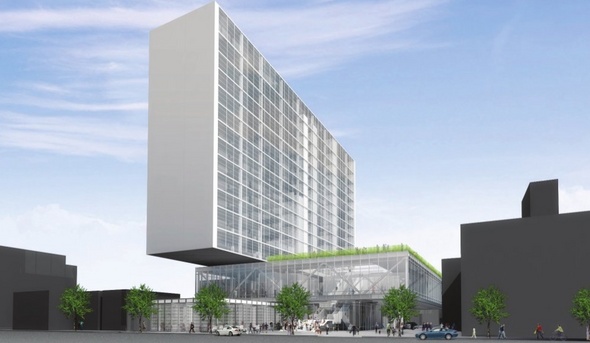
New York-based Valiant Partners' proposal for a hotel and conference center in downtown Ann Arbor has risen to the top in the city's review process and now awaits further evaluation by city leaders. The firm is promising to assume all financial risk on the project, but has scaled back the size of the conference center from 32,000 to 26,000 square feet.
Ryan J. Stanton | AnnArbor.com
New York-based Valiant Partners is proposing a reduced-size conference center in downtown Ann Arbor with one to two floors of additional commercial office space — designed to strengthen the viability of the project and rid the city of any financial risk.
Those revisions are outlined in a new report by the Detroit-based Roxbury Group, a consultant hired by the city of Ann Arbor to assess two competing development proposals from Valiant Partners and Acquest Realty Advisors of Bloomfield Hills.
The outcome of the consultant's study was announced Wednesday afternoon at a meeting of the Ann Arbor Downtown Development Authority.
AnnArbor.com has since analyzed the 30-page report, which concludes the Valiant proposal is "clearly preferable from a financial perspective." But it appears more evaluation is needed before anyone can say a hotel and conference center would be viable.
A year ago, Valiant and Acquest both proposed building a hotel on the city-owned Library Lot site on South Fifth Avenue, atop an underground parking structure being built by the DDA.
Both firms also asked the city to make a financial commitment to fund a conference center that would drive the success of the hotel. Valiant's plan included the conference center onsite, while Acquest asked the city to separately build a conference center across the street.
City officials expressed concerns early on about putting the city at risk financially, but Valiant now says it's promising a risk-free deal to the city.
"To ensure that this is the case, Valiant has offered to guarantee the amount of financing necessary so that any shortfall is covered by the developer, not the city," the Roxbury Group's report states. "Additionally, under the revised proposal, the excess ground rent plus the taxes generated by the residential units total roughly $275,000, more than double the original offer."
More simply put, the revisions to Valiant's proposal would increase the annual net cash flow to the city's general fund from $128,784 to $273,731, the consultant's report shows.
Valiant has scaled back the proposed size of the conference center from 32,000 to 26,000 square feet and has eliminated a rooftop public open space feature. It also has reduced the number of condominium units in the mixed-use project from 12 to 6.
Valiant still is expecting to build a 150-room hotel and says the conference center would offer banquet seating for up to 500 people. The project also would offer 48,000 square feet of office space, a 5,000-square-foot restaurant and 6,000-square-foot public plaza.
In all, there would be about 178,000 square feet of new development contained within a maximum height limit of 180 feet.
Instead of asking for $8.1 million in bonds backed by the city, Valiant now is counting on borrowing $6.9 million in the form of tax-exempt revenue bonds issued by the Economic Development Corp., which would be paid back over 30 years.
Roxbury is advising the city's Library Lot advisory committee to provide a "conditional selection" of Valiant's proposal and have the city enter into of a letter of intent with Valiant, setting forth specific terms of financing with a timeline for closing and construction.
Mayor John Hieftje said a lot of details still need to be worked out and there's "a long time to go" before it might arrive on the City Council's agenda. But he called it significant that Valiant is proposing not to seek any public money for the project.
"That's the most important thing that came out of this," Hieftje said. "I know myself, along with other members of council, quite some time back said we don't want to put the city at any financial risk for this. It's not a time to be putting the city at any risk for private ventures."
Roxbury notes upfront its report is "not intended to serve as a feasibility study for the concepts included in the two proposals." Rather, the consultant went into the evaluation with the assumption that both proposals are valid from a market and demand standpoint.
The report still states "both groups bring substantial wherewithal and access to financing based upon their past project experience" and "both present a credible case for having the ability to obtain financing for projects of the scale being proposed." However, the report also found both proposals raise issues of market feasibility.
"Both suggest the addition of a full-service hotel to the downtown, which while anecdotal market evidence would suggest is needed to meet current demand, will require further definition as to pricing, scale and offerings before any final transaction were to occur," it states. "Further, the Valiant proposal suggests other uses that may not be fully supported by current market demand, such as luxury condominiums and up to 48,000 square feet of Class A office space."
However, Roxbury concluded: "Valiant appears to have presented a mixed-use proposal that is inherently more capable of reinforcing its own uses to achieve greater viability, and remains flexible enough to adjust to market conditions."
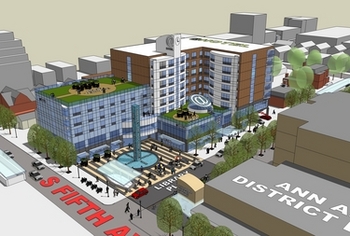
The Acquest proposal for a hotel on the Library Lot, with a city-financed conference center across the street, didn't provide enough specifics in terms of how it would be financed, according to a consultant's report.
The consultant found Valiant's revised proposal "represents a credible and comprehensive approach," which, on its face, "puts all real financial risk associated with the transaction on the developer’s shoulders, and essentially provides a path for privately financing the development without the need for government subsidy beyond the normally available entitlements."
But the report states "much additional due diligence" needs to be undertaken to ensure that the finance structure actually can work.
Acquest lost points in the consultant's evaluation for lacking specifics on how it would finance its project, relying instead on its track record of financing other similar projects. As such, the consultant found it "impossible at this phase to assess the degree to which the Acquest project can be financed." But it appears it would involve a financial commitment from the city.
Valiant, on the other hand, has provided a "very specific proposal for the financing of its project," according to the consultant. The report said the Valiant proposal is "far more compelling and significantly more responsive to the RFP, as well as to goals articulated in the stakeholder interviews, the A2D2 Initiative and the Downtown Plan."
While the consultant's report appears to suggest the Valiant proposal could be viable, much of the evidence presented is anecdotal and based on interviews with community leaders who already support the concept and data provided by the DDA itself.
A large portion of the Roxbury report is little more than a regurgitation of the options of leaders of the Ann Arbor District Library, Ann Arbor Area Convention & Visitors Bureau, Ann Arbor SPARK, the University of Michigan, and the Ann Arbor/Ypsilanti Regional Chamber of Commerce. The general consensus from those interviewed is there is a need for a conference center in downtown Ann Arbor to accommodate unmet needs.
For example, while U-M and two downtown hotels offer meeting rooms and banquet facilities that can be used to accommodate conferences, not a single facility in downtown Ann Arbor can both house and meet the conference needs of groups larger than 350.
"There is broad consensus around the proposition that a facility which can accommodate a minimum sit-down banquet capacity of 500 people would satisfy needs that are currently unattainable on either the university campus or elsewhere within Ann Arbor," the report states. "Some suggest, however, that given the availability of the Eagle Crest Marriott in Ypsilanti, which can accommodate 500, only a facility that could accommodate up to 650 would be seen as a ‘game changer’ within the market."
The report compares Ann Arbor to seven other medium-sized college towns throughout the United States, including Athens, Ga., Berkeley, Calif., Boulder, Colo., Columbia, S.C., Fort Collins, Colo., Madison, Wis., and Champaign-Urbana, Ill.
It found Ann Arbor has the highest hotel occupancy rate, but ranks 5 out of 8 in number of hotel rooms downtown. It also found Ann Arbor ranks 4 out of 8 in terms of total meeting space in the city, but it ranks at the bottom in terms of meeting space available downtown.
The largest meeting space in Ann Arbor — 6,325 square feet at the Michigan Union — is significantly smaller than the largest meeting space in any of the other comparable cities.
Based on several reports and interviews with community leaders, the consultant concluded Ann Arbor has a strong hotel market — one that is underserved in its downtown. "Ann Arbor is already a popular destination for visitors and conferences and will become an even greater draw given the trend to travel to smaller, less expensive venues," the report states.
"By establishing a 'game-changing' conference center as its central project element, Valiant has identified the more compelling project for the site," the report found. "Acquest itself recognizes the need for a conference center, but does not actually propose to develop one."
DDA board member John Splitt is one of five members of the Library Lot advisory committee, which also includes City Council Members Stephen Rapundalo and Margie Teall, Planning Commissioner Eric Mahler and Park Advisory Commissioner Sam Offen. Splitt said the committee still is expecting more financial data from the consultant.
"This needs to be talked about further. The proposal needs to be refined, but they removed the city being the holder of the bond for the conference center portion of the project," Splitt said. "If this goes forward and a letter of intent is signed, there's much more negotiating to truly define what it is they're proposing and how it will be financed, and that has further to go."
Ryan J. Stanton covers government and politics for AnnArbor.com. Reach him at ryanstanton@annarbor.com or 734-623-2529.
Comments
15crown00
Sat, Feb 26, 2011 : 12:48 a.m.
nut bags that's what these clowns are.expel them from the city never to return.
uabchris
Sun, Dec 12, 2010 : 8:33 a.m.
Ok build it, but please, please, please change the hideous design!
Chris
Tue, Dec 7, 2010 : 9:22 p.m.
A couple things come to mind. Firstly, the design is silly. It looks like something I came up with using Legos as a kid. It's way out of character for the city of Ann Arbor. I have reservations about building up in downtown if there is not a corresponding effort to increase capacity of thruways. I don't want to sit in snarled traffic any more than I already do. As long as cars are in use, we might as well keep them moving. Why not upgrade the BTC?
Joel Batterman
Sun, Dec 5, 2010 : 12:01 p.m.
I'd like to reiterate the usefulness of the article Glacialerratic cited, and in particular this concluding quote: "Ultimately, convention centers are an example of the tail wagging the dog: If cities had pleasant, vibrant, appealing neighborhoods of the sort that create their own economies and draw visitors they wouldnt need contrived assembly spaces in the first place." Ann Arbor and the University might be able to use some more conference and hotel space downtown. Like TrueNorth, I'd certainly prefer if more of our spaces weren't located in sprawling, out-of-the-way locations, like Eagle Crest. But that's still not a convincing argument for a hotel and conference center at this site. As other comments have noted, this location just doesn't seem right. If any place in Ann Arbor is right for a "townie" gathering place (or a new fountain), it's this one, right by the transit center, post office, and library. Moreover, the Library Lot space doesn't appear large enough for a conference center of the kind envisioned. The report states that Acquest chose to limit its proposal to a hotel because of that very fact. Public discussion of all this really should have happened before the underground garage got approved. The garage structure is designed to support a structure on top, which adds to the expense, though I don't believe it was necessary in the first place.
say it plain
Sun, Dec 5, 2010 : 11:12 a.m.
That's a very good point @Maple, and one I'd wondered about forever. What do the library board folks think of this? I don't use the downtown branch very often, but it seems to me to be a potential downer in a big way for people who'd like to make use of that as a *community* resource. Oh well, people who live near the downtown can drive to the pittsfield branch instead lol! And please, make that design go away, it's truly anxiety-inducing and dizzyingly nauseating. I won't venture near it!
Maple
Sat, Dec 4, 2010 : 8:10 a.m.
Has anyone even considered the un-desirability of locating a business such as this next door to a PUBLIC LIBRARY, which is an institution designed to serve the residents of the community, while a hotel and conference center is aimed at people from outside the community. It just doesn't seem to be a good "fit" (i.e., what is immediately next door to the library and sharing its parking lot should also be community-oriented) as well as makes one wonder if there might be any potential safety or other risks due to out-of-towners occupying that building and parking structure-- and I mean everything from confused out-of-town drivers hitting pedestrians to criminal activity.
Mick52
Fri, Dec 3, 2010 : 9:17 p.m.
I am on the fence on this one but I hope everything is being done to make sure this will not go the way the proposed development on the old Y lot did. Another thing to consider is that on football Saturdays the hotel will be full being the closest to the stadium. Would that income alone make this a profitable venture? Maybe it would be a better spot for a park. Nice and green in the summer and an ice rink in the winter.
Mike S
Fri, Dec 3, 2010 : 5:57 p.m.
Yuck, please, not a generic conference center. Id like to see a park with restaurants on one side where you could eat outdoors WITHOUT cars going by*. A friend mentioned an outdoor skating rink, which could also bring some chilled clientele in for hot food during winter. Some people think we have enough restaurants, but we dont have many with really nice outdoor seating. Dominicks comes to mind as one of the better places to eat outdoors, mainly because of the fenced in seating in the back. * Personally Im for turning Main St. into a greenway (like that will happen).
Gill
Fri, Dec 3, 2010 : 3:42 p.m.
If we want people downtown 24/7 due to this project, and for it to make a profit, then put a casino here. The casino would probably be willing to put in a large conference/theater center (gotta have music/comedy/etc shows) AND put a magical park on top of the building with fountains and unicorns.
leaguebus
Fri, Dec 3, 2010 : 10:55 a.m.
All I have to say is the city's winter street maintenance outside of downtown is a joke, the city does not collect XMas trees, no more leaf collection, and they are even thinking of doing this project? After Veracity's quick analysis of the finances, it appears this is another Talley Hall. Obviously the developers figure on making some money early in the process and then when it goes down the drain, they can walk away with their shirts and the city inherits the mess. I would advise the city to pay more attention to the little guys who see their services eroding and stop paying so much attention to the downtown big money guys. The next election is not far away.
a2scio
Fri, Dec 3, 2010 : 10:35 a.m.
1. We need the parking for people coming downtown to shop, eat, go to shows/movies. A big hotel and conference center will gobble up most of the parking in the underground lot. For this reason alone, I VOTE NO ON THE IDEA. 2. Just because we RANK low on conference space, does not mean that we need a bigger conference space. 3. How about putting up downtown housing, including many affordable units instead?
Will
Fri, Dec 3, 2010 : 12:46 a.m.
There is another, exciting proposal for this site: a central urban park. A citizens group has developed this idea for a "community commons" on the former library lot. There is a half hour presentation currently running on the Community Television Network (channel 17). The two remaining showings are Friday December 3rd, at 10:30 AM, and Monday, December 6, at 2 PM. To learn more about the Ann Arbor Community Commons project send correspondence to: a2communitycommons@gmail.com
Dog Guy
Thu, Dec 2, 2010 : 11:14 p.m.
Well, johnnya2, this naysayer would have the city fill in the muggatorium hole and repave the parking lot next to the library. If a conference center is built, they will not come. Eventually, the story will be told of who benefitted and how and history will certainly reveal this as Ann Arbor's most corrupt political era.
johnnya2
Thu, Dec 2, 2010 : 9:17 p.m.
1. What would all the naysayers have the city do with the area? City density is a goal and should be maintained. Having more activity downtown is preferable to the city than the hotels and shopping areas which go to Pittsfield Twp. 2. How this effects Eagle Crest should NOT be a concern. There is no benefit to the city from this hotel. 3. For those who want to whine about the old Hilton which was supposed to be a convention center. They didn't build the center, so how can you compare the two. I'd also suggest you look at what year that was. Things change. 4. The design is a CONCEPT. It will not be the final approved design. All projects come up with an off the wall idea and then before it is completed things are changed. 5. The Sheraton can not handle the size events. Having held events there in the past, we have since moved our events to the Rock Financial Center. This is projected to be about a tenth that size, but could easily handle many conferences, conventions and trade shows that a typical hotel can not.
bhall
Thu, Dec 2, 2010 : 8:52 p.m.
Do we need regulatory design standards in this city?
a2grateful
Thu, Dec 2, 2010 : 8:18 p.m.
Have I read this correctly? The City is considering this magnitude of expense and fiduciary risk for $273,731 per year? What? It's the type of scenario that makes the bleak midwinter seem warm and bright. What the heck are they thinking?
glacialerratic
Thu, Dec 2, 2010 : 8:08 p.m.
Bother--I posted this to the previous story before realizing there had been an update. The consultant's report is not a feasibility study. It relies on interviews with only 6 "stakeholders," which is a curious notion since Ann Arbor residents would be the primary stakeholders. I recommend a look at a thought-provoking piece about the far-reaching and questionable economic, social and architectural impact of convention centers that appeared last summer in Next American City's online magazine: http://americancity.org/magazine/article/unconventional-thinking/
Craig Lounsbury
Thu, Dec 2, 2010 : 8:02 p.m.
DeeDee@ "This is a hideous design,..." Too funny, those were almost the exact words that came to my mind when I saw the picture. I thought "that" instead of "this". The rest was verbatim. I scrolled down to the comment section wondering if anyone else thought the same thing.
Soothslayer
Thu, Dec 2, 2010 : 6:01 p.m.
Four Points Sheraton has great facilities and is right by the freeway to jump to the airport and the mall. There are downtown shuttles all the time. Whats the deal here, where's this study that shows Ann Arbor "NEEDS" a conference center which simply won't take business from the surrounding facilities? Sounds like the DDA simply has too much money to throw around. Time to absorb the DDA wholly by the City as a revenue source to balance the budget and stop throwing away funds for expensive parking holes and the like.
HBA
Thu, Dec 2, 2010 : 5:56 p.m.
We are unalterably opposed to this project. It is not needed; it is aesthetically extremely displeasing and we can envision a situation such as currently exists on Broadway. We urge everyone to contact their Councilpersons and demand that this proposed plan be subjected to a referendum before any decision is made. We would venture to guess that an overwhelming majority would be in opposition. Furthermore, has anyone investigated the Roxbury Group and ascertained their interest in this project?
Snarf Oscar Boondoggle
Thu, Dec 2, 2010 : 5:52 p.m.
i;ll be damnmnmnmned before i woeld permit a capitalistic enterprise (private business) to shovel a risk-burden onto taxzpayers that they themselves refuse to take!... oh, btw, has zanyone done an a2 occupancy survey covering at least the last five years? i;ll bet the developer has! further, what part of gotomeeting.com blinds council from lookiing into the future?
a2miguy
Thu, Dec 2, 2010 : 5:37 p.m.
This is the ugliest thing since ugly became a word.
Veracity
Thu, Dec 2, 2010 : 5:21 p.m.
The Roxbury Group did not actually do a feasibility study to justify building a hotel/conference center, even though that was the primary objective for their being hired... and paid. Such a study should include contacting potential organizations who could be clients in the future and determining what their needs would be for having conferences in Ann Arbor. Meanwhile, while awaiting real feasibility evaluation, the operational revenues and expenses for the Valiant Partners proposal can be estimated as follows: Assume that Valiant Partners will borrow $54 million dollars for 20 years at an interest rate of 6% yearly. The yearly interest cost will be $3,240,000. In addition Valiant Partners must have a sinking fund to pay off the entire loan after 20 years which will cost $2,700,000 on average annually. The combined annual cost of the loan totals $5,940,000. In order to meet financing costs, Valiant Partners will have to charge $104.32 per night for each of the 156 hotel rooms and only if every room is booked daily throughout the year. To be more realistic, with present hotel occupancy rates of 60%, Valiant Partners will have to charge $173.86 per night in order to cover financing costs. Income from renting the 53,000 square feet of commercial space (including the 5,000 square feet for the restaurant) at an average $25 per square foot (high end of Ann Arbor commercial space rental rate) will generate $1,325,000. Applying this money to reduce the cost of room rental results in a reduction of $23 per room per day. Thus, with a 60% occupancy rate, the daily room charge will be $150 per night. Of course, this calculation assumes that all the commercial space will be leased and at the stated rate per square foot. But, actually, Valiant Partners must charge even more in order to cover costs of hotel staff salaries, utility costs, insurance costs, and hotel upkeep and maintenance costs. Valiant Partners will most likely have to charge MORE THAN $200 per night for each room just to meet total costs. In order to pay taxes to the City and make a profit, the developers will have to charge considerably more. Will hotel room rates over $200 per night be competitive in the Ann Arbor hotel market? Will conferences want to book rooms at such high costs? Of course this analysis does not include monetary contribution from use of the conference center. I have no idea often the conference center will be booked each year. The best scenario will probably have the conference center leased for 3 or 4 days weekly. If each conference were booked for $10,000 and that money used to diminish the cost of hotel room rental rates, each night's rental rate would only be reduced by $8.78 per night, an inconsequential amount. If my assumptions and calculations are correct, the Valiant Partners proposed hotel/conference center will not be commercially viable. The project will become insolvent within the first year of operation. When efforts to sell the property fail, the city will acquire the white elephant and incur basic maintenance and utility costs in order to prevent deterioration. In the end, tax payers will incur expenses related to the Valiant Partners project and have another blight downtown. As the analysis applies to any similar hotel/conference center concept, City Council should terminate any consideration for such construction over the library parking lot or anywhere else in Ann Arbor.
JoeNuke
Thu, Dec 2, 2010 : 4:25 p.m.
While this seems like a plausible project, additional information would be useful. For example, how successful is Eagle Crest Marriott in Ypsilanti? Is it turning away bookings? Would a conference center in downtown Ann Arbor siphon demand from Eagle Crest such that it loses viability? I believe the downtown location is very desirable for attracting conferences, but the potential impact on Eagle Crest should also be considered.
leaguebus
Thu, Dec 2, 2010 : 4:14 p.m.
I am a little fuzzy, we give them the top of a parking structure and x amount of spaces inside and Ann Arbor is not monetarily involved in the deal? Looks like we have $59 M in the deal already. Are the developers going to reimburse us for the space above the structure and the parking spaces they will need to run the hotel? Doesn't sound like it.
Bertha Venation
Thu, Dec 2, 2010 : 4:02 p.m.
Oh... I see... so in addition to having to pay high taxes for the privilege of bagging our own leaves, we also have the great opportunity to fund a conference center that will not be fully utilized and sold to U/M, so we can pay additional property tax on THAT! GREAT going, City Council and Mr. Mayor! 'NOT" Still Sux. It's still an ugly building that does not belong in A2.
truenorth
Thu, Dec 2, 2010 : 3:41 p.m.
Completely disagree with a lot of what is being said. I Love the modern design. Love the idea of a boutique hotel. Love that the city is off the bond. This will be great for Ann Arbor. Enough with Urban Sprawl -lets keep as much as possible in the core of downtown.
Elaine F. Owsley
Thu, Dec 2, 2010 : 3:41 p.m.
Not if is has to be that ugly thing. It has no relationship to anything around it or in Ann Arbor, or this galaxy. Didn't AA learn anything from the industrial addition to City Hall?
A2Raven
Thu, Dec 2, 2010 : 3:38 p.m.
I cannot comment on the economic or investment factors involved in this project, but I can say that this is a HIDEOUS design... HIDEOUS.
Kathleen Kosobud
Thu, Dec 2, 2010 : 3:32 p.m.
@DeeDee: I couldn't agree with you more about the aesthetics of the proposed structure. I am still unconvinced that a conference center and hotel complex would be profitable in the area proposed. The former Ann Arbor Hilton on Fourth and Huron was originally supposed to become this sort of a facility, never made money, went through several owners, was vacant for several years, and finally became a residence for elderly and disabled people of limited income. The Campus Inn has also had its struggles to maintain solvency. If a conference center is truly needed in the downtown, I have yet to hear projections of the impact on traffic, parking, petty crime, and other unpleasant side-effects of large crowds of visitors in a concentrated area. It may seem that business in the downtown would benefit, but for how long, and at what cost? I'm all for promoting business in Ann Arbor, but a conference center seems to be the last thing a lot of people would like to see at that particular location.
DaLast word
Thu, Dec 2, 2010 : 3:31 p.m.
I say, yes. Build it, don't worry about the cost. We can always turn it into a shelter in 5 years to house our ever increasing homeless population.
Kim Kachadoorian
Thu, Dec 2, 2010 : 3:16 p.m.
This city is "ringed" by conference centers of all shapes and sizes. Each of those conference centers has on-site - free above ground parking and is easily accessible from the highways that also "ring" this city. I wish I could find the article I read once that stated it takes 2-3 owners of a hotel/conference center before it is profitable. In this economy it will probably be more than that.
DeeDee
Thu, Dec 2, 2010 : 3:07 p.m.
This is a hideous design, and there is plenty of risk to the City if the developer starts this project, can't complete, and an ugly and unfinished eyesore occupies this site! How about some creative thinking with the UM about meeting space on the new NCRC facility!!! Maybe the city could get some financial advantage from that, to make up for all the tax losses associated with it going off the tax rolls. Remember, the consultant is being paid to tell them what they want to hear - not what necessarily makes sense, as pointed out in this morning's 5 reasons article.