

Veterans Administration, Haven of Hope House help homeless veterans get back on their feet
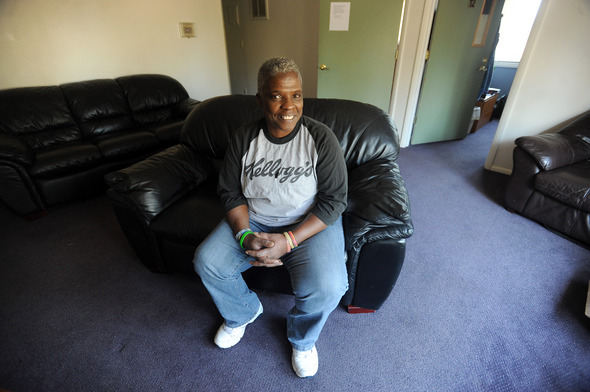
Janet Thurman sits in the common area attached to her room at the Staples Family Center in Ann Arbor. The Veterans Administration's Homeless Veterans Grant Per Diem Program is helping Thurman, who hopes to land a job in culinary arts.
Angela J. Cesere | AnnArbor.com
Former chef Janet Thurman knows finding a job can be a job in itself.
She posted her resume online through
But finding a job isn't her only challenge.
Thurman, a U.S. Army veteran who served from 1976 to 1981, is homeless.
After some help from the Veterans Administration and four months on a waiting list, Thurman said a bed became available at the TSA Staples Family Center in Ann Arbor.
"As a veteran, I have the option of staying for two years (at the Staples Family Center). That's a big help," she said. "But I don't want to stay there for two years, I don't want to stay anywhere for two years except my own place."
There are an estimated 107,000 homeless veterans in the United States on any given night, said Michael Smith, interim director of the Washtenaw County Department of Veterans Affairs. And about 56 percent of all homeless veterans are black or Hispanic, despite only accounting for 12.8 percent and 15.4 percent of the U.S. population, respectively.
Thurman is one of 11 veterans in the Veterans Administration Healthcare for Homeless Veterans Grant Per Diem Program. It helps homeless veterans get the services they need, including finding temporary housing. She's one of four veterans in the program living at the Staples Family Center.
The other seven veterans in the program are living at Veterans Haven of Hope House — a semi-independent, temporary housing arrangement for male veterans.
Ann Arbor's Haven of Hope House on Henry Street has been home to dozens of veterans while they work to find sustainable income, continue their education and find a home of their own.
Jennifer Brown, house case manager, said the program has helped about 70 homeless veterans since its inception in about 2004 and is "driven by ambition."
"(It's for) people that are really looking to be productive, to get ahead," she said.
Owned and operated by the Salvation Army of Washtenaw County, the Haven of Hope House is currently at capacity. Women veterans in the program, such as Thurman, or veterans with spouses or children are housed at the Staples Family Center, Brown said.
Haven of Hope House residents are referred by the Veterans Administration, Brown said, and must be homeless veterans who have not abused drugs or alcohol for at least a few months and are healthy enough to live semi-independently. She said all potential residents also must undergo a criminal background check.
Brown estimated the median age of the veterans currently living in the house to be about 37. As with the Staples Family Center, veterans can stay at Haven of Hope House for as long as two years.
Chuck Denton moved into Haven of Hope House in the spring. He is now attending Washtenaw Community College full time and aspires to find work as a photojournalist.
Denton, who served in the U.S. Army from 1974 to 1975, has not had a place to call his own in about three years. Before moving into the house he stayed at homeless shelters or with family members.
He said being laid off from a 20-year career in electronic manufacturing, getting divorced and suffering from anxiety were all precursors to his becoming homeless.
Denton says he likes to stay busy — he is enrolled in 17 credits at WCC — and is "turning a lemon into lemonade" by fully taking advantage of his time at the house.
"I'm really grateful that I got to be part of the program," he said. "Not everyone has that luxury."
He added, "I would be in worse shape without it. Once you're at the homeless level without a family or friends to bail you out, it's almost impossible to get back on your feet unless you trip over a bag of money."
In an effort to find people like Denton, Brown said an outreach worker visits places where homeless people tend to congregate in the Ann Arbor area and seeks out homeless veterans who may need medical treatment or assistance finding housing.
Haven of Hope House is often the last in a series of steps before veterans achieve independent living and may be preceded by "intensive treatment" programs through the VA, Brown said.
Each resident in the three-story home has his own furnished bedroom, and residents share the common spaces, which includes two bathrooms and a kitchen equipped with stainless steel appliances, Brown said. There's also a "computer nook" with two desktop computers.
The residents don't pay rent, but are expected to be productive, fulfill individual household responsibilities and buy their own food and personal items. Commonly used household items and any maintenance to the house are provided by the Salvation Army.
"Part of their responsibility is to obtain a stable income. That might be finding a sustainable job, it might mean working on getting their social security disability, or veteran's disability or pension," Brown said. "We also use our resources within the community, for example, some of our vets, I refer to Michigan Rehabilitation Services, some of them go to Michigan Works."
Brown said the program, which nearly always runs at capacity, has a number of success stories.
"People have really taken advantage of this opportunity" to save money, buy a car, attend school, and find independent housing, she said.
Brown said Haven of Hope House is one of numerous housing arrangements in which homeless veterans are placed by the Veterans Administration, but it's the only place of its kind in Ann Arbor. She said similar facilities exist in Toledo.
Brown encouraged veterans who are homeless to go to the Veterans Administration, 2215 Fuller Road, or the Delonis Center, 312 W. Huron St.
"There is help available," Brown said. "They should not have to live in unsuitable environments or suffer cold or hunger because they don't know what to do or they're afraid."
Thurman, who moved to Ann Arbor from Ferndale, said she was drawn to the area, in part, because of its lively culinary scene. She's looking into continuing her education and said she hopes to earn a bachelor's degree in culinary arts management.
Thurman said she's grateful to the Veterans Administration and the Staples Family Center for giving her a second chance. And despite the challenges she faces, Thurman remains optimistic.
"Attitude is what really determines ... you will be able to reach your goal," she said. "I'm not taking anything for granted today. I'm focusing on the moment."
- Find more information and resources for homeless veterans, including a map of VA locations across the country.
- Find resources for veterans in Michigan, including information on veteran benefits and job placement for veterans.
- Homeless veterans, or veterans who are in danger of becoming homeless, are encouraged to call the free, 24-7 National Call Center for Homeless Veterans at (877) 4AID-VET, or (877) 424-3838 to speak with a trained counselor.
Heather Lockwood is a reporter for AnnArbor.com. Reach her at heatherlockwood@annarbor.com or follow her on Twitter.