

In Washtenaw County, 43% of roads are in poor condition
Washtenaw County's roads are in poor condition, as anyone who drives or inspects them can attest.
And a new report issued today shows just how bad.
Washtenaw County was fourth in the state for miles of poor roads at 977 miles with a poor rating. Among Michigan counties, it was 14th in overall percentage of poor roads at 43% of its total 5,773 miles of federal aid roads.
Ann Arbor ranked third out of nearly 1,800 municipalities in the state with 189 miles in poor condition. Overall, 55% of Ann Arbor's 342 miles of federal-aid qualified roads were deemed poor, the report shows.
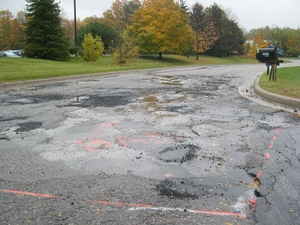
More roads in Washtenaw County are in poor condition, leading some to pay for road repairs themselves. Dan Meisler | For AnnArbor.com
Eric Bombery, associate transportation planner for the Washtenaw Area Transportation Study, said he isn't surprised at the findings. And while he said it's no secret the county's roads are generally in bad condition, he cautioned against focusing on the ranking of 4th worst in the state based on total poor miles - simply because Washtenaw County has more miles of roads than most other counties.
"It's what we expected," he said of the rankings. "We have poor roads, and they continue to get worse."
Bombery said the state process that led to today's report is used to identify roads in good and fair condition so municipalities can focus on fixing those before they become poor. Maintaining a fair road is much less costly than rebuilding a poor road, he said.
But finding the money to repair any roads in Washtenaw County has become a challenge.
A report discussed in September showed a list of nearly 800 deficiencies representing an estimated $1.6 billion worth of unfunded transportation needs. Officials said the region's transportation system is large and complex with many needs - $2.8 billion per year - but right now, there's only $1.4 billion per year in identified funding.
The Washtenaw County Road Commission, meanwhile, has made $1.4 million in cuts. Some of the cuts going into effect include reductions in street sweeping and snow removal services on nights and weekends, more limited sign maintenance and less pavement marking on local roads.
That lack of funding for road improvements has led some individuals and groups to take matters into their own hands. Over the past year, the Washtenaw County Road Commission has seen its first two privately funded road repair projects.
According to the report released today, the only counties with more miles of poor roads are Wayne County (1,841 road miles), Oakland County (1,292 road miles) and Genesee County (1,216 miles of poor roads).
In Washtenaw County, municipalities with the most miles of poor roads:
- Ann Arbor: 189 (55% of overall roads).
- Ypsilanti Township: 75 (31% of overall roads).
- Pittsfield Township: 73 (42% of overall roads).
- Lima Township: 50 (56% of overall roads).
- Ypsilanti: 45 (52% of overall roads).
"Our legislative leaders need to stop 'watching' the funding problem evolve into a crisis and take appropriate action to correct it," Mike Nystrom, vice president of government and public relations for the Michigan Infrastructure and Transportation Association and co-chair of the Michigan Transportation Team, said in a statement. "This isn't a case of road agencies not doing their jobs. Michigan's local road systems are collapsing because funding continues to plummet."
The report rated each road on a scale of 1-10, with 1 being the worst. It analyzed the municipalities with the most roads rating a 4 or lower.
The Washtenaw Area Transportation Study provided AnnArbor.com with a breakdown today of a study of federal aid eligible roads in Ann Arbor (not the entire system): (The PASER ratings are 1-10, with 10 being the best.)Â
- 1.485 miles
- 6.112 miles
- 8.473 miles
- 11.762 miles
- 10.766 miles
- 13.808 miles
- 27.890 miles
- 21.200 miles
- 9.910 miles
- 0.000 miles
Ann Arbor officials cautioned against the Paser ratings, which they say are a flawed measurement of road conditions. Last year, when the city was ranked 2nd worst, city staff looked at those ratings and found 32 miles in the report are state trunk lines and not under the city's jurisdiction, and the rating system is subjective.
"The resulting numbers are highly variable, and there is significant inconsistency with this method as evidenced by the PASER ratings themselves," the city's report said. "For example, while the 2007 ratings rank the City '2nd worst,' the recently published 2008 PASER ratings would rank us among the 'best' municipalities in the state with only 16% of the roads considered in poor condition."
Counties with the most miles of roads rated in poor condition:Â
- Wayne - 1,841 miles (26% of total roads)
- Oakland - 1,292 miles (25% of total roads)
- Genesee - 1,216 miles (45% of total roads)
- Washtenaw - 977 miles (43% of total roads)
- Calhoun - 932 miles (51% of total roads)
- Kent - 805 miles (23% of total roads)
- Macomb - 753 miles (26% of total roads)
- St. Clair - 586 miles (36% of total roads)
- Menominee - 550 miles (47% of total roads)
- Oceana - 534 miles (66% of total roads)
- Detroit - 586 miles (20% of total roads)
- Grand Rapids - 200 miles (33% of total roads)
- Ann Arbor - 189 miles (55% of total roads)
- Flint - 165 miles (27% of total roads)
- Livonia - 143 miles (30% of total roads)
- Southfield - 142 miles (34% of total roads)
- Lansing - 136 miles (28% of total roads)
- Sterling Heights - 119 miles (31% of total roads)
- Saginaw - 114 miles (39% of total roads)
- Mt. Morris Township - 114 miles (55% of total roads)
• Read the Michigan Infrastructure and Transportation Association report issued today.
• Read the Michigan Department of Transportation Roads and Bridges Annual Report - 2008
Note: All the rankings and percentages are based on number of "poor" federal aid miles compared to the total number of federal aid miles. The WATS data includes total federal aid miles, while today's report refers to lane miles, which are different.
Comments
Freemind42
Thu, Nov 12, 2009 : 4:19 p.m.
Call me crazy but wouldn't our city's money be better spent on road upkeep, and snow removal than on multimillion dollar city hall remodeling? Oh that's right, the number 1 issue in Ann Arbor is parking, not the fact that the actual roads needed to get to parking areas are crumbling beneath our feet.
Stephen Lange Ranzini
Wed, Nov 11, 2009 : 12:22 p.m.
What the study doesn't talk about is the condition of the roads in Winter. Last year, neither the city nor the county plowed the roads unless there was 4 inches of continuous snowfall. This year, they won't plow until there is 6 inches of continuous snowfall. Unfortunately, I don't own an SUV so I can't get to work if there is more than 3 inches of snow on the ground that isn't plowed as I found out last Winter. It doesn't really matter what the condition of the paving is if I can't get my car up a hill to get to work because it isn't plowed (I don't bicycle to work if it's raining or snowing). I am also told by a knowledgeable insider that Washtenaw County uses the least amount of sand and salt per capital in the Winter of any county in the region. I wonder what we will pay in extra car insurance when the insurance companies figure out that there is such a high accident rate during winter months in Washtenaw County? While the city and county governments "save" money doing this, really it just passes extra costs on to all of us. Not to mention the strong potential for life changing injuries and deaths.
Val Losse
Mon, Nov 9, 2009 : 9:08 p.m.
So where is the gas tax for roads going? I thought, believe, the county receives revenues for the roads. Where is the road money being spent? What is the budget? Why is it a secret?
CycloChemist
Mon, Nov 9, 2009 : 8:08 p.m.
Well, there are some nice, new roads. Yay for that! And when they are resurfaced or rebuilt in town we get great bike lanes and improved pedestrian crossings. Nixon at Plymouth is a great example. Nice work! The bad and deteriorating roads will get attention in time. Meanwhile, I appreciate the ruts and potholes - they slow down too fast driving, which is helpful for me as I usually ride a bicycle in town. A mountain bike, of course! With puncture resistant Kevlar tires! When I drive, I enjoy the bumps in my Jeep Wrangler - almost as much fun on Miller Road as a Jeep Jamboree!
Epengar
Mon, Nov 9, 2009 : 7:44 p.m.
@Ms. Nash, thanks for adding more information, and apologies if I overlooked the proportion right at the start of the article.
logo
Mon, Nov 9, 2009 : 6:50 p.m.
Thanks for the data Dalouie and Ms. Nash. My husband is an engineer who used to work for the state and he talks about how the road building lobby has a stranglehold on the legislature. The studies they sponsor are all about getting more money for themselves. And, as we see, the study is all over the place from year to year. In 2007 A2 had some of the worst roads in the state but in 2008 A2 had some of the better roads in the state and now in 09 they are suddenly among the worst? Crazy. He notes that A2 has a lot of miles of state roads that the city is not responsible for but the state doesn't pay to fix them. That helps to make A2's road look bad in this type of study because the state roads are lumped into the Federal Aid roads stat. The problem in A2 is not the city government; they only get 27% of the property taxes, it is that 40% of the land in the city is non-taxable and the UM just took away another 5% of the city's revenue when they took over Pfizer.
The Grinch
Mon, Nov 9, 2009 : 6:04 p.m.
I am bemused that many of the posters on this article who complain about A2's roads are the same posters at other places in AnnArbor.com who want lower taxes no matter what. Apparently they see no correlation between decreasing tax revenues over the last decade and the increasing number of roads that are falling apart. Nothing like keeping one's head in the sand.
Eric64
Mon, Nov 9, 2009 : 6:04 p.m.
Hey people ask yourselves how the mayor can be a mayor and sit on the d.d.a board to. No wonder he gets what ever he wants. Eric_M.
John Galt
Mon, Nov 9, 2009 : 5:20 p.m.
They need to sell the greenbelt land and use the proceeds to fund road maintenance.
Dalouie
Mon, Nov 9, 2009 : 4:50 p.m.
This just in: In 2007 the Passer ratings brought to you by the road builders lobby said that 60% of the roads in A2 were "poor" and 11% were "excellent" but in 2008 they said 16% were "poor" and 27% were excellent. My point: This study is wacko.
CynicA2
Mon, Nov 9, 2009 : 4:36 p.m.
I hope everyone expressing outrage about the condition of our roads will remember who has been running this town for the past ten years, and what their priorities have been - come next election. How many of your hard-earned tax dollars have come-back to your neighborhood in ANY form - street repairs or otherwise?! Where did they go?!? Take a look around next time you venture downtown... TajMahal city hall, $50 million dollar underground parking boondoggle, solar-powered parking meters (so Ann Arbor - a green way for government to pick your pocket!), retro street lights (like the ones we got rid of about 30 yrs. ago. Lots of YOUR dollars downtown, but try driving down your street without a trip to the repair shop. Maybe it's time we take some of OUR money back from the DDA and put it to work in the neighborhoods, where it belongs.
Dalouie
Mon, Nov 9, 2009 : 4:08 p.m.
Two problems with this. The study is paid for by the road builders lobby. The Passer ratings system is notoriously flawed.
Eric64
Mon, Nov 9, 2009 : 2:49 p.m.
Look People all the current mayor wants to do is bulid new things when the city can't even maintain roads and sidewalks. Have you seen how bad the green road loop is and packard road.What is the city doing about the kroger shopping carts being left all over the city by people who are to lazy to carry their groceries. Come on people there is to much stupidity going on in the city that is being ignored.Face it people the city council and the mayor do not care about the city just their pocket book and not the overall city wide problems that continue to get worse everyday.
KJMClark
Mon, Nov 9, 2009 : 2:45 p.m.
If you knew how road repairs are funded, none of this would be a surprise. First, Michigan is a donor state for gas taxes. That means we pay more in gas taxes than we get back in road funding from the Federal government, even though we have a freeze/thaw cycle that destroys our roads faster than most other states. You can thank Congress for that, but our Senators and Representatives have tried for decades to the funding inequity. Next, road money for Washtenaw County goes through the Washtenaw Area Transportation Study (WATS) as mentioned above, where projects get added to their plans (wish lists). Which projects actually get funded is partially down to the priority that WATS puts on them. This process is repeated regionally, because Washtenaw is now part of SEMCOG for transportation planning. The problem is that large municipalities don't have equal representation on either WATS or SEMCOG. Those bodies are set up like the US Senate; every jurisdiction gets one vote, regardless of how many people are there. You can see the WATS Policy Committee, the main committee, membership here: http://www.miwats.org/WATS/leftside/comm/members/policy.pdf. So Ann Arbor, with over 114,000 people, gets one vote, as does Scio Township, with 16,000, Northfield Township, with 8,000, and Ann Arbor Township, with 5,000. Even Barton Hills had a vote at one point. You can see how this basically works out. Scio Township got its four-lane with grassy median Jackson Road Boulevard funded, and Ann Arbor got Stadium Boulevard rebuilt. See? That's fair, Ann Arbor got one boulevard and Scio Township got one boulevard. It makes perfect sense unless you compare the funding by population or by miles of road. In that case, by population, Ann Arbor should receive seven times the road funding that Scio Township gets. Does it? The Scio Township DDA plan is here: http://www.twp.scio.mi.us/pdfs/ddaplan200609. It shows about $24.8 million on the Jackson Road project from 2006-2009, or four years, or $6.2 million per year, for that one project. There's literature to support the Ann Arbor Road Reconstruction Millage renewal in 2006 here: http://www.ci.ann-arbor.mi.us/government/publicservices/project_management/Documents/projectmanagement_2006millagerenewalfactsheet.pdf. It says that in road reconstruction projects over a five year period from 2002-2006, Ann Arbor spent about $101 million. But that includes $40 million from the millage. So Ann Arbor received about $61 million over five years beyond the millage, or about $12.2 million per year. Scio Township - $6.2 million; Ann Arbor $12.2 million; that doesn't look like seven times as much to me. Certainly there are other reasons for the spending difference. (At some point Ann Arbor put in an advanced traffic control system that speeds the commutes of non-resident commuters while giving bicycle commuters red lights up to 80% of the time, for example.) But still, it seems like some of Ann Arbor's road repair problems would go away if we were more fairly represented on WATS.
Thick Candy Shell
Mon, Nov 9, 2009 : 2:05 p.m.
"Overall, 55% of Ann Arbor's 875 miles of roads were deemed poor, the report shows." This is amazing in that Ann Arbor has less than 300 Miles of roads!
Eric64
Mon, Nov 9, 2009 : 1:50 p.m.
What do you people expect from the most liberal city in the country.
Eric64
Mon, Nov 9, 2009 : 1:46 p.m.
Wow what a shock ANN ARBOR MADE ANOTHER LIST.JUST LIKE THE STAGGERING UNEMPLOYMENT IN THE CITY. We need new leadership in the city.The Mayor and city council should be so happy of the ignorant and lazy job they are doing.EM.
Cash
Mon, Nov 9, 2009 : 1:44 p.m.
No one should complain about a road's condition until they have traversed North River Street in Ypsilanti from Clark Rd to the Highland (Protestant)Cemetery coming into Ypsi city. I have had to replace 2 tires due to the condition of the road. Traffic drives in the wrong lane or on the grass off the road because the holes and patches are so horrendous. The worst part is that for Catholics in Ypsilanti it will be OUR LAST RIDE....... to St John's Cemetery. That road is a disgrace. Excuse my rant, but I take every opportunity to highlight Washtenaw County's worse road.
Liberal Mike
Mon, Nov 9, 2009 : 1:32 p.m.
This is probably one of those areas where Mike Bishop is always saying Michiganders want less government in their lives. We'll just go out and fix them ourselves! @ Alan Goldsmith: I hate to burst your bubble, buddy, but it doesn't have anything to do with mismanagement; it's all about the greenbacks. Most road repairs are funded at the county, state, or federal level. When there's a state wide transportation funding shortage of $1.6 billion, it's considerably more complicated than "why hasn't that tree hugging mayor fixed the problem!?"
Epengar
Mon, Nov 9, 2009 : 1:19 p.m.
This story would be a lot less meaningless if it had some kind of proportional information in it. As it is you could have headlined it "counties with more roads have more poor roads" -- not exactly a surprise. Tell us what proportion of our roads are poor compared to the proportions in other counties, that would actually be useful. For all this story tells us, our county might be doing much better than average across the state. Also, you never actually tell us what the report is. There is a link to a report at the end of the the story, but it doesn't have any county-by-county breakdown in it, so where are you getting your information?
grimdaddy1
Mon, Nov 9, 2009 : 1:05 p.m.
this is a joke we want more bike lanes and tent citys but not improvements for the people who pay the taxes to support these idealist programs. how about improve things like this instead of trying to steal farmers land and say your saving it. a2 mayor isn't the problem it's the people who vote for him and the city counsel
81wolverine
Mon, Nov 9, 2009 : 12:24 p.m.
Not surprising in the least. Despite Washtenaw County being one of the economically best-off counties (supposedly according to the data) in Michigan, we have among the worst roads. I wonder if the numbers only include paved roads or ALL roads? Because, this county has a lot of miles of unpaved roads that are in horrible condition as well. The county has to continually grade them and try to keep them passable. I've been in other states in the midwest and further south, and you don't see all these unpaved main roads like you see around here. It's obvious that the state of Michigan and local governments have not made the roads a very high priority, as other states have. It seems the only choice in the short term (other than praying for Federal stimulus money) is to pass a county millage to help fund some of the road improvements that are necessary. Obviously, we can't afford the $1.6 billion needed to bring roads up to where they should be. But, some money needs to be found somewhere.
John Galt
Mon, Nov 9, 2009 : 12:15 p.m.
No surprise here. Roads have been neglected for so long that many need to be entirely re-paved. That is the spending that SHOULD have been driven by the stimulus bills. Rather than bailing out bankers and auto companies.
Thick Candy Shell
Mon, Nov 9, 2009 : 12:07 p.m.
What happened to the other 190 miles of Ann Arbor roads?