

Weather conditions 'off the charts' for West Nile Virus epidemic this summer
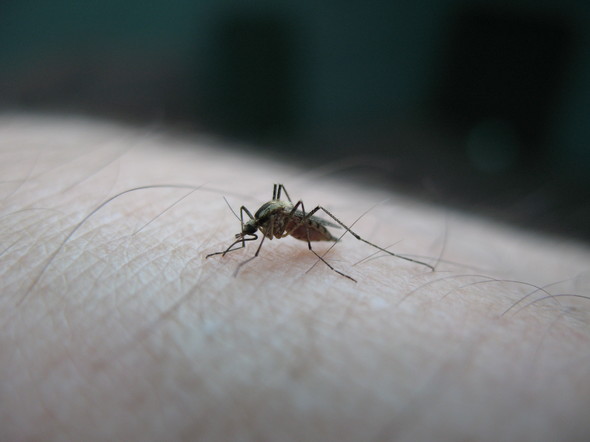
There have been two reported incidents of the mosquito-borne West Nile Virus in Michigan, one of which was a wild turkey in Washtenaw County. Experts say the hot, dry summer this year makes for prime conditions for an epidemic of the virus.
The incident in Lyndon Township is one of several factors indicating that conditions this summer are ripe for an epidemic of West Nile in Michigan, according to an expert in the field.
The turkey was found acting sick last week near a residence on North Territorial Road in the northwest corner of Washtenaw County.
A pool of mosquitoes in Saginaw County also tested positive for the virus last week. The two incidents are the earliest detection of West Nile in several years in Michigan, due to an unusually warm spring that encouraged the early hatching of mosquitoes.
The Culex mosquito that carries West Nile Virus thrives in hot, dry summer conditions.

Ned Walker
“The conditions are very suitable for an epidemic,” Walker said.
In the past three months, Washtenaw County has received only 25 to 50 percent of normal precipitation, according to the National Weather Service. The deviation is reflected among many of the southern Michigan counties.
Temperatures have been in the 90s for the past several weeks in the area, and the forecast predicts more of the same for this week.
West Nile Virus is transmitted by mosquitoes through bites and can cause a mild illness to severe illness - including encephalitis or meningitis, which are inflammations of the brain - in humans and other animals.
People age 50 or older are more at risk for West Nile Virus. Symptoms of severe infection include headache, high fever, stiff neck, disorientation, convulsions, muscle weakness and paralysis.
Walker’s lab at MSU has developed a model that uses temperature and precipitation to predict mosquito populations that correlate with West Nile Virus. Because the weather is about a month ahead of schedule, the recent period of prolonged heat puts the model "off the charts," Walker said.
Urban and suburban areas are particularly susceptible to large populations of the mosquito, as the insect thrives in catch basins of storm water drains.
“It’s not surprising that West Nile was found; it’s become endemic,” said Laura Bauman, epidemiologist for Washtenaw County Public Health. “It’s just a question of how bad of a year it will be.”
Summer conditions are ripe to have the virus amplify in the community, Bauman said.
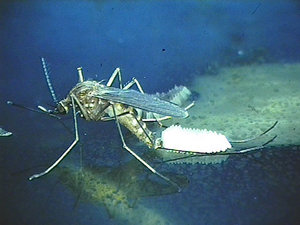
The Culex mosquito carries West Nile Virus.
The Centers for Disease Control and Protection
The virus made its first appearance in the state in 2001, but no human cases were reported. In 2002, more than 600 human cases were reported in Michigan.
Human cases of the virus tend to appear in August and September, Bauman said.
Tracking the virus and mosquito populations have become increasingly difficult as many communities can’t afford to fund testing and monitoring programs.
“Here in Michigan because of budget cuts, our ability to monitor that virus transmission system has really declined,” Walker said.
In Saginaw, Bay, Tuscola and Midland counties, their mosquito control and testing programs are funded through a millage, Walker said.
Washtenaw County de-funded its bird testing program about five years ago, Bauman said.
Now, the county health department only takes reports of dead birds on a hotline at (734) 544-6750. Sick animals can also be reported through the state’s website.
Though the birds’ deaths aren’t all from West Nile Virus, a peak in the number of dead birds in the summer is a signifier that the virus is likely present, Bauman said.
Reports of dead birds tend to spike a couple weeks before human cases begin to surface, Bauman said.
To protect yourself from mosquitoes, including those that carry West Nile Virus, the health department suggests:
- Eliminate standing water.
- Empty wading pools at least once a week; drain pools if not in use.
- Change the water in pet dishes, water troughs and bird baths at least once a week.
- Repair window screens.
- Wear long sleeves, pants, shoes and socks.
- Wear insect repellent or insect repellant clothing.
The Culex mosquito is typically active at night, Walker said, and will even travel indoors to bite.
“They’re the kind of mosquito that buzzes in your ear late at night,” Walker said, noting that even wearing repellent indoors may be a good idea.
Amy Biolchini covers Washtenaw County, health and environmental issues for AnnArbor.com. Reach her at (734) 623-2552, amybiolchini@annarbor.com or on Twitter.
Comments
whatsupwithMI
Thu, Jul 5, 2012 : 3:30 a.m.
-This is a predictive model, combining environmental data with known population dynamics of an organism of interest. -It doesn't matter that "you ain't seen a gosh-durn 'mozzy yet". -the positive test results in June are early and unique for the area. -if things continue, this particular invertebrate will ramp up its population. Ignorance of an organism's life history does not mean that this life history does not in fact, exist. This may come as a shock to Midwesterners in ragard to both invertebrate and primate systems. --> there is no reason for the AA reviewer to silently delete this comment.
Tru2Blu76
Wed, Jul 4, 2012 : 11:58 p.m.
Start lookin' for dead birds on lawns - there were lots of those during the last (mild in this county) West Nile outbreak. Then start slappin' on the bug repellent - especially before venturing near the Huron River or any body of water. Thanks Republican climate change deniers: There never was Nile Virus in North America until average temps became comparable to North Africa. Where do we send the bill?
whatsupwithMI
Thu, Jul 5, 2012 : 3:33 a.m.
To the West Nile, of course! failing that, hmm.... Dearborne? La Shish? Shatila??
Craig Lounsbury
Wed, Jul 4, 2012 : 11:51 a.m.
a couple of things worth noting from the CDC. less than 1% of people infected get seriously ill it is believed that once infected a long term "immunity" to reinfection occurs. So its possible that some of us (maybe more than we think) are actually immune to the disease. We may have been previously infected with very mild to nonexistent symptoms and never even knew. But now we carry antibodies that protect us froma reinfection. here is a link to the CDC FAQ page http://www.cdc.gov/ncidod/dvbid/westnile/qa/transmission.htm
Tru2Blu76
Thu, Jul 5, 2012 : midnight
First it's West Nile Virus, what North African virus will be next?? Whatever it is, I hope only Republicans' kids get it. ;-)
LuLzTrollFTW
Wed, Jul 4, 2012 : 8:38 a.m.
how can this site print this alarmist propaganda in good conscience?! the good citizens of ann arbor are more likely to expire due to heat stroke this summer than west nile virus! fact is we will all die from car accidents, cancer and heart disease, or old age. only hypochondriacs are worried about west nile virus! also: weblogs trying to sell advertising post sensationalism...
bedrog
Wed, Jul 4, 2012 : 10:51 a.m.
i'll see your 'chicken little/the sky is falling" and raise you with the 'grasshopper playing while the busy ant prepares " or 'nero fiddling while rome burns".
julieswhimsies
Wed, Jul 4, 2012 : 5:22 a.m.
I spend a great deal of time outdoors. My yard is dead. Standing water? The only standing water I have noticed is at the local pool....and it is chlorinated. I worry more about the incredible heat, combined with very dry conditions causing grassfires...especially from dangerous cigarette addicts flicking their still burrning butts out of their cars. Their carelessness may cause the loss of pastures, barns, farm animals and wildlife. Other than giving my horse a West Nile booster, I am not going to lose sleep over West Nile. Frankly, I have not gotten one mosquito as yet.
Madeleine Borthwick
Thu, Jul 5, 2012 : 7:37 p.m.
julieswhimsies, I hear you. I'd like to burn THEIR butts(see: "flicking their burning butts out of their cars.").
Attempted Voice of Reason
Wed, Jul 4, 2012 : 12:49 a.m.
And yet, despite all the obvious advice offered by the Health Department, our City leaders move forward with trying to turn the entire city into one large mosquito-infested marsh. First the destroyed West Park and turned it into an uninhabitable swamp (I'm talking here just about the intended design, not the broken stormwater system on top of it). Now they're using the railroad embankment failure to add another swamp on the north side, and on top of that, they're passing regulations that all new developments and houses should have their own individual swamps. (They often use the term "rain garden" to describe these items.) I'm all for treating stormwater. I'm all for controlling flooding and eliminating pollution. But not at the expense of our public health. Mosquitoes carry diseases, not just West Nile. Malaria used to extend as far north as Indiana (100 years ago). Even without diseases, excessive mosquitoes make the outdoors unbearable in the evening, or lead to so much mosquito spraying that the net stormwater chemical effect must be worse. Are our leaders oblvious to this? Or do they believe that added disease and death is a price we must pay? There are stormwater solutions that do not involve swamps, but our leaders are not interested in them. Lets do our best to replace the Hieftje Party in the upcoming elections. I don't care what your official party affiliation is, as long as you have common sense, fiscal literacy, and a willingness to research and debate the issues you'll get my vote over a Hieftje party member anyday. It's getting so bad I'll even vote in a Tea Partier (as long as they don't get a majority). And yes, I was about to run myself, but my Ward has a great candidate I can (and will) get behind. I urge everyone else to do their part to restore sanity to our government before we fall apart.
Madeleine Borthwick
Thu, Jul 5, 2012 : 7:35 p.m.
"AVOR", I completely agree. who is said candidate?
Epengar
Wed, Jul 4, 2012 : 3:29 a.m.
Your concern in general is valid, we do need to control mosquitos on town. However, rain gardens and swales, when correctly designed and built, drain out in a few days. They are temporary traps for stormwater, and they don't hold water long enough for mosquitos to breed. They are not the same as swamps. Mosquitos don't breed in streams, only in still water, so that takes care of much of the wet areas in the park. As for the pond (which is just a pond, not a rain garden) and the drainage ditch near the parking lot, there is an inexpensive, low-impact mosquito control treatment for ponds. It's a product derived from a bacterium, Bacillus thuringensis. It's commonly called "BT", and used to control caterpillars. There is a different variety that can be used in water to control mosquito larvae. I imagine that the city will use that if there's a problem in the park with mosquitos. I walk through there frequently on my way home after work, and haven't noticed mosquitos there.
sc8
Tue, Jul 3, 2012 : 11:26 p.m.
Alright! Here's the fear-mongering article I've been waiting for!
Fatkitty
Tue, Jul 3, 2012 : 9:01 p.m.
I usually have had numerous mosquito bites by now, but none yet this summer (knock on wood) . I figured it's been too dry for them.
djacks24
Wed, Jul 4, 2012 : 2:54 a.m.
I have yet to even see a mosquito its been so dry. And as far as standing water goes I'm surrounded by it with a wetlands conservation easement in my back yard and a couple decent (small lake size) ponds across the street from me. Even though it's stated these mosquitoes do best in a hot dry climate, I find it hard to believe with the lack of mosquitoes there have been. This article seems like more AA.com, slow news day fear mongering.
xmo
Tue, Jul 3, 2012 : 8:11 p.m.
I have had Wild Turkey in Ann Arbor recently an it tested positive for FUN! I think it killed the West Nile Virus that was injected into me! Maybe everyone should try it!
Madeleine Borthwick
Thu, Jul 5, 2012 : 7:33 p.m.
REAL FUNNY, XMO. try this joke on anybody who's had it. did your hangover also test positive for "fun"?
Epengar
Tue, Jul 3, 2012 : 8:10 p.m.
Sagging eaves troughs (gutters) on roofs can be an important breeding site for urban Culex mosquitos when they trap water in them. Some of these mosquito species are evolved to use treeholes to breed in. An old roof gutter or a puddle on a flat roof suits them pretty well.
julieswhimsies
Wed, Jul 4, 2012 : 5:32 a.m.
Where are all these puddles. We had a short downpour Yoda....but our gutters are dry as a bone. After the rain, The streets, gutters and any standing water was dried within a few hours.
jcj
Tue, Jul 3, 2012 : 7:25 p.m.
Strange that in a year when it is so dry the model would be off the charts. It is hard to find standing water anywhere!
whatsupwithMI
Thu, Jul 5, 2012 : 3:37 a.m.
@ whimsies: Talked to the guy driving the Utilities Authority truck lately, or even ever? There is more to the storm sewer system than you know about.
julieswhimsies
Wed, Jul 4, 2012 : 5:29 a.m.
@Amy Catch basins catching what water?
David
Wed, Jul 4, 2012 : 1:24 a.m.
Agreed. It would have been helpful for the article to explain this apparent counter-intuitive element (i.e., that this particular species has superior breeding adaptability in low moisture environments, unlike other mosquitos).
Amy Biolchini
Tue, Jul 3, 2012 : 8:49 p.m.
The Culex mosquito that carries West Nile does the best in dry, hot summers, Walker said, because they like to breed in catch basins of storm sewers. If it rained all the time, the basins would have a constant flow of water through them and the larvae would not be able to hatch.
Epengar
Tue, Jul 3, 2012 : 8:13 p.m.
I agree, and I wonder if the reporter might be misinterpreting. Did he mean the prediction of Culex populations was generally high? or just high for early July, but maybe not high compared to what's normal for later in the summer?
actionjackson
Tue, Jul 3, 2012 : 7:20 p.m.
A few years ago I took a dead crow from 48103 to a building in Ypsilanti. It did test positive for West Niles virus! Evidently this service no longer exists?
mpope
Tue, Jul 3, 2012 : 6:55 p.m.
We picked up four dead birds in our yard during the month of june. Who knew we were supposed to report them? Once reported, does County Health want the carcasses for testing?
julieswhimsies
Wed, Jul 4, 2012 : 5:26 a.m.
Interesting....cuts for public health programs....How about some of the major U of M donors throw some of their 1%er cash to fund these programs.
Amy Biolchini
Tue, Jul 3, 2012 : 7:06 p.m.
Washtenaw County Public Health doesn't have funding to test the birds anymore. You can still report the dead birds by calling the department's West Nile Virus hotline at (734) 544-6750.
JRW
Tue, Jul 3, 2012 : 6:50 p.m.
"Wear long sleeves, pants, shoes and socks." Not sure how many people are going to do this when it's 95 degrees outside.
Madeleine Borthwick
Thu, Jul 5, 2012 : 7:30 p.m.
you got THAT right.....I'd sooner stay inside.....