

'Imperfect' health care reform will have mixed impact for Ann Arbor-area patients, experts say
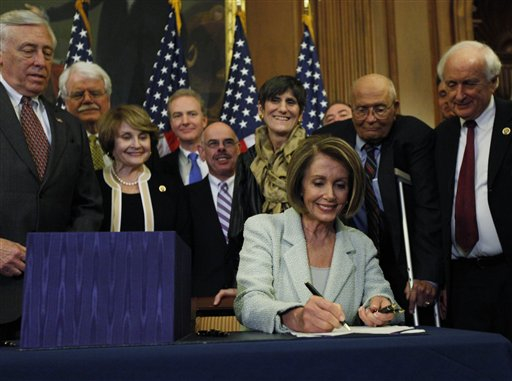
House Speaker Nancy Pelosi, D-Calif. signs the Senate Health Reform Bill, Monday, on Capitol Hill in Washington. From left are, House Majority Leader Steny Hoyer of Md.; Rep. George Miller, D-Calif.; Rep. Louise Slaughter, D-N.Y.; Rep. Chris Van Hollen, D-Md.; Rep. Henry Waxman, D-Calif.; Rep. Rosa DeLauro, D-Conn.; Rep. John Dingell, D-Mich.; and Rep. Sander Levin, D-Mich.
AP photo
There was no way Ivan Harner was going to bed before knowing what happened to the massive health care package moving through Congress Sunday evening, even though it was well after 11 p.m. when it finally passed.
For months, a national debate on the best way to overhaul the U.S. health care system had been raging as multiple versions of health care reform bills emerged in Congress.
When the debate promised to come to a head with a House vote, the executive director of the Ypsilanti-based Hemophilia Foundation of Michigan was among those keeping a close eye on the $940 billion national health care bill because of its potentially far-reaching implications. Harner and others in the Ann Arbor area who deal with health care issues every day spent Monday trying to sort out those implications.
Just one of them, Harner said, is language that would eliminate lifetime caps on the amount of health care costs an insurance company is willing to pay for an individual. For that reason alone, the passage of the legislation is welcome news to the local hemophilia community.
“Hemophilia is a very expensive disease to treat … The costs are $100,000 to $250,000 a year just for the medicine. People cap out their health insurance very quickly,” Harner said. “The only option often available to them is they have to change jobs.”
Passage of the bill left many medical care consumers confused. Blue Cross Blue Shield of Michigan was inundated Monday with calls from members asking whether their coverage would change or had already changed with the passage of the bill.
“People are generally concerned about the implications to their health care coverage,” said spokesman Andy Hetzel. “What this signals is people are confused and people are concerned.”
The answer to most questions, he said, is nothing is changing immediately. But customers could begin seeing changes later this year, he said. Those changes could range from expanded coverage for some people to more expensive coverage for others.
“As soon as the next six months, things will change. People with younger adults under 26 who claim them as dependents will be able to keep them on their health insurance,” Hetzel said. However, those who do not claim their adult children as dependents on their taxes will not. “That’s an example of the complexity and the confusion that accompanies that complexity.”
There are changes made with legislation, such as ending the practice of allowing insurance companies to bar coverage of individuals with pre-existing conditions, that will have clear positive effects on patients, Hetzel said. But the legislation also calls for taxes on insurance companies by 2018 to help subsidize coverage for individuals and it’s unclear whether that might result in an increase in premiums from the insurance industry. “We’re still trying to understand the impact (the legislation) will have,” Hetzel said. The focus going forward needs to be helping folks understand the content of the legislation and how it will impact them, Hetzel said.
Several local health care experts called the bill “imperfect,” but applauded pieces of the bill.
"I'm very pleased to see an imperfect, but extremely important piece of legislation,” said A. Mark Fendrick, who is a professor of internal medicine at the University of Michigan Medical School. The legislation will expand coverage to many more people, he said, and make it harder for health care plans to drop individuals once they develop certain illnesses. He does not believe those who already have health insurance will lose coverage.
“A very relevant issue to the demography of Ann Arbor is parents will be able to keep their child on their health plan until their children are 26,” Fendrick said. “Within the 2,000 pages of the bill are some innovative solutions to problems; there are solutions to improve health and wellness programs and also reforms to the payment system to get costs under control."
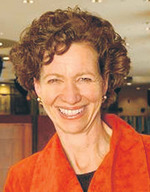
Marianne Udow-Phillips is the director of the Center for Healthcare Research & Transformation in Ann Arbor.
"For certain people with private coverage, they should see some benefit such as an increase (in the coverage) of preventative exams." Those with Medicare will more immediately see some relief from the so-called "doughnut-hole," a gap in prescription drug coverage between certain expense levels. Those who use tanning beds will notice a new 10 percent tax on the service. The bill may also increase the cost for people who already have insurance, she said.
A 40-percent excise tax will go into effect on family health coverage more than $27,500 in 2018. That's quite a bit higher than the average family premium in Michigan, which was more than $11,301 in 2008.
"It will decrease the rate of increase in the cost," Udow-Phillips said. "The actual cost of health care will go down."
Those already enrolled in Medicaid shouldn't really experience any changes, Udow-Phillips said. "What the legislation does do is that it will increase reimbursement for primary care physicians to Medicare levels, which is quite significant," she said. "With this bill, there are a lot of new people who will qualify for Medicaid." An estimated 500,000 additional Michigan residents will become eligible under new guidelines in the legislation,she said. That could create additional pressure on the system that will need to be dealt with down the road, she said.
Also included in the legislation is a mandate that all people purchase some sort of health coverage or pay a $695 penalty. Udow-Phillips said a mandate can help increase the number of young and presumably healthy individuals who are paying into insurance systems. However, she questions whether the penalty would be high enough to push individuals to purchase insurance.
"If you're young, you're going to play the risks," Udow-Phillips said. "People will be doing the trade off in their minds about what the premium is, what the chances are they're going to need healthcare and what the penalty is. We'll see how that plays out over time."
In a part of the state that has not been immune to auto workers losing both their jobs and their coverage, the creation of new markets, called exchanges, through which individuals can purchase coverage could have a significant impact, said Matt Davis, an associate professor of pediatrics and communicable diseases and internal medicine at the U-M Medical School. That, and increasing the pool of people eligible for Medicaid, could have a big local impact, he said.
"What this new national health care reform does is it provides coverage to patients and makes it easier for health care providers to get patients for the care they offer," Davis said.
In the future, there will be more cost sharing and some consumers who already had coverage may find themselves having to pay more for coverage they already received as part of the new system, and it may make some people unhappy, he said. In his own clinic, he's recently seen many more patients asking for cheaper alternatives to the prescriptions and tests he suggests. That is an example of how those who have coverage, but also have to cost-share, may just help bring overall health care costs down in the future.
"The question is, will heath care costs be controlled well enough with this health care reform or will they grow even faster because more people have coverage? We don't know the answer to that just yet," Davis said.
Tina Reed covers health and the environment for AnnArbor.com. You can reach her at tinareed@annarbor.com, call her at 734-623-2535 or find her on Twitter @TreedinAA.
Comments
Jon Saalberg
Wed, Mar 24, 2010 : 8:04 a.m.
The audacity of hope trumped the cynicism of hate.
shepard145
Tue, Mar 23, 2010 : 7:23 p.m.
Soon there will be calls to boycott the socialist census until obama is thrown out of office in 2012....once the democrat party is crushed back into the corner where they belong and adults take back leadership of the nation, the health care fraud repealed (or equal) and the constitution reinstated. Then the census can be conducted in relative safety. NEVER VOTE DEMOCRAT AGAIN.
shepard145
Tue, Mar 23, 2010 : 7:18 p.m.
I do enjoy the irony that much of this grab bag of entitlements for deadbeats will be financed via the IRS FORCING YOUNG PEOPLE WHO DON'T NEED HEALTH INSURANCE to buy it after they voted for obama!! Change you can believe in!! Once you crawl out of college with your student loan burden, enjoy your lower standard of living, cheaper first car and crummier apartment (because you won't be buying a house)!! LOL...and once again, the youth learn another painful lesson!
Bob
Tue, Mar 23, 2010 : 11:27 a.m.
"I can't believe that all of this anger is really about the health care bill. We're talking about helping our fellow citizens when they are sick and most need help." AGREED! I'm an American making less than $250K a year and I support this bill....All the complaining is no more than a bunch of sore loser republicans and their fringe group rich radical friends stomping their feet...You didn't see democrats doing that on this scale when we were putting up with 8 years of Bush and his "ruining" of America. This will improve quality of life for those with little or without...and with any luck...we may actually get the middle class back...instead of having an upper and lower class society...
AAbob43
Tue, Mar 23, 2010 : 10:31 a.m.
tree town cartel: "take money from the middle class?" Whom do you think is paying for emergency room care of the uninsured? And were is the middle class when their employer takes away their unfunded, unvested medical benefits? We run outrageous medical costs in our current hodge-podge "system."
treetowncartel
Tue, Mar 23, 2010 : 10:22 a.m.
Great to take money out of the hands of the middle class, it should really help boost spending and get the economy going. Next thing you know they will be asking for our bootstraps.
AAbob43
Tue, Mar 23, 2010 : 10:03 a.m.
Yeah Peter, I don't believe in HDTV's either.
Peter A Webb
Tue, Mar 23, 2010 : 9:35 a.m.
I can't believe that all of this anger is really about the health care bill. We're talking about helping our fellow citizens when they are sick and most need help. And actually, most people will still be paying for their own private insurance. We are not talking about handing out free HDTVs to welfare queens, as if there were such a thing.
Tina Reed
Tue, Mar 23, 2010 : 9:35 a.m.
This story was updated to reflect a fix to a typo in the above story. Thanks.
AAbob43
Tue, Mar 23, 2010 : 9:31 a.m.
In the story above, paragraph 10 should read "...clear positive effects (not "affects") on patients. Beyond that matter of grammar, I note that in the U.S., we have a largely employer-based system of health coverage. I have been a benefits attorney for almost 34 years, so I have deep knowledge of the subject. I know how this system is (among other negatives) (a) increasing costs of coverage, (b) crippling our economy, (c) crippling our industry, (d) leading to substandard coverage, and (e) putting the existence of healthcare coverage itself at jeopardy. It seems that many people who currently have healthcare coverage like what they have and decry the "socialist" attempts to change the system. But what about the millions whose employers have discontinued coverage for active or retired employees? By ambient law, employees do not "vest" in healthcare coverage. It can be, and frequently is, taken away. How good does the current "system" look then? I represent lots of international employers. They are amazed at how expensive and inefficient our employer-based healthcare "system" is. Honestly, steam cars once prowled our streets, but no longer. In the Dune trilogy exists the mantra "fear is the mind-killer." It's time for people to overcome fear of change, examine the facts, and realize that we can't continue to treat the uninsured in emergency rooms, at outrageous cost. Estimates are that had the Clinton-era proposed reforms been adopted, we as a country would currently be about $500 billion to the good, if I recall correctly. It's easy to "stand pat." Not necessarily smart, but easy. Get informed. Our system of employer-based coverage must change. (And this comes from a person who makes legal fees off that very system!)
just a homeowner
Tue, Mar 23, 2010 : 9:29 a.m.
If the teabaggers object so much to government programs, the return your social security payments and buy insurance and don't use medicare. It's easy to object to government paying for others when you are already getting expensive services. I applaud health insurance reform. Obama's got a lot of guts and persistence to get this through.
voiceofreason
Tue, Mar 23, 2010 : 8:50 a.m.
New National Holiday: March 23 Happy Dependence Day! Fireworks Prohibited.
chimarathon
Tue, Mar 23, 2010 : 6:49 a.m.
"We don't know the answer to that just yet". That sounds promising and hopeful
FreedomLover
Tue, Mar 23, 2010 : 5:44 a.m.
racerx, please take the time to read what I said, if you can. I never said anyone chooses to get cancer or anything else. However, people do make a choice as to whether they want to improve their economic situation. Someone who CHOOSES to stay on welfare and not improve themselves doesn't deserve another handout from the hard working people. And by the way, Medicare and Social Security are socialistic and going broke! I have no problem with helping those "30 million" get health insurance, I just would like to see them work for it the same as I do. Those who are unable to work because of physical or mental limitations should be taken care of by our government but not those who choose not to work. Teabagger and proud of it!
racerx
Tue, Mar 23, 2010 : 1:55 a.m.
Oh, so I guess Medicare, Social Security are also Socialism at it's best too? For 70 years our nation has attempted to provide some premiss of health care for its citizen's. Heck, even Richard Nixon tried. So now that we have it and the simple fact that over 30 million people can now receive health care when they had none before, thus, increasing my cost through my provider for they are paying for those who use emergency rooms for basic treatment, its all Socialism. As with the rest of those Teabaggers, get a life and try to understand that this is a moral issue as much as a health issue. The richest country on the planet not being able to take care of their own people. So I guess those who disagree would just let them eat cake. Or in this case, put a lime in the coconut and call me in the morning! And to FreedomLover, how do you choose to get cancer? The common cold? Asthma? So, since I choose to take care of myself, does this mean that I won't get cancer? You have as much depth of thought as a saucer.
FreedomLover
Mon, Mar 22, 2010 : 11:30 p.m.
After reading this article it seems that the health care professionals don't really know what impact this bill will have on health care. It seems to me that our elected officials should have researched the impact before passing such a socialistic change in 1/6th of our economy. One thing that history has taught us is that whenever the government gets involved with anything the costs rise and the service gets worse. Only time will tell. Once again the hard working Americans who have been financially successful will pay for those who choose not to improve themselves.
frozenhotchocolate
Mon, Mar 22, 2010 : 10:04 p.m.
Just give CPR training.
jondhall
Mon, Mar 22, 2010 : 9:06 p.m.
This Health care bill is total joke the problem are the costs increasing so rapidly and this bill does nothing to curb that. The mandate was for an increase towards Socialism in this once wonderful country. Another way to tax the working people and transfer payments, that is what the Democratic party is known for.