

Whooping cough: Health officials urge vaccinations as cases present in Washtenaw County
State and local health officials are urging people young and old to be vaccinated against whooping cough as the disease continues to be present in Michigan and Washtenaw County.
Whooping cough, more formally known as pertussis, is a very contagious respiratory illness caused by bacteria. It spreads from person to person through close exposure, said Dr. Alice Penrose, medical director for Washtenaw County Public Health.
To date, 22 cases of pertussis have been confirmed for the 2012 calendar year in Washtenaw County -- five of which were reported during September and two in October.
In Michigan, 597 pertussis cases have been reported as of Sept. 30.
The number of cases this year have not amounted to the same epidemic-levels that they reached in 2010, when Washtenaw County had the highest case count in the state with 232 confirmed cases.
During the 2010 epidemic, 50 whooping cough cases were reported in the month of September during a spike in the case count. There were 26 confirmed cases throughout all of 2011.
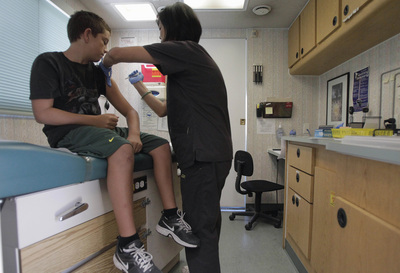
Trevor Reese, 13, gets his Tdap shot from pediatric nurse practitioner Jenny Lu, right, in Tustin, Calif., in this photo taken Aug. 18, 2011.
Jae C. Hong | The Associated Press
Symptoms of pertussis include runny nose, slight fever, diarrhea, coughing fits, as well as coughing hard enough that it leads to vomiting.
Additionally, if a person is making the characteristic “whooping” noise after they cough they should see a doctor.
The first symptoms typically look like that of a common cold and begin about a week after exposure to the bacteria. About 10 to 12 days later, the severe coughing bouts begin. Infections typically last about six weeks.
Infants are at the highest risk for dying from the disease.
Throughout the past five years, there have been no whooping cough deaths of Washtenaw County residents.
The relative decrease in case load since 2010 could partially be attributed to the number of people receiving immunizations, Penrose said.
“Pertussis comes in waves,” Penrose said. “It tends to reach a population, and then a lot of people become immune.”
However, 2010 was a bad year overall for whooping cough: 27,550 cases were reported in the U.S. From 2011 to 2012, Michigan and California were the only two states in the country to see a decrease in the number of whooping cough cases reported; the rest of the states saw a marked increase.
“The big reason for vaccination is that it can be a life-threatening disease,” Penrose said. “You want to get as many people vaccinated as possible to protect (everyone) as some people can’t get vaccinated.”
Vaccination for pertussis is included in the DTaP vaccine for infants, which also includes the vaccines for tetanus and diphtheria.
For children between the ages of 11 and 18 years old, as well as for adults over the age of 18, the vaccination for pertussis is included in the Tdap vaccine.
Health officials are now recommending pregnant women receive a single dose of the Tdap vaccine during the third trimester, Penrose said.
Penrose said that even if an adult has been vaccinated against pertussis and their child gets the disease, the adult should also be on the antibiotic treatment.
“It’s an imperfect vaccine,” Penrose said.
The Tdap vaccine is about 95 percent effective for the tetanus and diphtheria portions, and is about 80 percent effective for the pertussis portion, Penrose said.
In 2011, a total of 933 people were vaccinated against pertussis in Washtenaw County and 644 of them were over the age of 18.
Penrose stressed that even though an individual may have had whooping cough at some point in their life, their immunity may wane over time.
In Washtenaw County, if a child in a classroom has pertussis, then a letter is distributed to the students in the classroom to take home informing the parents of the need for vaccinations. Penrose said she did not know of any specific classrooms or schools where letters had been sent this year.
Amy Biolchini covers Washtenaw County, health and environmental issues for AnnArbor.com. Reach her at (734) 623-2552, amybiolchini@annarbor.com or on Twitter.
Comments
G. Orwell
Wed, Oct 31, 2012 : 4:09 p.m.
Let me clarify my earlier statement. It turns out that the vast majority of the people getting the whooping cough are people that have already been vaccinated. For example, in Kitsap County, Washington, where they had a whooping cough outbreak in 2011, 74% of the whooping cough cases where from people vaccinated for the whooping cough. Thus, it is reasonable to conclude that something in the vaccine is causing the sickness. You have nearly 300% greater chance of getting the whooping cough if you are vaccinated from it. Not good. Therefore, common sense would tell you, it would be far better not to be vaccinated if you want to prevent whooping cough. "Kitsap County has not been immune to the whooping cough epidemic spreading through the state. Seventy-four percent of confirmed cases in the county are people that were vaccinated against whooping cough." North Kitsap Harold - The facts are correct but please do not believe the spin the North Kitsap Harold is putting out in their article. They basically argue that you need to be vaccinated for the whooping cough. Incredible. http://www.northkitsapherald.com/news/153828135.html
Rork Kuick
Wed, Oct 31, 2012 : 7:04 p.m.
"You have nearly 300% greater chance" - the article doesn't say that, and it's not clear how you get that, except if I assume you are doing bad math like mhirzel above. 74%/26% is about 3, but you forgot to consider what percent of people were vaccinated (or you are assuming it is half). Say it's 90%. Then (74/90)/(26/10) = .82/2.6 =.32 and the unvaxed people are getting it 3 times more often. This ain't even algebra.
DBH
Wed, Oct 31, 2012 : 6:10 p.m.
Like many vaccines, the pertussis vaccine's effectiveness diminishes over time, more quickly than others. Even if vaccinated recently, because its effectiveness is about 80%, one can still contract pertussis if exposed, though one's risk is substantially decreased. And if the vaccination took place over 5 years ago, for many their susceptibility to infection approaches that of someone never vaccinated. Vaccinations only reduce a person's risk of contracting the disease in question; there is no guarantee. And, as referenced above (both in the article and in the comments/replies), the more people vaccinated, the lower the risk in the unvaccinated, including those for whom vaccination is either not possible or inadvisable (herd immunity).
John of Saline
Wed, Oct 31, 2012 : 5:50 p.m.
Your ignorance of basic cause and effect, disease transmission, and scientific thinking is stunning.
annarbor28
Wed, Oct 31, 2012 : 2:06 p.m.
To Orwell: Pertussis is caused by a bacteria, not a virus. The vaccine does wear off, that is why there is a recommendation to revaccinate. Also those vaccinated get less harmful cases, if they do acquire it. This disease often causes death in babies, prior to their immunizations. It is highly recommended that women and others who will be around babies get the immnuization ASAP. Here is a link to an artilce about a mother whose baby recently died from pertussis, who had refused vaccines for her children. By the way, there is no real cure, one can give erythromycin medications but it is very hard to treat, mostly it is supportive care and the anitbiotic to prevent the spread. http://www.freep.com/article/20121030/NEWS06/310300041/Franklin-mom-who-lost-child-to-whooping-cough-has-this-advice-Get-vaccinated
Rork Kuick
Wed, Oct 31, 2012 : 7:10 p.m.
Orwell, see my reply below where I claim your math is in disarray. Your link to natural news, a notorious source of misinformation, by the author Mike Adams, one of the worst money-inspired quacks in our nation, is doing similar bad math - but what is worse is they probably know they are computing falsely, so I think it's fair to call it lying. For them, it's lying for profit, so we understand why they would lie. Why others would repeat the lie is less clear.
G. Orwell
Wed, Oct 31, 2012 : 4:08 p.m.
And here: http://www.naturalnews.com/035466_whooping_cough_vaccines_outbreaks.html
G. Orwell
Wed, Oct 31, 2012 : 3:24 p.m.
Let me clarify my statement. It turns out that the vast majority of the people getting the whooping cough are people that have already been vaccinated. For example, in Kitsap County, Washington, where they had a whooping cough outbreak in 2011, 74% of the whooping cough cases where from people vaccinated for the whooping cough. Thus, it is reasonable to conclude that something in the vaccine is causing the sickness. You have nearly 300% greater chance of getting the whooping cough if you are vaccinated from it. Not good. Therefore, common sense would tell you, it would be far better not to be vaccinated if you want to prevent whooping cough. "Kitsap County has not been immune to the whooping cough epidemic spreading through the state. Seventy-four percent of confirmed cases in the county are people that were vaccinated against whooping cough." North Kitsap Harold - The facts are correct but please do not believe the spin the North Kitsap Harold is putting out in their article. They basically argue that you need to be vaccinated for the whooping cough. Incredible. http://www.northkitsapherald.com/news/153828135.html
mhirzel
Wed, Oct 31, 2012 : 11:16 a.m.
This is a press release, NOT journalism. Why don't you ask Alice Penrose how many of the pertussis cases are occurring in the FULLY VACCINATED, as I did back in 2011 when your predecessor, Juliana Keeping, posted her own version of government-press-release-as-journalism. Here is a direct quote from the response I got then from Laura Bauman of the Washtenaw County Health Dept: "I can tell you that most of our pertussis cases this year have been vaccinated. " The same pattern is happening all over the country. The real story is that this is a vaccine failure, not a call for wider vaccination. Of course, Americans (and their "journalists") seem willing to believe almost anything these days, so I guess, why not help peddle more vaccine concoctions, if you can..........
Rork Kuick
Wed, Oct 31, 2012 : 1:45 p.m.
Help fight bad math. The vaccine is not perfect does not imply it is not helping. Most pertussis cases are in people who've been vaxed, because so many people have been vaxed. The question is whether getting the jab reduces risk: it does. Or you might think of it as the rate of pertussis being higher in the unvaxed. (Or try another example: Americans not descended from Autralian aborigines get almost all the cases of pertussis - so that must be the problem. Not.)
John of Saline
Wed, Oct 31, 2012 : 1:43 p.m.
"Herd immunity." Look it up.
squidlover
Wed, Oct 31, 2012 : 11:05 a.m.
One clarification: Even if a person has received the tetanus booster (usually Td vaccine) within the past ten years, it is still safe and recommended to receive the Tdap vaccine to get the pertussis coverage.