

With Earth Day approaching, University of Michigan experts offer tips to help environment
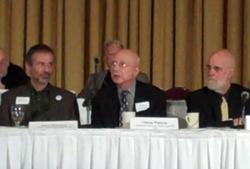
University of Michigan Climate Change expert Henry Pollack, center, discusses the link between the economy and the importance of reducing the state's dependence on carbon-based energy.
Tina Reed | AnnArbor.com
What do transportation, food and the Great Lakes have to do with one another?
Plenty if you're trying to do something about fighting climate change, experts said during a University of Michigan Teach-In held Thursday in honor of the approaching 40th annual Earth Day.
Earth Day is April 22.
The event featured panels discussing the importance of creating ways to reduce how much people rely on carbon-powered vehicles, alternative energy potential and pitfalls, the value of purchasing healthy and locally grown foods and protecting the Great Lakes.
The consensus appeared to boil down to one question: How do you change people's social behaviors to help fight climate change and increase environmental sustainability?
Several panel members featured during the conference expressed frustration that the U.S. and institutions, including U-M, seemed to lack a sense of urgency about climate change. That's particularly the case when other issues like creating jobs in a weakened economy are pulling attention away from energy and environmental issues.
U-M professor emeritus of geophysics Henry Pollack said the incentive for environmental change does hit the pocketbook, particularly in Michigan.
Pollack was a member of the Intergovernmental Panel on Climate Change, which shared the 2007 Nobel Peace Prize with former vice president Al Gore.
"If I said there was one industry in Michigan that exports $18 billion of product a year, what would you identify that as?" Pollack asked the audience. "It's money. That's what we pay for our energy in Michigan, both in terms of petroleum that we import for our vehicles, in terms of coal which generates our electricity."
The incentive of retaining that $18 billion a year is the jobs that could be created and the funding for university and businesses that could be spent inside the state, he said.
"Yet we seldom hear any attention called to the economics of what this means for the state to be so reliant on the carbon-based energy," Pollack said.
Here's a look at what some panelists from an environmental sustainability discussion during the Teach-in event had to say about what should be going on at the individual level, and more broadly, to help the environment.
Comments
AlphaAlpha
Mon, Mar 29, 2010 : 6:38 p.m.
Uh oh. UM 'climate change expert' Pollack = geologist. Evangelism.
Phillip Farber
Mon, Mar 29, 2010 : 7:06 a.m.
@anonymous Oh Please, not the Weekly Standard. You might as well quote Fox News. Freeman Dyson may be one of the smartest people living but he is a theoretical physicist not a climatologist. Do you want a mechanical engineer to do your heart surgery or a cardiac surgeon? There are plenty of web sites that have sprung up in opposition to the facts of human induced climate change and the measures that need to be taken to keep the planet habitable for our children and their children. Consider the source. Denial.
Anonymous Due to Bigotry
Sat, Mar 27, 2010 : 11:08 a.m.
@Phillip Farber: The truth that's being ridiculed is that, even if they did play a significant role (and that is in doubt), carbon reductions won't have any useful effect. If there's a real problem then some sort of geoengineering will be needed and nobody is even talking about that. A decent summary of recent revelations regarding anthropogenic global warming is contained here: http://www.weeklystandard.com/articles/denial Even without that, the climate models are still quite terrible and still have not made any verifiable predictions. Models are pretty useless when they can't make any valid predictions. Funny, but Freeman Dyson, Nobel prize laureate and one of the smartest people to ever exist, is quite doubtful of the impending disaster: http://e360.yale.edu/content/feature.msp?id=2151 Also interesting is the misplaced priority on "climate change" even when you use bogus figures for the impact on humans: http://www.copenhagenconsensus.com/Home.aspx Mitigation is #29 on the list, and that's even when you accept doubtful claims about impending disaster.
jcj
Fri, Mar 26, 2010 : 8:47 p.m.
Mr Farber Your quote doesn't hold water! You might want to try again! I think your belief falls into the "goofy Crap" section. This is a quote that ISN'T used when actual evidence exists. A better quote would be Some truth is ridiculed, some truth is violently opposed, then later seen as self-evident but lots of goofy crap goes through the first two stages as well. Einsteins Theory of Relativity was neither ridiculed or violently opposed http://cinrambler.wordpress.com/2009/10/21/all-truth-goes-through-three-stages/
Phillip Farber
Fri, Mar 26, 2010 : 5:52 p.m.
"All truth passes through three stages. First, it is ridiculed. Second, it is violently opposed. Third, it is accepted as being self-evident." Sounds like the commenters in this thread are still in the first stage.
cinnabar7071
Fri, Mar 26, 2010 : 12:17 p.m.
I can't believe Al Gore isn't in jail yet.
stunhsif
Fri, Mar 26, 2010 : 7:40 a.m.
"Earth Day" who cares, other than it brings to mind how "global warming" is nothing but a scam created by Earth Day hippies!!!!
AlphaAlpha
Fri, Mar 26, 2010 : 6:21 a.m.
Agreed. The unproven and now obviously flawed theory of human caused global warming is rapidly headed for the scrap pile of failed theories. http://wattsupwiththat.com/
Anonymous Due to Bigotry
Thu, Mar 25, 2010 : 11:17 p.m.
This story would have been more complete with coverage of all of the scandals related to climate change recently. For example CRU ("climategate") and the IPCC if not others. That's why people are lacking a sense of urgency and not taking climate change seriously. It's hard to take these guys seriously when all serious scientists know that carbon reductions capable of addressing the exaggerated disaster scenarios are totally infeasible. Either they know the disaster scenarios are bogus or they're terribly ignorant of what it will take to stop them in terms of pure emissions reductions. The failure of the supposed experts to discuss geoengineering solutions is a dead giveaway to the fact that disaster isn't really expected to happen.