

Ypsilanti fourth Washtenaw County municipality to consider manufactured fertilizer regulations
Ypsilanti could be the next of several Washtenaw County municipalities to regulate the use of manufactured fertilizer.
The City Council approved the first reading of an ordinance on Tuesday and will likely revisit the issue at its next meeting.
Local ordinances are part of a United States Environmental Protection Agency mandated effort to reduce excess levels of phosphorus - which is part of most manufactured fertilizers - from the middle Huron River by 50 percent.
Laura Rubin, executive director of the Huron River Watershed Council, said higher levels of phosphorus in waterways are responsible for excess vegetation and algae blooms that choke off oxygen supply in the water. Phosphorus is a nutrient that helps plants grow.
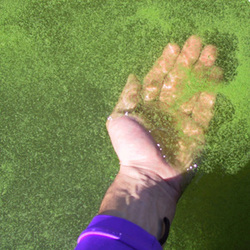
This file photo shows algae blooms in Ford Lake.
The blooms are most significant in Gallup Pond, Ford Lake and Belleville Lake, producing slimy, blue-green sheen and emitting a strong, unpleasant odor. The blooms are highly unpleasant for boaters and swimmers. Because the blooms deplete the water’s oxygen supply, they often lead to one or two large-scale fish kills per year and are particularly problematic in late summer, Rubin said.
All communities in the middle Huron River area are required by the EPA to reduce phosphorus levels because they are upstream from Ford and Belleville lakes. Ann Arbor, Ypsilanti Township and Pittsfield Township have already passed similar ordinances to the one Ypsilanti is considering.
Most of the communities in the middle Huron, including Ypsilanti, are also under contract with the HRWC for a separate partnership aimed at meeting reduction goals and measuring phosphorus levels.
Rubin said excess phosphorus comes from two sources - non-point and point source. Point source includes a facility like the waste water treatment center, while non-point sources include run-off from lawns and sewers or other non-direct avenues.
Ypsilanti's ordinance would target non-point sources and prohibit residential, industrial and commercial application of manufactured fertilizers on lawns before April or after Nov. 15 because the frozen ground can't absorb fertilizer.
It would also require residents or businesses to water any lawn on which manufactured fertilizer is applied within 14 hours. The fertilizers can't be stored on driveways, streets or other impervious surfaces for more than hour and can't be applied within 25 feet of a waterway or stormwater retention center.
Exempt from the proposed ordinance are gardens, farms, areas where soil tests have concluded phosphorus levels are low or surfaces where turf or grass seed is laid for the first season.
City Manager Ed Koryzno said enforcement will come on a complaint-driven basis. The city will seek to inform residents, lawn care companies and other businesses of the new ordinance by using the city’s e-mail list, contacting neighborhood associations and notifying as many lawn care companies in the city as possible.
“We won’t have the fertilizer police out … but we will make every effort to inform as many residents as possible,” Koryzno said.
Residents and companies will then be expected to comply with the ordinance, and those who don't face a fine of up to $250.
Council Member Bill Nickels questioned whether any data was available from Ypsilanti soil samples. He said he believes phosphorus is an issue, but asked staff to have someone speak to council and “demonstrate the need for this ordinance.”
In a phone interview Wednesday, Rubin said Michigan State University Extension Service has found 85-90 percent of the soil tested in Washtenaw County contains sufficient levels of phosphorus and nitrogen.
The problem first became visible in the area in the mid-1990s, Rubin said, and legislation to address the issue at the state level has been introduced in each of the last seven years. It has died due to opposition from the agricultural industry, but Rubin said local municipalities put pressure on state lawmakers by creating ordinances.
“Commercial applicators hate having different regulations because it’s a pain for them, so the more of these local level ordinances we have, the more likely we are to get statewide legislation,” she said.
Commercial applicators would be required to register with the city in Ypsilanti and comply with the same rules as residential users.
Rubin said progress has been made in reducing phosphorus levels in recent years, though continued efforts are still needed.
“The news is going in the right direction,” she said.
Tom Perkins is a freelance writer for AnnArbor.com. Reach the news desk at news@annarbor.com or 734-623-2530.
Comments
Kai Petainen
Tue, Sep 7, 2010 : 3:13 p.m.
a lot of attention is paid to using phosphors with respect to fertilizer, but phosphoric acid can come from other uses.... is phosphoric acid used to clean parking lots at the University of Michigan and elsewhere in Ann Arbor? is it completely disallowed? is it sometimes allowed? if so, why? is that hypocritical? is it used in cleaning fuel/oil drums? has it been used for that? if someone spills some phosphoric acid... at what confidence does that have to be, before it can be prosecuted? do you have to have 100% confidence? and note -- a phosphoric acid test/spill with 88% confidence is not considered to be an evident environmental threat -- according to some officials. is phosphoric acid used in other ways, apart from fertilizer in ann arbor? is it used for food? medical? is phosphoric acid used to clean petroleum spills, or oil spills? in other-words... do educate the residents (and perhaps do your best to blame them?), but also make sure to educate others as well, and don't just educate the residents, especially if/when phosphoric acid is used by larger entitites as well.
katie
Fri, Aug 20, 2010 : 10:13 p.m.
I hope that this impacts some of the companies that apply fertilizer, since they want to sell as many treatments as possible to make money. I don't think that they do a soil test of each lawn they spray. If someone has the right to use fertilizers on their lawn, that's up to them. It's just that it is then up to them to prevent any from going into the water supply. I own that water, and I have to pay more for the water department to filter it, etc. Plus it screws up the lakes and rivers. Do the right-to-fertilize folks want to say that they own them, too? When the rivers and lakes die, can I prosecute them to pay to restore them? Do they own the fish that die? Does anyone know what effect the dams have on stagnation, for instance, Argo Dam?
amazonwarrior
Fri, Aug 20, 2010 : 8:46 a.m.
I don't know of anyone who fertilizes their lawn in April (too early) or November (much too late), so this is a rather senseless ordinance. And anyone I know who does use fertilizer doesn't apply it to their lawns unless it's going to rain, so telling people to water within 14 hours doesn't make any sense either. Actually, most of the people in our neighborhood could stand a good dose of WEED KILL on their lawns! No "pride of ownership".
haulin donkey
Fri, Aug 20, 2010 : 12:13 a.m.
The one thing everyone should do befor appling fertlizer to there garden or lawn is get a soil test. It's not expensive, then you only apply what is needed. Anything more than the test calls for is a waste of money.
treetowncartel
Thu, Aug 19, 2010 : 2:32 p.m.
Why would you want chemicals in the yard your dog and kids play in anyhow? Plus, you get much more wildlife in your yard if you don't put that stuff down.
jameslucas
Thu, Aug 19, 2010 : 12:41 p.m.
xmo is watching to much Glen Beck, I don't think using manufactured fertilizer is a right. If it was it would not be more of a right then God given community and private water rights.
Woman in Ypsilanti
Thu, Aug 19, 2010 : 12:23 p.m.
None of my neighbors in Ypsilanti use commercial fertilizers anyways. This sounds like it is more of a symbolic ordinance since it seems like anyone who really wants fertilizer on their lawns will be able to put it on anyways. If they happen to the sort of neighbors who would rat them out, they can just do it when their neighbors aren't looking. Still, I support the ordinance because it helps send the message that those kinds of fertilizers can cause damage to our local lakes.
Depot Town
Thu, Aug 19, 2010 : 12:23 p.m.
xmo is right! We have a right to use fertilizer that contains phosphorus and we shouldn't let city council take that right away from us. We need to mobilize and protest at the next meeting. They'll get my fertilizer from me when they pry it from my cold, dead hands.
xmo
Thu, Aug 19, 2010 : 11:32 a.m.
First you inform on your neighbor who uses manufactured fertilizer, then you inform on your neighbor who does not recycle, then you inform on your neighbor who reads the wrong books,then you inform on your neighbor who is not the right religon, etc etc. Sounds like Hitler's Germany, Mao's China, Stalin's Russia. Think before you give up your rights!
tdw
Thu, Aug 19, 2010 : 11:21 a.m.
There's times when Ford lake looks like it has a fairway in the middle of it.Never noticed too much on Bellville though
Epengar
Thu, Aug 19, 2010 : 11:02 a.m.
scooter dog, yes, actually, it can.
scooter dog
Thu, Aug 19, 2010 : 9:41 a.m.
Can't be any more of a problem than the gazillion tons of road salt they dump on the roads and then it goes to the river every year