

Ypsilanti sets up 'blight court' to battle ordinance violations, property maintenance issues
Broken down cars on the front lawn, junk scattered throughout the yard and angry neighbors on either side of the property - such was the scene on one Ypsilanti block recently.
Previously, the city's ordinance officer would have written a citation, which would then be handled by a judge or magistrate at the 14A-2 District Court. But the city is now developing a new tool that puts violators in front of a city-run “blight court” to help resolve such issues more quickly and efficiently.
Ypsilanti's City Council unanimously approved creating the new city department, technically called the Administrative Hearings Bureau.
“The bottom line is, we want compliance, and we want blight removed,” Planning and Development Director April McGrath said. “We’re trying to develop the best way for that to happen, and there are so many levels to this.”
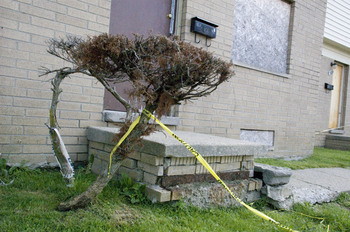
Ypsilanti is aiming to cut down on ordinance violations and blight in the city.
The particulars are still being worked out, but council members expressed optimism over its potential. However, several worried about placing an additional burden on already-stretched city staff.
In a presentation to council, Assistant City Attorney Karl Barr said the bureau is a new city department that would only require hiring a hearing officer. The city clerk would initially function as the court’s clerk, though it is not yet known how much time the clerk’s efforts would require.
McGrath said the court would result in some extra work for staff, but she believes managing a small workload at the outset will help determine how to best build the bureau.
“We plan on starting this slowly on specialized cases, rather than sitting down and saying ‘what if, what if?’” she said. “We just need to start this and figure out where it goes, and I think in the end, it’s going to help.”
Among the issues that would make their way into the blight court are ordinance violations, property maintenance complaints, noxious weeds, dumping, abandoned vehicles, junk on a front lawn, couches on a porch or any issues with a property being deemed unsafe.
In the event that a person was failing to mow the lawn, for example, building inspector Frank Daniels, who is also the city’s ordinance officer, would first approach the violator and try to correct the issue without writing a ticket, McGrath said. If the problem persisted, a citation would be issued.
The city clerk would then send the violator a notice to appear in blight court within 14 days. Court would likely be held in council chambers two mornings a month.
Once offenders were in court, they'd meet with the city attorney and building staff to resolve the issue. If no resolution was met, the case would go to trial before the hearing officer.
Should the hearing officer rule in favor of the city, that person would be ordered to pay a fee and remedy the problem. Barr used the example of $225 for a lawn ordinance violation in his presentation, though no fee schedule has yet been set.
Barr and McGrath observed a similar concept in action in Jackson, where many of the citations being issued carried fines in the range of $400 to $600. Officials said the city will collect the full amount of the fines. Currently, the district court collects the money, part of which is distributed to the county.
But the city must pay for the costs of prosecution, and McGrath said she doesn't expect the court “to be a money-maker, and is not intended to be.” She said the city may end up contributing a little bit to run it.
“The bottom line is, it’s another tool for us to address blight, and we can work with people a little more closely,” she said.
McGrath said Jackson’s court provided social work to address problematic residents. She said that element could be beneficial in Ypsilanti, though she isn't sure which staff would be involved. She said the more challenging cases involved people who simply didn't care that they were violating ordinances or didn't have the resources to do anything about the problem.
“You have to sit down and make them understand why it’s important and build that relationship to encourage them to take care of it,” she said, adding the city pays for the abatement otherwise and ties up city resources.
McGrath added programs are available through the county and other entities to help those who can't afford a lawnmower, for example.
“When it’s the very serious cases - that’s where we need it most,” Council Member Brian Robb said. “And I think this is a very needed organization that will benefit us greatly.”
McGrath said the city is still trying to determine how it will deal with out-of-state institutions or owners who neglect their properties.
The city has already developed the ticket, informed the district court of its intentions, written the hearing officer's job description, assessed staff capabilities and approved a budget.
It now must hire a hearing officer, put the word out to community groups about the new court, train staff and implement the program.
“I think this is going to be a great success when we get it together,” Council Member Pete Murdock said. “I’m looking forward to this thing getting off the ground and going.”
Tom Perkins is a freelance writer for AnnArbor.com. Reach the news desk at news@annarbor.com or 734-623-2530.
Comments
MI-expatriate
Fri, Jul 30, 2010 : 12:43 a.m.
Charlie's got the best answer. If people care about their neighborhoods, why don't they care about the people in them, or know anything about their circumstances? If the problem is perpetual, then yes, fine them but be sure to enforce the fines, both to residential and commercial owners. Blight absolutely drags down value for everyone.
dading dont delete me bro
Thu, Jul 29, 2010 : 3:42 p.m.
another department, although one person, the city can't fund. then they will look forward to cutting it due to budget cuts.
Charley Sullivan
Thu, Jul 29, 2010 : 3:22 p.m.
Several years ago, during a death in my family, my lawn went unmowed for the three weeks I was gone. I came back to find something on my door saying the lawn was more than 12" high (it wasn't) and that if I didn't mow it, the city would, and I would be charged. Fresh back from a funeral, etc., I cut the grass, when I rather would have done something else, to be sure. I called the City and they said that the warning came as the result of a neighbor complaint, but of course, wouldn't tell me who. So I went to my neighbors, told them of the death, and asked that next time, before calling the city, they perhaps ask if I needed any help for some reason. And that's the way our street has sort of worked since then. So, ask first, neighbors, if there's anything you can do to help; you may end up helping shovel someone's sidewalk, or helping weed their garden, but it doesn't always have to go to court, and you may not ever know why the place next door is the way it is.
SonnyDog09
Thu, Jul 29, 2010 : 2:48 p.m.
tom wrote: What the city is trying to do is cut out the 14A-2 District Court from the picture, which is reducing a step from the process. When the new, fake court gets ignored, will that be the end of things, or will the process just end up in 14a-2 district court? Adding yet another layer does not reduce the steps in the process. Jinkies, don't they teach process control in journalism school?
Tom Perkins
Thu, Jul 29, 2010 : 12:33 p.m.
Thomas, Yes, offenders would go in front of a hearing officer at city hall, not a magistrate or judge at the district court. AmazonWarrior, What the city is trying to do is cut out the 14A-2 District Court from the picture, which is reducing a step from the process.
Cash
Thu, Jul 29, 2010 : 10:57 a.m.
AmazonWarrior, Have you called your council person? If so, and they haven't taken care of it for you, let us know who it is! Anyone on council should be able to follow through for you. We need to keep their feet to the fire!
MorningGirl
Thu, Jul 29, 2010 : 10:43 a.m.
I agree with Cash. Excellent move.
amazonwarrior
Thu, Jul 29, 2010 : 9:59 a.m.
"Broken down cars on the front lawn, junk scattered throughout the yard and angry neighbors on either side of the property - such was the scene on one Ypsilanti block recently." This is a problem all over town, including the rental property next door to us, a major eyesore on our street. Complaints have been filed, but nothing has come of it, and the owners weren't sited for the blight when they applied for and received a certificate of occupancy. And now the city wants to add another step to the process so even less will be done. Sounds like a way to protect the absentee slum lords of the city, and take more money from the rest of us. If the city doesn't do something soon with the properties that are in deplorable conditon, we won't have to go to the city landfill to shoot rats, we'll be able to do it in our own backyards.
Cash
Thu, Jul 29, 2010 : 8:47 a.m.
I commend the Ypsilanti Council and Ms McGrath for this plan and for being a "grassroots" council. Improving the appearance of Ypsilanti will be a benefit to all taxpayers. Whether the Blight Court will work or not remains to be seen. But I give them credit for trying something at least!
Craig Lounsbury
Thu, Jul 29, 2010 : 8:13 a.m.
"Previously, the city's ordinance officer would have written a citation, which would then be handled by a judge or magistrate at the 14A-2 District Court. But the city is now developing a new tool..." to create another level of tax payer funded Government folly. Evidently the good people of Ypsilanti aren't yet paying enough money to the city.
Rasputin
Thu, Jul 29, 2010 : 8:02 a.m.
I think a perfect test case could be the Thompson block. Let's see how many ordinance violations will actually be leveled against Beal? What a nightmare.
Marshall Applewhite
Thu, Jul 29, 2010 : 7:41 a.m.
The result here will be similar to Detroit setting up a blight court. Too much blight, and not enough power to do anything about it.
Thomas
Thu, Jul 29, 2010 : 7:25 a.m.
How is this different from the nuisance team the citys already got? Cause now we have our own judge?
Tony Livingston
Thu, Jul 29, 2010 : 7:16 a.m.
This scares me tremendously. I have already experienced their rental property inspectors for several years. They sight every little cosmetic maintenance issue and micromanage the property. They go after the easy targets -- property owners that actually pay their way and maintain their property. I don't consider these steps to be "blight". And the fine amounts they are suggesting are outrageous. I don't trust this at all.
Ignatz
Thu, Jul 29, 2010 : 6:59 a.m.
Blight target #1 = The Big Blue Blight on the NE corner of E. Cross and N. River. Blight target #2 = Railroad Depot.