

Ypsilanti voters will be asked to approve dedicated tax to fund AATA bus service
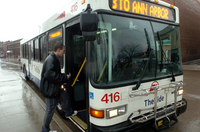
Ypsilanti voters will be asked to approve a tax increase to support the city's current bus service through the Ann Arbor Transportation Authority.
The Ypsilanti City Council voted unanimously Tuesday to place an amendment to the city charter on the Aug. 3 ballot, allowing a .9789 mill Headlee override solely for transportation purposes.
The proposal would restore the city’s ability to capture 20 mills instead of the 19.0211 maximum allowed per the Headlee Amendment, which would then provide an additional $281,000 for public transportation in 2011. Residents whose homes have a taxable value of $100,000 would pay $97.89 more annually.
Council members adopted the resolution after a countywide public transportation millage failed to materialize in recent months. In September 2009, the council approved a 21-month contract agreement with the AATA to provide bus service from Oct. 1 through June 30, 2011, at a cost of $312,000. At the time, the council hoped a countywide or regional system would now be under serious consideration.
During negotiations with the AATA, Council Member Pete Murdock broached the possibility of a dedicated funding source instead of continually entering into purchase agreements. The City Council must draw money from its general fund to pay for the service, and the last agreement included a one-time allotment of federal stimulus dollars to help sustain the service in 2010. A Headlee override would guarantee funding every year.
Murdock, Mayor Paul Schreiber and City Attorney John Barr largely crafted the language of the proposal in recent weeks. Barr said in the event the AATA develops a countywide transportation system, the city would not be required to levy the .9789 mills unless it's deemed necessary to supplement a new funding structure.
The city budget projects council spending of $218,000 on public transportation in fiscal year 2011 and $281,000 in fiscal year 2012.
Council Member Mike Bodary said the tax would gives council one less service to worry about as the city develops a budget without knowing how much it will receive in state-shared revenues.
“I think in the long run, this is the best thing to do,” he said. “The main thing about making a separate millage is it's dedicated - it’s automatically going toward those transportation costs, and we’re no longer pulling that money out of the general fund and hoping we have enough."
Schreiber praised the proposal's flexibility.
“I think this is a good proposal because it gives the AATA the ability to fashion a countywide system without jeopardizing the funding here if it is passed by voters,” he said.
Schreiber also pointed out that for the first time in years, property taxes will likely drop by more than 6-percent while the millage represents a 1.5 percent increase, so even if the millage passes, taxes would go down for most residents.
Council members acknowledged the poor economy could complicate efforts.
Another potential complicating factor? Politics.
All council members and mayoral candidates currently seeking seats are Democrats, so those races will be decided in August. That could impact some council members' efforts to campaign for their seats and also a tax increase.
“I don’t know who is going to fight for it, and it’s going to need a champion,” Ypsilanti resident Beth Bashert said during the public meeting. “Without a champion in the anti-tax environment we’re in, I’m worried that a very important thing like public transportation will not pass, so I want you to think about it and come up with that good committee - that effective committee - that will put together the plan to pass this with the voters.”
Schreiber agreed a solid team to campaign for the issue is essential.
“Hopefully we will have enough grassroots support and energy in the community that we can give it a good shot,” he said.
Murdock, who is running for mayor against Schreiber, said he knows of several organizations that would likely jump in and campaign for the proposal.
“I told the mayor if he’s supporting it, I’m supporting it and most of the council candidates are supporting it, then we should be able to get it through in fine shape. It may be close, but we’ll work to do that,” Murdock said.
The council agreed the August ballot was preferable to November because the later elections will likely see more candidates and issues.
Bodary said he believes residents will agree with the council that public transportation is important for the city’s overall health.
“It’s beneficial for the citizens, the city and for the future of the city,” Bodary said. “It makes us accessible to the county and Ann Arbor, and it just works out better all the way around.”
If the millage is defeated, it can't be placed on the ballot again for another two years.
Tom Perkins is a freelance writer for AnnArbor.com. Reach the news desk at news@annarbor.com or 734-623-2530.
Comments
Bonnie
Fri, May 21, 2010 : 12:07 p.m.
19.0211 (general operating) 5.1481 (police & fire pension) 2.7814 (sanitation) 0.0000 (debt retirement) 1.9097 (street improvement 2001) 1.9989 (street improvement 2003) 30.8592 (TOTAL) Per http://cityofypsilanti.com/services/fiscal_services/accounting_division/Reports/Budgets/2009-2010Budget/2009-2010Book.pdf, page 2-1 (32 of the PDF)
jjc155
Fri, May 21, 2010 : 9:15 a.m.
Lets see, a small fare increase could easily take care of this, but that would not be "right" to tax those that use a service, tis better to tax 100% for the good of 5% right, LOL Why not a millage to save the 5 cops that are getting laid off July 1st? Since the AATA transit center on Pearl st is a common and repeated "customer" of public safety services in the city of ypsilanti. Everything from general quality of life issues (vagrancy, open drinking) to more serious stuff (drug dealing and assaults and robberies) occur at and immediatly adjacent to the transit center (while AATA and the city will be quick to point out that AATA has private security at the site, they do NOTHING). That will not stop, but there will be less cops to handle it when it does occur. Oh wait the council obviously feels that PUBLIC TRANSPORTATION is more important that PUBLIC SAFETY, nevermind, LOL. It will be interesting when crime increases (or atleast is preceived as increasing) with the lay off how city council will cry that more needs to be done with less. @murph, I was a city resident/property owner for about 6 years in the late 1990's and early 2000's and never remember there being a line for "Police and fire retirement support" on my property tax bills. When did this start and who can I talk to, to comfirm this? Plus if it is truely for "retirement support" as you mention that would have nothing to do with current staffing, correct? Lastly I moved to the township about 8 years ago. I moved from a 900sg/ft house on Charles st to a 2000sg/ft house and my taxes are lower in the township, by a pretty substaintial margin. Just think about how different things could be if that income tax would have passed...........ah but alast it didnt.
kenUM
Fri, May 21, 2010 : 2:45 a.m.
@murph I totally understand your suggestion of the Bus System, and the idea that this may free up some City money for Public Safety. I also agree that we need the Bus System, however I think our priority should be our Public Safety services first. Even if this tax is passed there is no guarantee that this will offset the City's ability to maintain the Police and Fire services. That being said, if the tax does not pass, and bus service is cut there are other alternatives that does not mean the end of Bus Service in Ypsi. First, AATA does not need to run 4 routes between A2 and Ypsi all day all week. Second, there is the possibility of the County wide tax initiative passing, thus restoring any eliminated service that may occur. I just find it frustrating that we talk about paying extra taxes to pay for Bus Service but we really do nothing to preserve Public Safety services within a City that is so close to bankruptcy.
Kyrie
Thu, May 20, 2010 : 3:51 p.m.
Everyone in my household depends on the bus being there to take us to work and grocery shopping and where ever else we need to go. If the bus I do not know what we would do because we would not be able to get to work and pay our bills. I remember when there was talk about the aata no longer running to Ypsi before they worked out the new agreement and I was scared about what I was going to do. We used to have a car but it was just to expensive to keep because we had a decrease in income and now my other half is left unemployed do to the movie store closings. There are a lot of people that depend on the bus in Ypsi to get to work and make a living and if it wasn't there then I feel there would be a lot more people would lose their house. Bus fair has gone up 0.50$ over the past year in a two step process.
Woman in Ypsilanti
Thu, May 20, 2010 : 1:21 p.m.
@Tag I think you will find that a lot of people are perfectly ok having the government services they use while at the same time demanding that those they don't use not be subsidized at all. @AndyYpsilanti It isnt just extra services that folks would have to pay for. If there were no bus service, it changes the labor market and it especially changes the labor market at the lower end of the scale. If the gas station or retail establishment or restaurant has a diminished pool of workers because of a lack of public transportation, they'll have to raise the prices they charge to consumers. That's right folks, even if you can't stand to see your taxes raised in order to fund public transportation, you are still going to have to pay one way or another in the end.
AndyYpsilanti
Thu, May 20, 2010 : 12:39 p.m.
Oooo, the subsidy part, this is my favorite. That's right folks the roads you drive on in Michigan are, one and all, subsidized by the federal, state, and local governments. Heavily subsidized. If we were going to have all car drivers pay their fair share you would be looking at a gas tax that would likely double the cost of a gallon, at least. Think about that when you talk about bus riders paying their fair share. Public transit relieves congestion and saves wear and tear on those roads. I'm also a fan of the take a look at all of these successful cities and their amazing public transit argument. I don't know if anyone has noticed, but we're really bad at cities in Michigan. We have two really nice successful ones, Ann Arbor and Grand Rapids, and the rest are barely surviving. Maybe it's time we start to really take a hard look at what successful cities do with public transit. Just say'n. I own a car, and I choose to commute on the bus. It takes a little more time to save me a lot of money, effort, and frustration. For those who can't afford a car, the bus is a lifeline. Cash is right, pay for a bus or pay for food stamps, unemployment, and welfare. What do you think is cheaper?
TAG
Thu, May 20, 2010 : 11:53 a.m.
Those that say bus users should pay higher fares to cover costs should also be willing to pay road tolls on all the roads they drive on - roads are subsidized so why shouldn't public transit be subsidized?
MGoYpsi
Thu, May 20, 2010 : 11:36 a.m.
Yes Rose, taxes did go down for once, after years of continued increases. What also went down was property value and many peoples income due to pay cuts.
stunhsif
Thu, May 20, 2010 : 11:19 a.m.
This is rubbish. Charge more for the people that use this service. Bus tickets prices are already a great deal so raise the cost for the people that actually use the service. Don't tell me they cannot afford it, neither can I and I don't ride the bus.
Cash
Thu, May 20, 2010 : 9:26 a.m.
To even the most selfish among us, look at it this way: You will either pay an additional tax for bus service for people to get to work or you will pay additional tax for food stamps, welfare, crime prevention, not to mention seeing your property values drop even lower. If part of our community cannot get to work, we all pay the price, like it or not.
Rose
Thu, May 20, 2010 : 9:09 a.m.
Ben: If you are like every other household in Ypsilanti, you saw your taxes go down this year. On a federal level, individuals and family paid the lowest amount of taxes since 1950. This anti-tax mantra doesn't make sense in the current economy. Also, we live in an interconnected society. If you cut out the bus service, people will not be able to get to work. This will affect your life in Ypsilanti in a number of ways, including an increase in crime, vacant and neglected housing, and yes, increased taxes to pay for the costs of a deteriorating city.
Ben
Thu, May 20, 2010 : 8:25 a.m.
When people without the luxury of a car ride buses to get to jobs to support their families and be productive members of society, we all benefit. I get that. As an owner of an average home in Ypsilanti, however, I cringe at every tax bill. The existing millage rate is outrageously high. How can I, as a rational human being of limited means, support adding to it?
Heather
Thu, May 20, 2010 : 7:30 a.m.
We all benefit from having a good bus system, even if we personally never ride a bus. If you add up the number of people who ride the bus every day to go to work (according to the numbers that Tom Perkins just gave us from Terri Blackmore) that's more than 14,000 people who are not driving their cars between Ann Arbor and Ypsilanti every day. If we don't pay for good public transportation, then we'll pay to increase the capacity of our roads.
Rose
Thu, May 20, 2010 : 6:17 a.m.
Kudos to City Council and the Mayor in recognizing that bus transportation is essential to our community. My taxes have gone down substantially in the past year, and I am willing to pay a little extra to preserve the bus. The value of my home has declined, and I believe it would decline further if this essential service was removed.
angela
Thu, May 20, 2010 : 6:14 a.m.
Why cant they charge the users of the bus system more to use it. If demand does not require the service then the service changes. Its not fair to charge people who dont use it.
Bonnie
Wed, May 19, 2010 : 11:47 p.m.
@Val- To address your comments: 1. It is an override on the Headly Amendment. Overrides on the Headlee Amendment are unfortunately rather common, as property taxes are the primary source of income for municipalities, due to the unpopularity of income taxes. 2. It is an unfair tax. A home owner should not be paying for something that everyone should be paying for. Institute an income tax. I'm not entirely sure what you mean by this. Property taxes affect all those who live or own property in the taxing jurisdiction- even renters, because landlords pass the cost on. Those who simply work in Ypsilanti are less affected, though. 3. A small percentage of the voters can force a majority to pay the tax. Example: It can pass if 3 people vote, 1 against and 2 for. How fair is that? Yes, I know everybody should vote. This is true for everything that comes to ballot. Are you saying, then, that we should not hold elections? 4. Property tax can and does force people to move if they cannot afford to pay the tax even if they have paid off their mortgage. Example: Tax is $4,800 and SSI is $12,000 per year. Car insurance $1,200, house insurance $600, car expenses $1,000, home energy $1,200, food $4,800, medical $2,000 plus general expenses $1,000 leaves a $1,200. $2,200 in the example you gave are car-related. With a robust public transportation system, these costs could be lessened. If $4,800 is the person's total tax bill, the transit millage being, say, $1,000 of that (for example), the person could potentially be saving money.
Bonnie
Wed, May 19, 2010 : 11:36 p.m.
A public transportation millage will help ensure transit service in Ypsilanti. Transit helps both my neighbors and myself keep our jobs and roofs over our heads, by helping us get to our jobs without spending ridiculous amounts of money on taxis, cars, parking, or trying to live right next to work (try doing *that* in a household of more than one person!). A significant percentage of Ypsilanti residents currently rely upon public transportation for daily use, as Murph mentioned above and as the Census shows. That figure doesn't include the people that rely upon it for backup transportation (when their car is in the shop, or suchlike, as I've done many times in the past), those who rely upon it as their commuting vehicle (such as my neighbor- she doesn't want to pay for parking, and saves her SUV for errands), or visitors to town who may use it (relatives and other guests of mine have used the bus when I had to take the car elsewhere). Public transportation saves people from unexpected expenses- having to take a taxi, having to take a whole day off work, and so on. Having a millage- a predictable annual expense- helps to ensure that those people don't have to spend that money on a taxi, or to take a day off work, or to be stranded somewhere. A millage for public transit doesn't take money out of the police and fire budget. It preserves money in the general fund from the often unpredictable AATA service fee, and allows for better, smoother budgeting overall. As Murph, above, mentioned, the police and fire pension plans- one of the biggest line-items in the police and fire budget- are already taken care of through another millage. Trash collection is, too, if we want to go down the list of "essential city services." I own my home in Ypsi. I chose the location in large part because of its proximity to bus routes- one of which has already been cut. I'd like to ensure that there are still bus bus routes nearby when I choose to sell, in case someone else shares my values, or has need of it.
ybecuz
Wed, May 19, 2010 : 8:05 p.m.
Ypsi currently has a millage over 58 mills for a homestead in 2009. More than any other city or twp in the county. You are on the pipe if you think the wonderful metropolis of Ypsi is worth more taxes. It needs to be dozered and started over.
Val Losse
Wed, May 19, 2010 : 7:38 p.m.
I urge people to vote no on the millage increase. 1. It is an override on the Headly Amendment. 2. It is an unfair tax. A home owner should not be paying for something that everyone should be paying for. Institute an income tax. 3. A small percentage of the voters can force a majority to pay the tax. Example: It can pass if 3 people vote, 1 against and 2 for. How fair is that? Yes, I know everybody should vote. 4. Property tax can and does force people to move if they cannot afford to pay the tax even if they have paid off their mortgage. Example: Tax is $4,800 and SSI is $12,000 per year. Car insurance $1,200, house insurance $600, car expenses $1,000, home energy $1,200, food $4,800, medical $2,000 plus general expenses $1,000 leaves a $1,200. Forget going to a movie, eating out, having a drink, buying a present etc. There is no money for the property tax.
murph
Wed, May 19, 2010 : 5:31 p.m.
@kenUM, a few thoughts: First, part of the benefit of pulling the transit funding out to its own millage is that it will reduce budget competition with other services, like police and fire. Currently, transit and police are competing for the same general fund dollars, leading to the trade-off you mention - I would think it's in the firefighters' interest to support this ballot item. Second, as an Ypsilanti homeowner, my property tax bill already includes an additional line item for police & fire retirement support on top of the general fund - a little over 5 mils this year. That's been on the books for years now, making it far from being a second thought after transit.
Anonymous Due to Bigotry
Wed, May 19, 2010 : 4:58 p.m.
Buses save the environment; cops and firefighters just save people. We all know the environment is more important than people.
Woman in Ypsilanti
Wed, May 19, 2010 : 4:29 p.m.
I think public transportation is especially important to Ypsilanti. It is important even to the homeowners who don't use it for some of the same reasons it is important for those who don't have children to fund the schools. It is funny too because even though I never used to ride the bus at all, the availability of the bus service and the proximity of my house to a bus stop were major reasons why I decided to move to the City of Ypsilanti rather than out in the township. I did that because sometimes my car has needed to be in the shop the option of being able to take the bus to work is important to me. I mean, how crummy would it be to lose a job because one's car broke down? I will be voting for this for sure and I will strongly encourage my neighbors in Ypsilanti to do the same.
kenUM
Wed, May 19, 2010 : 3:46 p.m.
To bad that we can't seem to fund our Safety services (Police and Fire) as easily as we can fund the bus service. Grassroots? What about preserving the Safety Forces or at least making as much noise to preserve those services as the Bus Service! I know several laid off Fire Fighters(or soon to be) that have plenty of time to Champion for this ridiculous millage!
dading dont delete me bro
Wed, May 19, 2010 : 3:34 p.m.
thanks for reposting those statistics mr.perkins, however, only the 3,836 from Ypsilanti could be eligible to vote on this ballot issue (provided they're registered voters)
Tom Perkins
Wed, May 19, 2010 : 3:15 p.m.
Thomas Jones, Here are some statistics from a previous AnnArbor.com article on the issue. Terri Blackmore, executive director of the Washtenaw Area Transportation Study, offered figures for the number of riders commuting to jobs in Ann Arbor daily - 3,836 from Ypsilanti, 6,327 from Ypsilanti Township, and 1,419 from Superior Township. Blackmore also said 1,156 riders from Ann Arbor, 2,201 from Ypsilanti Township, and 460 from Superior Township use the bus to get to jobs in Ypsilanti.
dading dont delete me bro
Wed, May 19, 2010 : 2:48 p.m.
@murph, can you get that 5% to vote? if you assume they vote in favor, what do you anticipate turn out to be? say a fraction over 10%? the fraction puts it over...fail mississippi of the north? what the heck?
murph
Wed, May 19, 2010 : 2:43 p.m.
Mr. Jones - I spoke at Council last night to note that, without bus service, I would not have moved to (and bought a home in) Ypsilanti. At that time, my household had 3 employed, college-educate adults, 2 of whom used the bus to get to work. (The third walked.) My household is not alone: according to the Census Bureau, around 5% of Ypsilanti residents regularly use transit to get to work. (That doesn't count occasional users, trips to school, to shop, to entertainment, to medical appointments, etc.) And, at a meeting on Friday, the Ann Arbor / Ypsi Chamber of Commerce President noted that transit is essential to attracting an educated workforce and the types of business that want to employ those people. So I wouldn't rule it out quite so quickly.
Top Cat
Wed, May 19, 2010 : 2:39 p.m.
The City Council must know this millage doesn't have a prayer. I guess they figured somebody has to say No. Easier for the public to do it than for the Council to.
Ignatz
Wed, May 19, 2010 : 2:29 p.m.
I can pretty much guess what most of the public sentiment will be. I'll vote yes, but I'm thinking I'll see this region continue on it's way to being the Mississippi of the north.
dading dont delete me bro
Wed, May 19, 2010 : 2:25 p.m.
city council, publick transportation tax = fail
Thomas Jones
Wed, May 19, 2010 : 2:13 p.m.
Funny... they want Ypsilanti home owners to pay more in taxes for public transportation,thats laughable!!! but I'm willing to bet that less then 1% of the ypsilanti tax payers use the public trans system... I'm not voting for that your crazy!!!!