

Ypsilanti Township officials debate how to regulate medical marijuana dispensaries
Ypsilanti Township officials are considering an ordinance to regulate medical marijuana dispensaries within the township.
The proposed ordinance focuses on zoning, but officials tabled it Tuesday until they can get more details on how to zone a dispensary and decide what restrictions to place on its operations.
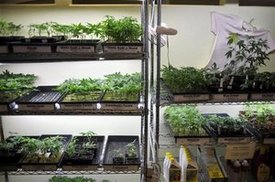
Ypsilanti Township officials are discussing how to regulate marijuana dispensaries.
Assistant township attorney Angie King, who crafted the proposed ordinance, and Joe Lawson, the township planning and development coordinator, discussed the measure with board members.
The proposed ordinance requires dispensaries to be 1,000 feet from churches, schools, day cares, libraries and residential zones. It also limits dispensaries to 60 plants.
“We have to address it from a zoning standpoint,” Supervisor Brenda Stumbo said. “I believe (a dispensary) helps people, but in the hands of the wrong people it is, of course, not good … Right now I have more questions than answers.”
In 2008, Michigan voters approved the use of medical marijuana. King told the board that under the law, patients and caregivers can grow up to 12 plants for five patients. Anyone who doesn't have a felony drug conviction and completes a state-run course can receive a caregiver’s card.
How dispensaries operate varies in communities throughout Michigan, King said, but they're mainly a place where patients can go to buy marijuana from a caregiver. She said in many cases, the growing operation also takes place at the dispensary. In that arrangement, growers can form collectives or associations in which they grow hundreds of plants under one roof, but remain within the personal limit per caregiver.
Township officials varied in their opinions on how a dispensary should be zoned if plants will be grown, packaged and sold there.
Lawson said the ordinance originally permitted dispensaries only in industrial-commercial zones, which largely run down the township’s eastern border. The planning commission then added language allowing dispensaries in general commercial zones, including along stretches of Michigan Avenue, Washtenaw Avenue and Ecorse Road.
Lawson said some planning commission members likened a dispensary to a pharmacy, which is allowed in commercial zones. Members also felt traveling too far to purchase pain medication could be an impediment.
Lawson said he believes dispensaries are less like pharmacies and more like the township’s industrial greenhouses in the industrial-commercial zones.
“They don’t make Motrin in the back of a CVS,” he said. “They manufacture it somewhere else, it’s packaged, then sent to the CVS. That was the thought process - how do we differentiate the two or separate those uses?”
Police Services Administrator Mike Radzik echoed Lawson's concerns.
“Pharmacies are regulated by the state and federal government … Marijuana dispensaries are a completely different animal,” he said. “What we’re doing is an attempt to take a reasonable and carefully thought approach on where they should be placed and what limits should or shouldn’t be placed on their operation.”
Radzik said state law has been essentially silent on dispensary issues.
“Statewide, it’s been left to the local jurisdictions to kind of figure it out,” he said. “There’s been a wide array of responses, ranging from attempting to zone them out of business to embracing them as a business and entrepreneurial opportunity. I think we’re trying to take a reasonable, middle-of-the-road approach in the best interest of all the stakeholders.”
Stumbo said properly zoning dispensaries will help avert problems down the road. She said a dispensary in Ypsilanti at the corner of Pearl and Hamilton streets has caused problems in that neighborhood, and the township is cautiously proceeding to avoid such issues.
“We need to make sure we learn from other communities,” she said. “What we have to do is put it in the appropriate zoning with the appropriate regulations. It’s all new to us, but it was approved by the voters, and we have to figure out how to deal with it in a professional manner, and figure out how to do what’s in the best interest of the community.”
The board will further discuss the proposed ordinance at its next regular meeting on May 18.
Tom Perkins is a freelance writer for AnnArbor.com. Reach the news desk at news@annarbor.com or 734-623-2530.
Comments
Christine
Sun, Apr 25, 2010 : 2:41 p.m.
A this point, nothing short of total legalization is ridiculous. That being said, this is a step in the right direction. I am relocating Ypsi and bringing a high paying job with me. Why? Because of the more enlightened laws on marijuana in the area. If you want the drug dealers out of your neighborhood, vote for legalization. Just like the repeal of prohibition drove some mobsters out of biz. Wake up people. This is the best possible direction the city and state can go in. Trust me, you want your 18 year old going to a dispensary versus a dealer that has every drug under the sun for sale. Legal marijuana and dispensaries are lowering the addiction rate, increasing tax revenue, increasing the employed population, and lowering crime in one fell swoop. This is going to be an amazing step forward for Ypsi and other communities around the state that embrace it.
Boanerges
Fri, Apr 23, 2010 : 10:14 p.m.
Supervisor Brenda Stumbo said. I believe (a dispensary) helps people, but in the hands of the wrong people it is, of course, not good Right now I have more questions than answers. Helps people??? WAKE UP BRENDA!!! WAKE UP ANGIE and the rest of you spaced-out township officials!!! Get the drug dealers OUT of Ypsi Township! Need more answers? Try starting here: "Woe unto them that call evil good, and good evil...." - Isaiah 5:20
Gersh Avery
Fri, Apr 23, 2010 : 6 a.m.
Gee.. a single parking space directly in front of the store is being ticketed as if it were not directly in front of the store. I'm guessing that any time that someone parks directly in front of the store, someone calls the city and complains that someone is parking in the wrong spot. For some reason or other, one of the people living in the ares seems to think that a parking space that is directly in front or a commercial building belongs to one of the houses nearby. The people that own the building have a permit to use the parking space directly in front of the building. The parking place should be reassigned to reflect it being directly in front of the commercial building.
jamie
Thu, Apr 22, 2010 : 1:51 p.m.
There are 2 major issues with this story. First, it is very rare to have a dispensary and a grow operation in the same building as assumed by members of Ypsilanti Twp. Board. Secondly, and most importantly, as a Director of the 3rd Coast Compassion Center in Ypsilanti, there has NOT been ANY issues with our operation. The statement about our Compassion Center, levied by the Township Board member and reported on by the journalist, is extremely incorrect and completely ignorant and irresponsible to say or report as if it were true without investigating the facts. No one ever called us to talk about it. One of the companies that rents space in the building has had some minor parking complaints- NONE of it has had to do with 3rd Coast directly. I assure anyone who may care that it is of much greater appreciation that a building, that had been dormant for quite a while, is now being used to house a few businesses and create traffic to restaurants and cafes and other establishments, than it is to be concerned about a minor parking complaint. We encourage growers to look at light industrial facilities and work with the City on how best to implement that and get more vacant buildings used and jobs created.People have moved in, directly as a result of our Center, and have purchased or rented property in Ypsilanti that had been sitting vacant for months or years.Associated professions and businesses have enjoyed opportunity and growth as well. Accountants, doctors, lawyers, electricians, plumbers, carpenters, and others have all seen increased business as a result of our efforts, the efforts of the medical marijuana community at large and as a result of the Michigan Marihuana Act, passed by 63% of the voters and winning in every single county in Michigan. Please do not believe the misinformation expressed in this article and research the facts.
Anonymous Due to Bigotry
Wed, Apr 21, 2010 : 4:25 p.m.
It seems like the obvious thing to do here would be to just let people mass produce the stuff out in agricultural areas just like every other plant that's grown and sold. Only allowing lots of people to grow a tiny amount each, usually (if not always) using grow lights is kind of ridiculous and only drives up the cost of production for the people who need it. Regulation would seem much easier to me if you had 10s of sites growing it instead of 1,000s, but what do I know....
Atticus F.
Wed, Apr 21, 2010 : 3:56 p.m.
Just out of curiosity, are bars required to be 1000 feet away from a residential zone?
Tom Perkins
Wed, Apr 21, 2010 : 3:28 p.m.
Doug, The problems were reported by the neighbors and have to do with parking, traffic and bright grow lights that are on all the time - not criminal activity. The township's clerk said she has spoken with the neighbors, and, from what I've heard from city officials, it has been reported to the Ypsilanti Police. The point the township is making is that they want to keep dispensaries 1000 feet from residential zones so they don't have similar problems.
salineguy
Wed, Apr 21, 2010 : 2:35 p.m.
Unlike any comment thus far, it seems to me that what the township is doing is a reasonable exploration of alternatives on how to implement a policy that conforms with state law while making sure that collectives or dispensaries are located in an appropriate areas within the township. 12 plants in a house with five 'patients' is a lot different than 100s of plants growing in a greenhouse. Maybe my take is wrong, but a reasonable ordinance seems appropriate. Stumbo dashing of an Ypsilanti (city, not township by the way) is not, however. She should worry about her own township's problems and leave the city to deal with theirs
David Briegel
Wed, Apr 21, 2010 : 12:58 p.m.
"as THEY selectively enforce"
David Briegel
Wed, Apr 21, 2010 : 10:23 a.m.
Good Grief, Just leave them to heck alone! Legalize NOW! End this insane "war on sanity" that we call the "war on drugs" Prohibition did NOT work! The outcome of the status quo is that it ties law enforcement in knots as they try to figure out which laws to apply to which circumstances as the selectively enforce the victimless crime laws! Meanwhile we are funding the criminal drug cartels that are merely supplying a product that is in high demand. Free Market!? Is that really what we desire to accomplish?
tdw
Wed, Apr 21, 2010 : 10:17 a.m.
As some may know I'm pretty far to the right but it should just be legal and treated like alcohol.Pot does'nt make people violent crash cars or commit crimes ( other than smoking it )Alcohol causes much more problems than pot
Atticus F.
Wed, Apr 21, 2010 : 10:09 a.m.
The few dispensaries in Michigan are all co-op's. They often work hand in hand with compassion clubs/groups. And the majority of medicinal cannabis is donated by patients who belong to the co-op. Also, different strains of cannabis can be good for different ailments. for example, the strain "chemo" was specifically bred to combat the nausea and fatigue from chemotherapy... So it's hard to say there needs to be conformity as far as the THC levels or levels of cannibinoids.
MikeAA
Wed, Apr 21, 2010 : 9:23 a.m.
Thank you Dr. Krivitsky. It is always refreshing when a legitimate authority posts something to these forums.
Ignatz
Wed, Apr 21, 2010 : 9:14 a.m.
@Justavoice, I'm absolutley certain that calls to poilce have been reduced in at least one area: Drive by machine gunnings over bootleggers' territories. Pot should be legalized. Allow some homegrown quantities and moderatley tax sales through businesses.
glimmertwin
Wed, Apr 21, 2010 : 8:50 a.m.
Justavoice - all excellent points. I find it typical that government (fed/state/local) is more than willing to cut off their arm by fighting smoking at ever turn, yet loves that money (and depends on it, too) from the sale. If it is legal to buy cigarettes, than why is it such a problem to smoke them? This is an entirely different debate, but in the end, I feel that the government should just butt out of this issue also. If I don't like cig smoke, at a restaurant, I will go to one that doesn't have it. Let the market decide. Let consumers decide. I am aware of the health issues, and yes, we all end up paying for all of those that get sick because of smoking. But people are going to smoke - cigarettes, pot, whatever. People that get married are going to be married forever, yet half of them get divorced. Kids won't have sex if they are educated not too, yet teen pregnancy continues to exist. The list goes on. No matter what is right or wrong, people will do what they want. Government should just leave it be. I am a non-smoker and I don't do drugs of any kind. But I resent anyone telling me what to do, and I think everyone should be able to make their decisions based on their views, not the government.
Justavoice
Wed, Apr 21, 2010 : 8:37 a.m.
What I don't understand is how we can be taxing and pushing cigarettes out of existence but yet be promoting smoking another substance. I do have to ask is legalizing another drug really the answer to solving all our problems? People point to the fact that alcohol is legal but they also point to the fact that legalization of pot will reduce the load on the cops. However, do you really think legalization of alcohol really has reduced the load on the cops and court systems? (Ask any cop how often he gets a call involving alcohol). This is not to say I'm against pot legalization, it just seems like everyone is on the bandwagon just not because how this will better us as a society, but because what's in it for me (Taxation, my right to get high, etc). I am all for what you do in your own home, but when you start impacting others when you take it out into the community (Much the same way with alcohol and tobacco) this becomes a problem. We haven't fixed the issues with our current legalized drugs, will this actually make things better? With this said, i do believe if there's a medical use for it (And not just a sham for gaining it legally as a recreation drug) then I'm all for it, however they need to do something on the legal level so it's consistent and sold through pharmacies. With that said, please don't take this as an anti anything. I'm all for doing what you want in your own home behind closed doors as long as your not negatively impacting anyone else. I really just wonder how we can be going one way with smoking tobacco, a completely opposite way on pot, and why everyone things an additional drug on the market will solve all the ills (Baring the clear medicinal impact it may have for some patients). To each there own.
Top Cat
Wed, Apr 21, 2010 : 8:10 a.m.
I completely agree with glimmertwin.
treetowncartel
Wed, Apr 21, 2010 : 8:09 a.m.
Well said Dr. Also, if you take away marijuana as an experimental drug for teenagers, who time and again it has been shown are not going to stop from being curious, then what gate should they enter? Perhaps, meth, heroin, cocaine, prescription drugs or maybe huffing? I would argue that it is actually more of a buffer than a gateway.
Doug Orton
Wed, Apr 21, 2010 : 7:59 a.m.
According to Stumbo, " a dispensary in Ypsilanti at the corner of Pearl and Hamilton streets has caused problems in that neighborhood, and the township is cautiously proceeding to avoid such issues." Amazing that no one else has heard of these so called problems. There have been no negative reports coming out of the Y'psi police department. In studies done in L.A. the area's that surround dispensaries are relatively crime free when compared to the crime that was happening prior to the establishment of the dispensaries. Go figure...
glimmertwin
Wed, Apr 21, 2010 : 7:53 a.m.
This entire medical marijuana dispensary is a sham. If people with ailments feel better smoking pot, then let them smoke pot. Pot should be legal. If someone chooses to smoke pot, they should be held accountable just like someone who drinks. You drive under the influence, you go to jail. If you flunk a drug test, you don't get the job, etc. The government should just butt out.
Leonard Krivitsky, MD, DD
Wed, Apr 21, 2010 : 7:44 a.m.
I worked in several drug addiction clinics of Philadelphia, PA as a Program Physician and I have seen plenty of dependence on alcohol as well as all kinds of narcotics, tranquilizers and "anti-depressants". No wonder CNN reported recently that thousands of our veterans...are "hooked" on controlled prescription drugs. However, the only questionable cases of pure "marijuana addiction" were those referred by the State parole and probation departments after failing a drug test. There is no such thing as lethal marijuana overdose, and neither is there a physical withdrawal syndrome with marijuana use. Also, the so-called "gateway drug" theory has been proven to be a fiction and a fantasy by the science of addiction medicine. It is also a fact that cannabis use suppresses violent behavior, and as the prestigious Substance Abuse: A Comprehensive Textbook, 4-th Edition states in page 267, "only the unsophisticated think otherwise". All this together with the the medicinal properties of the plant that are really beyond dispute. The following quote from a true expert summarizes the situation: "Cannabis will one day be seen as a wonder drug, as was penicillin in the 1940s. Like penicillin, herbal marijuana is remarkably nontoxic, has a wide range of therapeutic applications and would be quite inexpensive if it were legal". Dr. Lester Grinspoon, professor of psychiatry at Harvard Medical School, Los Angeles Times, May 5, 2006 The opponents of medical marijuana know that they can never prevail denying medical marijuana's remarkable medicinal qualities, so they are engaged in fear-tactics that we must see and reject. What the City of LA and other jurisdictions should worry about is not some "illegal" marijuana shops, but a widespread prescription drug abuse that really kills people or sends them towards the "revolving doors" of "rehabs" and "detoxes" and eventually to a long term methadone maintenance programs, this should be their real worry.