

Washtenaw/Oakwood project fails to gain planning commission support, now goes to city council
An Eastern Michigan University-developed plan to widen the intersection of Washtenaw Avenue and Oakwood Street is going to the Ypsilanti City Council without the planning commission's recommendation.
Planning commissioners split 3-3 in their vote to recommend the plan as presented, with two commissioners absent. The project will next go in front of the council at its Dec. 7 meeting.
Opponents of the project contend EMU could more effectively alleviate congestion by improving the stretch of Oakwood to the north of Washtenaw Avenue and the intersection of Oakwood and Huron River Drive. Those changes would result in less impact on residents living at Oakwood and Washtenaw. University officials have said they don't currently have the funds to perform work north of the intersection.
“The tie represents the challenge of the project, which is balancing the traffic needs of EMU and the needs of the neighborhood on the three other sides — there is no perfect kind of answer,” City Planner Teresa Gillotti said.
EMU has invested more than $200 million in capital improvement projects over the course of several years. Many of those have been on the west side of campus, bordering Oakwood. The new student center, library and busiest parking lots and structures are only accessible by car from Oakwood, leading to significant traffic back-ups throughout much of the school day.
EMU commissioned a study in 2009 that provided suggestions on addressing Oakwood’s traffic problems, but the university says it doesn’t have the funds to implement all of the ideas. Money through a Congestion Mitigation and Air Quality grant became available for the Washtenaw and Oakwood intersection project. If plans are approved by the end of the year, the project costs would be covered.
If the plans aren’t submitted in time, EMU will be responsible for 20 percent of the costs. Gillotti said the project is still on schedule, despite the planning commission’s vote.
Council Member Pete Murdock said he thinks the improvements are only a partial solution when put in the larger context of traffic issues around EMU. But he said the project would help alleviate some of the congestion at the intersection and noted it has immediate funding available.
“You look for the money, get the money and do the part that the money is there for,” he said, adding that ultimately officials must consider how to encourage students to get to EMU by means other than a single-person occupied car.
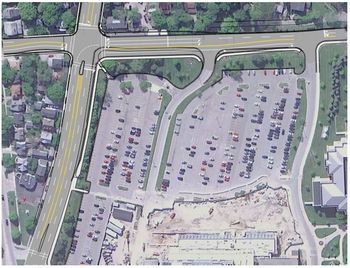
Improvements are planned at the Washtenaw/Oakwood intersection bordering the Eastern Michigan University campus in Ypsilanti.
Courtesy of the city of Ypsilanti
Residents who live at the intersection Oakwood and Washtenaw questioned why the university invested so much money without allocating any toward the traffic issues. They say it has impacted their quality of life and argue a major overhaul of the Washtenaw and Oakwood intersection would be unnecessary if issues were addressed to the north of Washtenaw on Oakwood.
Frank Wright lives at the intersection of Cross and Oakwood streets. He said the problems have increased as EMU closed off roads on campus and continued building without accounting for how it would impact traffic.
"They spent a quarter of a billion on construction with no plans implemented for infrastructure," he said. "No developer would ever be allowed to put in a quarter of a billion of new building construction without also paying for infrastructure improvements before sticking the first shovel in the ground."
Leigh Greden, executive director of government and community relations for EMU, said the adjustments university officials made to the plans were well-received by planning commissioners. He said the university will make several other small changes before going to council.
“We did receive positive feedback, even from commissioners who voted against us,” he said. “I understand their frustration about the rest of Oakwood, but it is impossible for EMU or another governmental entity to make promises about financing capital projects in this current fiscal climate.”
Major changes planned at the intersection include adding a right turn lane to westbound Washtenaw before Oakwood and adding a left turn lane on southbound Oakwood before Washtenaw. A pedestrian island is expected to be installed along Washtenaw Avenue on the east side of Oakwood to improve pedestrian safety.
The city “owns” the road 300 feet north of Washtenaw Avenue, and the university owns the rest of Oakwood to the north.
Gillotti said city officials were pleased to see several changes to the plans after they were first presented to the planning commission in October. Striping and signage were added to prevent traffic on southbound Oakwood north of Washtenaw from blocking driveways. The university also has committed to adding a landscape screen to block some light coming from vehicles.
Oakwood's lanes will be slimmed to 11 feet, and officials want to create perpendicular curbs to shorten the span of the crosswalks. Gillotti said the distance across the intersection will be slightly shorter, despite adding lanes.
A smaller pedestrian island than originally planned will give traffic turning left from Oakwood onto Washtenaw more space. That will help address the concerns of a resident who lives on the intersection’s southeast corner, officials said.
The university also will install pedestrian sensors to trigger the crosswalk signals instead of requiring pedestrians to physically push a button.
EMU and Ann Arbor Transportation Authority officials plan to discuss the possibility of moving a Washtenaw Avenue bus stop just east of the intersection a bit more to the east.
In a separately funded project, EMU officials also are considering how to improve flow into their parking lots — specifically the McKinney lot, which sometimes backs up into Washtenaw Avenue.
Wright said he credits the current EMU administration for improvements, but said the university is still the "800-pound gorilla on the block."
Gillotti said despite some difficulties, the process has been open and positive so far. But she said communication between the city and EMU needs to remain that way.
“We would like to know what they have on the pipeline. It would help for our own planning,” she said. “College Place was really successful, and I think more of that can happen, but it's going to take sustained communication between to two entities to get to that point.”
Tom Perkins is a freelance writer for AnnArbor.com. Reach the news desk at news@annarbor.com or 734-623-2530.
Comments
joe golder
Thu, Nov 25, 2010 : 5:03 p.m.
I'm not looking forward to moving snow from a 5th lane up hill.
joe golder
Wed, Nov 24, 2010 : 4:36 p.m.
Thank you James Todd! Anyone missing a car part?
James A Todd
Wed, Nov 24, 2010 : 3:21 p.m.
I totally understand how Joe Golder feels. I lived at 1002 Washtenaw for close to three years and the traffic congestion has gotten progressively bad over the years since the size of the road was increased. If the university is willing to spend the money they are spending to improve and develope the campus, then some funds should be spent to relieve the traffic issues on that intersection. It seems like the city of Ypsilanti is allowing EMU to make physical changes to the campus and the areas around it without the imput of the residence who pay the taxes. I'm waiting to see the outcome of the 3 to 3 vote will be.
joe golder
Wed, Nov 24, 2010 : 9:12 a.m.
The traffic coming into this main entrance is equal to several walmarts.If walmart wanted to put something here the whole town would show up ready to tar and feather someone. Is getting people from normal park to work more important than our home owner rights? in the fall its christmas at briarwood for 7 weeks. big deal you get them in and out faster. we still have to endure the hell they bring. is this a residential neighborhood. NO, NO No i hope the council members aren't in denial. I also hope any council members who were on the council in 1999 stay out of this and don't vote. certainly we would not be here if they did their job back then.
joe golder
Tue, Nov 23, 2010 : 11:05 a.m.
How irresponsible could the city be to allow a main entrance to a major university 15' from a residential home? Oh! and who does emu think they are? Governor Snyder please help us!
BobFox
Mon, Nov 22, 2010 : 1:46 p.m.
Where are the bicycle and pedestrian counts? This grant is supposed to reduce vehicle emissions by improving the flow of people on and off the EMU campus more efficiently? What about planning for bicycles and pedestrians? Is there anything that reduces emissions more than using those modes of transportation? Yet I don't see any planning for bicycles. There has actually been consideration for reducing lane widths! Really? It's already hairy getting through there on a bike. And the only consideration for pedestrians looks to be an island in the traffic that will cause problems for residents in the 900 block of Washtenaw needing to go westbound on Washtenaw. EMU has stealthily transformed Oakwood at Washtenaw into the main entrance for the 5th largest university in Michigan. Look at accident statistics. The neighborhood has suffered in silence as ongoing piece-meal adaptations have rendered the intersections at each end of EMU's Oakwood corridor two of the most dangerous in the County! Step up EMU! EMU created these problems. It's time for a hundred year fix that includes safety and the needs of the community!
joe golder
Mon, Nov 22, 2010 : 11:04 a.m.
dc175 most of the students coming to emu are commuters. they have jobs,families and busy lives.walking across a huge parking lot during a mi. winter to stand waiting for a bus will not happen. there will be a bunch of empty buses running around spewing emissions. they will park as close as possible. emu knows this.
joe golder
Mon, Nov 22, 2010 : 8:47 a.m.
emu didn't build peninsula place, micky d's,the strip mall, river rain apartments. the city had an agenda in 1999 to move the students north of campus. it turned the area that used to be student housing into a eye sore. go city of ypsi. The whole corridor has to be re thought. Fixing that intersection certainly needs to be addressed. just ask all the people injured in the many accidents( highest accident intersection in the city, 6th in county) at that intersection. go city of ypsi. There will have to be a whole new plan for huron river drive,clark rd corridor and this issue has nothing to do with that gaffe. Were trying to fix this gaffe. The tax paying residents here at washtenaw and oakwood would like nothing more than others benefit from owning a home in a residential neighborhood. A yard you can use without getting killed. a place you can raise a family. emu should be paying for the restructuring of washtenaw and oakwood knowing what they had planned. Shame on emu, city of ypsi. the tax payers certainly shouldn't be footing the bill. we shouldn't even be talking about this. ypsi, county,and state should be working on money for huron,clark corridor. The agenda was so obvious in 1999. That whole corridor was another catastrophic gaffe committed by the city. The list is getting long. If your using a gps and punch in emu where will it take you?
DC175
Mon, Nov 22, 2010 : 12:53 a.m.
EMU has plenty of parking, but the students don't use what's there due to a lack of a proper every-5-minute parking shuttle. The vast parking lots North 1 and North 2 are never anywhere near capacity. Purchasing or leasing a couple of buses to create a continuous circuit from there to the west circle drive loop would be much more cost effective than building more parking slightly closer.
wait.think
Sun, Nov 21, 2010 : 9:36 p.m.
I am a resident of Ypsilanti and a graduate of EMU. The Washtenaw/Oakwood intersection needs this improvement. Everyone who travels through that area knows why. Here are a couple more things on my wish list: 1. EMU - Put in more parking spaces. LOTS more. If every driver knew there was a going to be a place for them, there would be fewer "parking lot aggression" incidents. There's open land available on campus. Build a beautiful parking structure. 2. Consider an intersection improvement at the other end of Oakwood, at Huron River Drive. A left-turn lane for westbound drivers sure would smooth things out, not just for travelers to EMU, but for those going to WCC, and the St. Joe complex. How fun would it be to reduce that area to just three lanes instead of four to accomodate the left turns? Ypsilanti is a GREAT place to live. Eastern Michigan University is a wonderful institution. Let's all work to make it even better!
joe golder
Sun, Nov 21, 2010 : 5 p.m.
Thank you gardengoddess. The pollution is really bad too.There will always be traffic piled up somewhere at the intersection so where is relief from emissions. Gee! a cmaq grant(congestion mitigation air quality) without an environmental impact study go figure. This is another money grab by a irresponsible selfish state institution that could be used better somewhere else. deja didn't this happen the same way in 1999? Hey emu planning 101 infrastructure first. The last time they widened the they used a mir( Michigan institution road fund grant) grant on a city street without a public hearing that would have exposed emu's move west and given the residents an opportunity to ask important questions. There has never been a environmental impact study done period. three quarters of a million in new buildings and renovations and emu can't afford a proper driveway. poor emu# The only traffic study done was for emu and by emu The heavy truck traffic 24/7 will rattle your house real good too 24/7. I think its past time the city and emu step up to the plate and come up with a 100 year fix. Enough with the triple standards.
Garden Goddess
Sun, Nov 21, 2010 : 9:28 a.m.
Yes the intersection is a huge headache, and living near it is not a picnic either. EMU should work with the city to plan more parking on the EMU campus, diverting traffic and parking away from established residential areas that are a large tax base for the city. Maintaining our neighborhoods to maintain that tax base is vital. A large traffic zone surrounding your home year long does nothing to enhance it's value. It is not only the traffic congestion to think about it is the noise, heat from more asphalt, and increased lighting. More parking on the north side of campus could divert traffic down Huron River Drive and lower the traffic on Washtenaw. This could also improve foot traffic and increase security for the student population by enhancing more lighting and security on that side. Having large green spaces are beautiful, and we need that more on the West side of campus to maintain the beauty and quality that many of our neighborhoods in Ypsilanti strive to maintain. Thank-you board members that voted no, this plan needs more thought. EMU has land that they could utilize, not my backyard, sideyard or frontyard. EMU needs to work with the city to work on a plan for increased commuter traffic, pedestrian safety and the neighborhoods that surround them to develop a plan to improve and enhance all.
BobbyJohn
Sun, Nov 21, 2010 : 12:09 a.m.
Pedestrian sensors instead of a button to push?? That's crazy! If someone is waiting at the corner that will create an even worse traffic jam.
dading dont delete me bro
Sat, Nov 20, 2010 : 5:09 p.m.
i see, "my luggage", i.e. "my bag" i see the planning committee should drive by there the beginning of a semester than.
eastsidemom
Sat, Nov 20, 2010 : 5:06 p.m.
dading: the planning commission is who voted. read "developed plan to widen the intersection of Washtenaw Avenue and Oakwood Street is going to the Ypsilanti City Council without the planning commission's recommendation.The project will next go in front of the council at its Dec. 7 meeting." It is a terrible intersection that needs addressing.
dading dont delete me bro
Sat, Nov 20, 2010 : 4:52 p.m.
i charge each council member that voted this down to drive that intersection when semester starts. we'll see if they change their vote next time around.
eastsidemom
Sat, Nov 20, 2010 : 3:54 p.m.
thanks Tom
Steve
Sat, Nov 20, 2010 : 11:30 a.m.
Pedestrian 'censors' (6th paragraph from the end)? Those lippy pedestrians!!
Tom Perkins
Sat, Nov 20, 2010 : 9:52 a.m.
eastsidemom, Yes - Rod Johnson, Gary Clark, Dan Lautenbach No - Bret Lenart, Brian McClemens Mark Bullard Absent - Richard Murphy, Cheryl Zulleg, Joe Schultz
eastsidemom
Sat, Nov 20, 2010 : 7:50 a.m.
So who is on the planning commission and who voted this down? And who wasn't there to vote on this important piece of improvement that is funded? This seems like the case of the perfect being the enemy of the good.