

Ypsilanti to offer three weekly farmers markets this year, with focus on local vendors
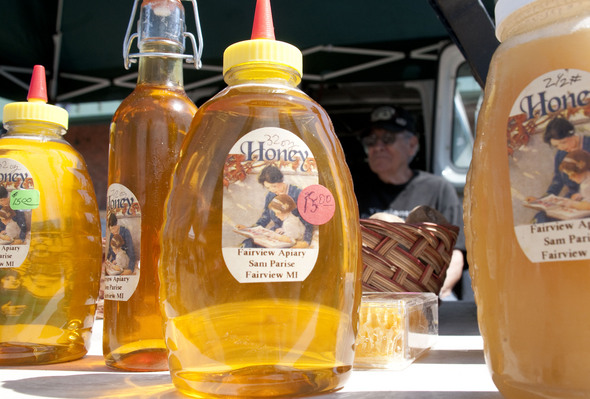
Sam Parise sells honey from his Fairview Farms at the Depot Town Farmers' Market. He is helping open a third farmers' market in Ypsilanti.
Tom Perkins | For AnnArbor.com
He was one of the roughly 100 people an hour to visit the Depot Town Farmers' Market under a clear blue sky on its opening day May 7. Like other shoppers there, he was pleased to see a new option for buying food open for the season.
The Depot Town market is one of two farmers' markets in Ypsilanti, and a third is planned to open in June.
Strassel, an Ypsilanti resident, said one of his main motivations for doing business there was to support the local vendors.
“It’s small but it has a lot of nice goods,” he said. “I make a point to come because it won’t grow if you don’t do business here. Anything you can buy at Meijer that you can buy here instead supports" local vendors.
According to Ypsilanti historian James Mann, a farmers' market was first established in 1919 in the city, and one has operated almost continuously at various locations since.
So why are the markets such important fixtures in a relatively small city like Ypsilanti?
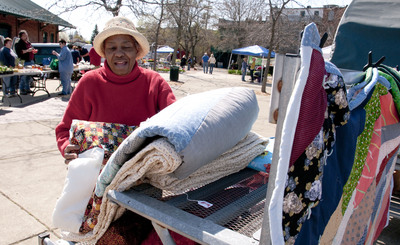
Maggie Minor of Maggie's Baked Goods and More folds some of the quilts she made and sells at the Depot Town Farmers' Market.
Tom Perkins | For AnnArbor.com
“Ypsilanti is a food desert,” she said.
Aside from the Ypsilanti Food Co-op, there simply aren’t many options for buying fresh food in the city. There is a Kroger south of Ypsilanti on Whittaker Road and several large grocery stores west of the city in Ypsilanti Township, but the farmers' markets are the only venues that offer locally grown fresh food and support the Michigan economy, Weise said.
“We have no grocery stores and people want to get outside and be a part of their community, get to know their neighbors and their farmers and actually talk to people who are growing their food,” she said. “You don’t have that customer service at a big grocery store.”
And, she theorized, unlike other communities, Ypsilanti’s residents are more “salt of the earth” people dedicated to supporting their community’s efforts.
The Depot Town Farmers' Market operates Saturdays from 8 a.m. to 1 p.m. and averaged 15 vendors weekly last year, though Weise said she hopes to boost that number to 20 to 25 this season. Depending on the month, different vendors offer different foods and goods, including everything from baked goods to plants to quilts to produce.
Weise said she also hopes start a monthly newsletter, bring back live music and develop partnerships among Depot Town and downtown businesses and the market.
She will also have her own table on the second Saturday of each month for her kid-friendly project, Second Thoughts. With the help of Dreamland Theater, Weise will take discarded materials from Maggie’s Organics, make puppets out of the materials with kids, and put on puppet shows.
On Tuesdays, the Growing Hope-run Downtown Ypsilanti Farmers' Market is open from 2 p.m. to 6 p.m. on Ferris Street between South Adams and South Hamilton streets. It is the larger of the two markets, with over 30 vendors in the season’s peak and between 600 to 800 people weekly.
Both markets accept EBT cards and the Downtown Market offers “bonus bucks”, which give EBT users up to $10 in matching EBT dollars to spend on food.
The Downtown Market also participates in the WIC Project FRESH and Senior Project FRESH, as well as the Washtenaw County Public Health Department’s Prescription for Health Program. Those programs provide coupons to low-income families and seniors to buy fresh Michigan-grown produce at farmers markets.
Downtown Farmer’s Market manager Christine Easley is in her first year and highlighted several changes and new ideas implemented for 2011. She said the market’s focus will remain on providing the community access to healthy food, but organizers are also trying to make it more attractive to families by providing live music and a clown who will do face painting, for example.
Starting in June, a nutritionist will be on site to provide information about the produce and to hand out recipes for cooking foods and vegetables that might be unfamiliar to shoppers. Food Gatherers will also be at the market weekly to help sign people up for EBT cards.
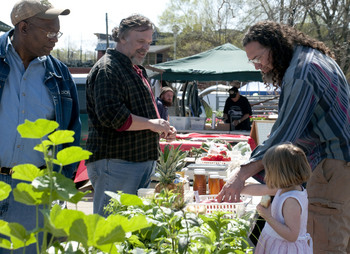
A family picks up apples at opening day of the Depot Town Farmer's Market.
Tom Perkins | For AnnArbor.com
Once a month, Saint Joseph Mercy Hospital will help focus on the health of particular demographic. For example, there will be a senior health day or a children’s day near the start of the school year at which kids could get immunized.
Many vendors set up tables in Depot Town as well as downtown. While some residents say they go to both markets, vendors say the downtown market is more accessible to residents at a nearby senior center and residents on Ypsilanti’s south side and gets different residents out.
Maggie Minor and Priscilla Williams are a mother-daughter team from Ypsilanti who run Maggie’s Baked Goods and More, and sell at both markets. Minor said there aren’t many places to get fresh-baked pound cake, carrot cake, navy bean pie or the other baked goods she offers in Ypsilanti, so their business does well at both locations.
Erik and Amalia Ambessa work at Belleville’s Green Diva Farms, which also has a table at both markets.
Like others, they said there are numerous advantages to buying food from Ypsilanti’s markets.
“You support local people, the local economy, and the food is fresh and from close to where it was grown,” Erik Ambessa said. “People can have a direct relationship with the person who grew the food — they can come here and actually talk to us.”
One of Growing Hope’s core missions is to provide greater access to healthy food, and Amalia Ambessa said bringing fresh, organic food to more tables is what their farm does. Because food begins to lose its nutrition as soon as it’s picked, she said, locally grown food is naturally healthier.
“If you can eat it soon after it’s harvested, then you get more nutrition, you get fed more, you feel more filled up, and you have a healthier body,” she said.
In addition to the Tuesday and Saturday markets, Sam Parise, who runs the 120-acre Fairview Farms and sells honey and other food at the markets, said he is planning to start another market on Fridays outside the Ypsilanti Senior Citizens' Center at 1015 N. Congress Street.
That market is scheduled to open June 3 and run from 2:30 to 6:30 p.m.
Tom Perkins is a freelance reporter for AnnArbor.com. Reach the news desk at news@annarbor.com or 734-623-2530.
Comments
Amanda Edmonds
Tue, May 17, 2011 : 7:29 p.m.
I need to counter the suggestion that farmers' markets are food for the rich. The Downtown Ypsilanti Farmers' Market mirrors many other farmers' markets across the United States, which were begun specifically to provide *affordable* healthy food for people in our community who otherwise have limited access to it. Our market in its five years (this is our sixth) has done that; over 20% of market sales are to persons using food stamps or other similar programs available to low-income families. That doesn't take into account the additional or supplemental cash sales from the market. In 2009, the market brought in $108,000 in sales to local vendors, many of whom are low-income by our region's metrics; there were over 15,000 visits to the market that year, and over 1/2 of customers reported also frequenting other downtown businesses and institutions when they come to market. In peak season, that's over 800 people in our downtown in just 4 hours on a Tuesday afternoon, which contributes positively to downtown vitality and safety. If you'd like to read more about these metrics and other measured impacts, particularly as related to creating affordable healthy food opportunities, you can do so here: <a href="http://www.growinghope.net/programs/market/impact" rel='nofollow'>http://www.growinghope.net/programs/market/impact</a> Additionally, several studies have proven that fruits and vegetables farmers' markets are often in a similar price point or less expensive than other sources. You can read some of them here: <a href="http://politicsoftheplate.com/?p=864" rel='nofollow'>http://politicsoftheplate.com/?p=864</a> (summary of the two reports below) <a href="http://nofavt.org/pricestudy" rel='nofollow'>http://nofavt.org/pricestudy</a> <a href="http://www.leopold.iastate.edu/pubs/staff/prices/prices.pdf" rel='nofollow'>http://www.leopold.iastate.edu/pubs/staff/prices/prices.pdf</a> The pricing structure at markets is generally different than at groceries-- i.e. in Michigan we don't often sell by the pound at farmers' markets (in some other states that's standard)-- so comparing quarts or pounds can be difficult. Some individual items might be more expensive, but overall these studies hold true in most communities. I welcome anyone to visit!
foodfighter66
Mon, May 16, 2011 : 6:26 p.m.
& I echo the comments above about the Ypsi Food Coop and Dos Hermanos--they are both full service groceries with more than their fair share of both everyday & exotic items. Thanks Lisa for pointing out Sunshine market & I would add there is also the Asian Grocery Store next to Asia City restaurant on Washtenaw. So while I agree that many parts of Ypsilanti would be definitely considered food deserts due to the absence of a chain grocery stores, I would also say that Ypsilanti has many more sources of fresh, local food than most cities of its size. FYI: I would point out that *both* markets accept EBT, "DoubleUp FoodBucks", WIC Project Fresh and Senior Project Fresh and that the Depot Town Market has been around officially since 1978 while the Downtown Market is currently in its 6th season.
foodfighter66
Mon, May 16, 2011 : 6:08 p.m.
Ypsi already has a third farmer's market, run by St. Joseph Mercy and farmer Dan Bair of 'the Farm at St. Joes'. See: <a href="http://www.annarbor.com/entertainment/food-drink/st-joseph-mercy-ann-arbor-talks-about-expanding-farm-to-include-fruit-orchard-community-gardens/">http://www.annarbor.com/entertainment/food-drink/st-joseph-mercy-ann-arbor-talks-about-expanding-farm-to-include-fruit-orchard-community-gardens/</a> But does anyone have more info regarding the other Ypsi farmer's market described in the article? Who will be running it & which vendors will be selling there? This is the first I've heard of it & it's supposed to be opening in June? I would like more info, please & Thanks!
Joe
Sun, May 15, 2011 : 7:46 p.m.
The wording of the statement from Kate Weise is misleading. The Ypsilanti Food Co-Op does sell locally grown produce nearly year round. In the last week, they've carried local asparagus, chard, spinach, mixed greens, radishes, onions, shiitake mushrooms and rhubarb, and the amount of local produce will increase throughout the summer. They sell other Michigan agricultural products, such as flour and beans. They also have a wide variety of products made in Michigan, such as jams, hot sauce, salsa, beer and wine, chips, bread, pasta, etc. The farmers markets and the Food Co-Op are both great ways to support the local economy.
Lisa Bashert
Sun, May 15, 2011 : 3:08 p.m.
Really glad to hear about the upcoming market at the Senior Center. I shop at both markets and love them both for different reasons. I worked at both markets last year and they continue to improve. One thing not mentioned was that Community Supported Agriculture is growing at both markets -- you pay for your share upfront and then pick up veggies all summer. Thus the farmer gets the money early, when it's needed, and the customer bears some of the risk. There are a number of CSAs at both farmers' markets -- it's another great way to get fresh food in Ypsi. Also, I was pleased to see the Ypsi Food Coop mentioned. The food coop is in Depot Town and does have a full-line of groceries, including meat and fish. It is open to all shoppers (you don't have to be a member to shop) and it's open 9 to 9 every day. Like Dos Hermanos, it's a viable option that is walkable & bikable. So that's just to say, while we don't have a chain grocery store, we do have some options in Ypsi. Some might argue that smaller shopping venues like the coop, farmers' markets, and Dos Hermanos (and the Sunshine Market at Mansfield & Washtenaw) are actually better for the community than chain grocery stores.
DFSmith
Sun, May 15, 2011 : 2:53 p.m.
According to the photo, that 32oz bottle of honey costs $15.00. This is probably the main reason, that, in these cash-strapped time, I avaoid all politically-correct farmers markets. Heck, even Whole Foods and Trader Joe's sell 32 oz bottles of honey for much less!!!!!
Lisa Bashert
Mon, May 16, 2011 : 9:40 p.m.
I'm glad to hear that your honey was American, DF. I'm a beekeeper myself, and struggling with the issues of Colony Collapse Disorder. Michigan beekeepers experienced 65-70% colony loss this past year (2010). Local honey is very precious and I suppose that accounts for the high price. I still don't agree that farmers markets are politically correct. Did you know that "fresh" produce at the chain stores is an average of 9 days old? Whereas, produce at the Farmers Market has likely been picked within 24 hours. Matters to me.
DFSmith
Mon, May 16, 2011 : 4:53 p.m.
LIsa, I checked, the bottles of honey i got from Whole Foods say, "Product of the USA".
Joe
Sun, May 15, 2011 : 7:36 p.m.
How would the term "politically-correct" apply to farmers markets? Is this the blanket term you use for anything that you distrust due to its positive benefits on yourself and the community?
Lisa Bashert
Sun, May 15, 2011 : 3:11 p.m.
I just read a recent study that showed that farmers' markets are the same or less expensive overall than chain stores -- and yes, honey from China and India ARE cheaper at the places mentioned. Check the bottle.
suem
Sat, May 14, 2011 : 1:14 p.m.
Spelling correction! That's Dos Hermanos.
goingfast3579
Sat, May 14, 2011 : 6:32 p.m.
You're right. That's a good little market. I like the Tamales and Homemade Salsa.
suem
Sat, May 14, 2011 : 12:55 p.m.
Downtown Ypsilanti has a grocery store. It's called Dos Ermanos and they have great meat and produce. The parking lot could use some work and the space isn't all new and glitzy but everyone should give it a try.
Gramma
Sat, May 14, 2011 : 1:41 p.m.
I agree that their meat and produce are excellent. Rather than one great big supermarket, small stores like this are great.
cmadler
Sat, May 14, 2011 : 1 p.m.
Yeah, Dos Hermanos is an excellent grocery store right downtown, and they generally have good selection of fresh produce and meats at fair prices.
goingfast3579
Sat, May 14, 2011 : 12:27 p.m.
That's good news a third location. I enjoy shopping locally and support both markets. But I have an idea since we can't get and keep job's in Ypsilanti and it's Twp. that pay a living wage. The closest store by I-94 and Emerick was closed. Some people have trouble getting around weather due to age, disability, transportation, low income etc. The nearest grocery would be south, east or west with no public transportation. The area does need a grocery store where you can buy meat, seafood, toiletries etc. that the market can't support. We don't need another park in Ypsilanti or a Rec. Center, Fast Food or Parking Lot. Sadly, Without job's the Bar's, Restaurants and film industry are not doing anything. If you want to keep applying for useless grants why don't you try to get a useful one. The property on Water Street would make a nice Grocery Store. We as a Community could Probably run it. With are vast experienced workforce. We could Work with education to set up management training program's, butcher's training(how many of those do you see) cashiers, stock, Purchasers, Food and Beverage, etc. Of Course for Local's first. I have never heard of such a concept maybe we could be the first. A lot has been said of Ypsilanti that it can't be done and it was. This was just a morning breakfast with Ann Arbor.com thought. Have a Nice Day.) 0
joe golder
Sat, May 14, 2011 : 5:17 p.m.
Brilliant Ideas!!!!!
Gramma
Sat, May 14, 2011 : 1:46 p.m.
We do, also, need parks and rec centers and other positive places for people to meet and interact.