

Ann Allen: A Southern lady's trip north to Ann Arbor
Ann Allen longed to join her husband, John Allen, who left hurriedly on a business trip to the East Coast hoping to restore his family fortune. He left her with a 1-year old child and no means of support.
She was widowed and had two children by her first, happy marriage. He had two children, was widowed, and was suffering under his father’s land speculation debts. He had hoped to use her inheritance from her first marriage to restore his family’s finances but failed.
Ann was reared by caring relatives, educated and sent to finishing school in Baltimore and found her first husband there, a distant relative from a well-to-do family studying medicine. The war of 1812 sent her back to Virginia soon after, and at age 16, she married the doctor who set up practice on his family estate. He died suddenly from typhoid fever five years after they wed leaving her widowed at 21. She was adrift …
John Allen needed a wife. Ann needed a husband and a future. They married in 1821, she bearing one child, a daughter named Sarah. The future turned sour as her husband’s finances collapsed. He left Virginia in the autumn of 1823 never to return. He knew the family properties were in foreclosure and his family had to be off the property by Oct. 1, 1824.
He was labeled locally as a cheat and scoundrel. The husband with borrowed money or the money of relatives took cattle to the east. He never returned to Virginia to settle his or his father’s debts. Rather than settle his debts, he took the cattle money and decided to go West to make money in land speculation. He made his way through Canada to Detroit hoping to invest in western land in Ohio. In a tavern he met Elisha Rumsey, charged with embezzlement in New York, who convinced him that Michigan was the promised land. They pooled their ill-gotten resources, and in early February of 1824 had found the spot on the Huron River which was to become Ann Arbor.
Imagine the shock to Ann Allen, when her father-in-law stopped by and either read or gave her a letter from her husband, John Allen, in August of 1824. Her father-in-law, Col. Allen, than told her family of his intention to take Ann, Sarah and his wife and youngest son and depart for Detroit to join his son in Michigan. Ann had mixed emotions. She would have to leave her sons from her first marriage to be raised by relatives and might never see them again. Her family and friends were distraught. They uniformly opposed her leaving her two sons to join a man they considered a scalawag. Yet she was sworn to go, having taken the unbreakable oath of obedience in her wedding vows as a devout Presbyterian.
Ann faced a daunting task. A mother with two young children left behind, she chose to follow her new husband. Ann was raised in the comfort of Southern gentry, educated in Baltimore and had servants perform the mundane chores of everyday life. She knew nothing of the frontier or the rigors of frontier life. Yet she was about to embark on a trip to a virtually uncharted destination along ill defined venues. Her brother-in-law, Turner Allen, who was part of the entourage to Michigan, kept a diary and wrote that their “... traveling out fit consisted of an old fashioned Pennsylvania wagon (covered) drawn by four horses, and three riding horses with saddles. The riding horses were a great convenience, for any one of the party becoming fatigued or weary riding in the wagon could relieve themselves by taking a ride on hose back.”
So on Aug. 28, 1824, Ann and the Allen family left Staunton, Virginia, and started their journey by covered wagon to Detroit with limited understanding of route, time, and difficulty. The Allens had to travel from Staunton to Lewisburg, Greenbrier County, to reach the Great Kanawah River Road, a distance of roughly 100 miles. Once they left Lewisburg, life changed dramatically. Part of the road was turnpike, making for easy going, but beyond the turnpike the road was very bad. Not only had the road changed, but the living accommodations had as well. After leaving Lewisburg, Turner Allen recalled, “not one of the parties slept in a house during our long and tedious journey to Lake Erie. We had a good tent which we pitched every night, and which was occupied by all our company except Mr. Barnes and myself…”
The Allen family traveled the Great Kanawah River Road until it ended at the Ohio River north of Gallipolis. They crossed the river in heavy rain on a ferry. The roads that were impassable by wagon forced the family to send their belongings down river by barge to Gallipolis. The party then traveled up the Scioto River and through the Ohio towns of Chillecothe, Columbus, and Marion; Marion being the last vestige of civilization, beyond which the area was “new and sparsely settled.”
From Marion they headed toward the Black Swamp at the head of Lake Erie. Finding the Black Swamp impassable, they were guided around it “over the Prairie and around the Swails” to a road leading to Sandusky, Ohio, where they hoped to catch the only commercial steamboat sailing on Lake Erie that occasionally stopped at Sandusky. When it did not stop after several days, the Allen’s hired a schooner (sailboat) to take, them and their belongings from Sandusky across Lake Erie to Detroit. The horses, which were indispensable, had to be walked through the Black Swamp by the youngest Allen and the only non-family member of the party.
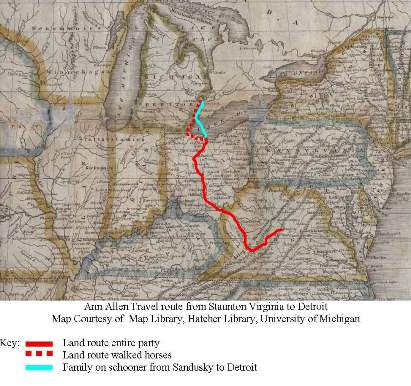
Ann Allen's Trip North
So the Southern Lady, Ann Barry McCue Allen arrived, completing the trip from a manor brick residence of landed gentry to a frontier log cabin.
The trip from Staunton to Ann Arbor took the Allen clan nearly two months. Today a trip over the road from Staunton Virginia to Ann Arbor takes less than 10 hours and covers less than 400 miles.
Most of the material in this post was drawn from Bidlack, Russell E. , "Ann Arbor’s First Lady", Bentley Historical Library, University of Michigan, November 1998
Comments
Peggy Lampman
Thu, Dec 3, 2009 : 6:32 p.m.
I enjoyed the story! My mother is (was) named Ann Allen and lived in the south all her life. She always was amused by this story. Thanks for refreshing the town on our history! Peggy