

New global safety standards for nuclear power?
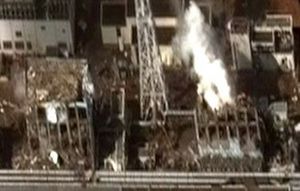
Reactor Units 3 and 4 at the Fukushima I Nuclear Power Plant in Japan on March 14, 2011. That day an explosion in Reactor 3, at right, was caused by a build up of hydrogen gas.
Photo courtesy of Wikimedia Commons
Our hearts go out to the people of Japan. The news today is even worse than yesterday, which was worse than the day before. Now, there’s evidence of plutonium leakage, and a partial meltdown might be under way. At the same time, it’s hard not to be concerned about radiation reaching the U.S., especially the west coast. Are you worried?
About four of 10 Americans are at least somewhat concerned, according to a recent poll by Rasmussen Reports. Fifteen percent are really concerned. It surprised me to learn that the level of worry now is lower than it had been last week. Even more surprising, Americans who live on the west coast — Oregon, California, and Washington — are a bit less concerned than Americans living in the rest of the nation.
Americans have been affected by radiation before. Those born in the wrong place at the wrong times died from leukemia and other cancers at rates higher than the rest of the population. Starting in the early 1950s, hundreds and hundreds of nuclear tests were held at the Nevada Test Site.
This was before we understood the dangers of radioactive fallout. At the time, tourists would flock to Nevada to see the mushroom clouds.
The so-called downwinders — especially children living in Utah and born between 1951 and 1958 — suffered a pronounced increase in cancer deaths. (Click here to read more about the Nevada Test Site and see a national map of the exposure area.)
This, of course, is an entirely different situation from the tragedy in Japan. But it goes to show that we have a lot of evidence — and a lot to think about — when it comes to reliance on nuclear power.
Some, including French President Nicolas Sarkozy, believe nuclear power itself isn't the problem. Sarkozy visited Japan this week, where he called for new global safety standards for nuclear power plants. France hosts the G20 meeting next month and Sarkozy wants the topic on the agenda.
“The problem is more about establishing safety norms than it is about the choice of nuclear energy, for this there is no alternative right now,” explained Sarkozy. “We must address this anomaly that there are no international safety norms for nuclear matters. We want international standards because the world is a village and what happens in Japan can have consequences elsewhere.”
The disaster in Japan may be a wake-up call for nuclear energy. It has triggered debates everywhere about the nuclear energy, renewable energy, natural gas, and dependence on oil. This debate also seems to have hardened both pro-nuclear and anti-nuclear sentiments.
Do you think the answer is better global standards?
Would that make you feel safe and secure?
Is that even the right question to be asking?
Dr. Wayne E. Baker is a sociologist on the faculty of the University of Michigan Ross School of Business. Baker blogs daily at Our Values and can be reached at ourvaluesproject@gmail.com.