

Do we need a third party to find a true statesman?
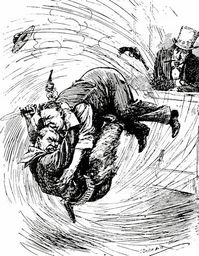
THIRD-PARTY BATTLE IN 1912: Punch published this cartoon showing President Taft and former President Roosevelt fighting to the death in a saloon. Taft wields a Bowie knife; Teddy Roosevelt is firing a six-shooter. Uncle Sam watches the fight from the safety of the bar.
Photo courtesy of Wikimedia Commons.
Editor's note: This post is part of a series by Dr. Baker on Our Values about core American values. This week Dr. Baker is discussing the concept of a "statesman" — a woman or man in politics who is a virtuous leader, one who puts the public good above partisanship.
Is it time for a third political party?
Is that how we’ll find true statesmen? Third parties haven’t done so well in the past, except as spoilers in presidential elections. Theodore Roosevelt’s “Bull Moose” bid for the presidency in 1912 is considered the most serious third-party challenge — and he didn’t win.
But the idea is popular once again!
The majority of Americans believe the two parties don’t represent the American people and they want a third party, according to a new Gallup survey.
Gallup has asked since 2003 about preferences for a third party. There have been only two other times when a majority of Americans said they wanted one: 2007 and 2010.
This time, however, is the first time that a majority of Republicans say they want a third party. Maybe it’s because the current field of GOP candidates is “unimpressive.” That’s the most frequently used word to describe the current GOP candidates, according to a Pew poll.
Tea Party supporters are likely to opt for a third party: 60 percent say they would like a third party. Given the strong, partisan views of Tea Party activists, I doubt that anyone we would consider a statesman would emerge from their ranks. The classic definition of “statesman” involves rising above partisan politics to serve a greater public good.
Is it time for a third party in American politics?
Or, is the search for a statesman in America a futile quest?
Know a statesman? Nominate her or him for The Lincoln Award for Statesmanship. This non-partisan award is given annually by The Statesman Group.
Dr. Wayne E. Baker is a sociologist on the faculty of the University of Michigan Ross School of Business. Baker blogs daily at Our Values and can be reached at ourvaluesproject@gmail.com or on Facebook.
Comments
Dog Guy
Sun, Jun 12, 2011 : 2:29 a.m.
This essay is puzzling to AnnArborites. How about a second party or even a one-and-halfth party here?
BhavanaJagat
Sat, Jun 11, 2011 : 3:45 p.m.
We are looking for a man or a woman in politics who is virtuous and places public good above partisanship. How could this requirement be satisfied by the creation of a Third Political Party? We have to conclusively demonstrate that the existing Political Parties have intrinsic problems and hence can not produce leaders with the above defined qualities. The issue is not about partisan political agendas. We are discussing certain human qualities. Creation of any number of new political parties would not change the situation.
Technojunkie
Sat, Jun 11, 2011 : 1:51 p.m.
The goal of the Tea Party is to elect competent candidates who obey the Constitution in the Republican primaries so we can avoid the third party spoiler problem. In theory we could do the same in Democrat primaries but it doesn't look to be worth the effort. There's enough trouble wading through all the RINOs trying to co-opt the Tea Party movement when they're not trying to keep us out, Democrat water carriers in the MSM attacking us, Democrats funding fake Tea Party candidates, overcoming decades of government school indoctrination in our own ranks, etc. And then we have to find candidates willing to put their families through this mess and run for office. Honestly, when alleged "Tea Party" candidates speak of "saving" unconstitutional progressive programs to the applause of many of our members it's difficult to be hopeful.
demistify
Fri, Jun 10, 2011 : 4:14 p.m.
There was a third party that elected a President (on its second try), the Republican Party with Lincoln. The Progressive Party continued after Teddy Roosevelt, led by the respected Senators LaFollette. In both of these cases, the new party had a serious program as an alternative to the existing ones. Other parties with a clear philosophy that broke a million votes in the early twentieth century were the Socialist Party and the Prohibition Party (whose platform extended far beyond liquor). Other third parties have come and gone, most often as a flash-in-the pan associated with a short-lived protest or candidacy (e.g. Strom Thurmond and Henry Wallace in 1948, George Wallace, Ross Perot, Ralph Nader). The vestigial current third parties are marginal out-of-the-mainstream cults. The polls cited by Baker trivialize the issue. They are "none-of-the-above" votes, not an endorsement of a real third party movement. The "Tea Party" is also just a fuzzy expression of dissatisfaction.