

On iPhones and love: How deep is your smartphone obsession?
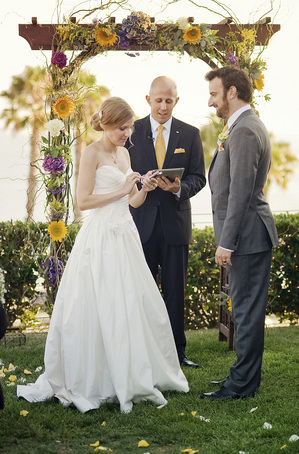
Groom James Williams watches his bride Lauren Barnes use her iPhone to accept his Facebook relationship status change to married during their wedding Sept. 3 in Long Beach, Calif.
AP Photo/Luminaire Images Photography, Molly Yarchin
It was a column in the New York Times a few days ago about a new study finding that iPhones activated parts of the brain normally associated with feelings of love and compassion. Subjects weren’t just addicted; they loved their iPhones, the author said.
It ended with advice to “Shut off your iPhone, order some good Champagne and find love and compassion the old-fashioned way.”
Ha, I thought, remembering two friends of mine recently talking about how they both sleep with their iPhones — in bed, on the pillows next to them.
For a minute I felt really smug about my relationship with my Android. I mean, I have it with me constantly during the day, and it recently took up nighttime residence on my bedside table. But at least it’s not in bed with me. So clearly I don’t love my smartphone like those silly iPhone users.
Except… then I remembered a night last week, when I was forced to do exactly what the writer advised. My husband and I had arranged our first date in oh, about two months. As he dropped me off at the restaurant door and drove away to park the car, my stomach dropped.
I had left my phone at home on the charger.
After thinking a few choice words, I quickly started to formulate a plan. Here was my approximate thought process:
I’ll call my husband and ask him to run back home. No, I can’t call without a phone.
OK, once he gets here, I’ll use his phone to call the sitter, and ask her to bring it to me. No, that’s ridiculous to have her pack up the kids and come downtown just to bring me my phone.
So, I’ll call the sitter, and ask her to keep an eye on my phone to see if I get any texts or chats. No, that would be weird.
Maybe I could just check my email on my husband’s phone. But no one emails me with urgent messages.
As I sat waiting for him, I felt jittery. I longed to be able to whip out my phone and make the rounds.
When he walked in, sat down and pulled out his own Droid, I felt a stab of jealousy. My eyes flicked to it, looking for the telltale flashing green dot — today’s version of “You’ve got mail," or a text, or a chat, or a Facebook message, or a Twitter mention…
There was no flashing light, but he quickly went about checking in to the restaurant on Facebook, while I tapped my foot.
I told him I had forgotten my phone. He looked at me with unmasked glee.
“So I guess I’ll have your full attention tonight,” he said. I made a face, but he didn’t notice because he’d gotten a reply to his check-in.
Despite my initial uneasiness, I forgot about my missing phone quickly enough, and relaxed into an easy dinner conversation.
But later in the evening he excused himself to visit the men’s room. As he left, he took his phone.
“Why don’t you leave it here”? I asked, feeling a sudden desire to check the latest headlines, at least. He laughed and walked away.
When we got home, after paying the sitter and checking on the kids, I went directly to my phone. OK, OK, I didn’t even check on the kids first.
I had a couple of missed calls, a couple of texts and a gchat, and I texted them all back immediately. All were for different reasons, and all evoked a different feeling.
Looking back on this, something struck me that should be very obvious, where the column got it wrong. Several scientists have harshly criticized the study for misinterpreting the data, but I think even if the data was right, the conclusion was faulty.
It’s not the device, but the people behind the communication the device facilitates that evoke those warm, connected feelings.
I’m reminded of growing up, how much my mom clearly looked forward to getting the mail every day. I teased her occasionally about her obsession, because she usually just got bills and junk. But I knew it was the occasional letter that fueled her interest.
It never occurred to me that she might be in love with the mailbox.
The relationship to our smartphones is similar, but amped up by the volume of communication we receive. By repeatedly connecting with people we care about through our phones, I think we do develop an affinity for them in classic Pavlov style. But take away those personal experiences, and I would love my cherished Droid about as much as I love a calculator.
Jen Eyer is director of audience engagement for AnnArbor.com. Make her green light flash at jeneyer@annarbor.com or (734) 623-2577.
Comments
treetowncartel
Thu, Oct 6, 2011 : 4:15 p.m.
Here is a great cocktail party question. What is worse to misplace/lose/have stolen, your keys, wallet/purse or smart phone?
Matt Whale
Thu, Oct 6, 2011 : 2:56 p.m.
I would have a cell phone/iphone free get togther or party and the organizer would tell everyone that. If a person accidently brings their cellphone, I would have a little 'prison' to put it in. Each time a cellphone in the prison rang, an angel would get his wings. I will bet a lot of angels would get their wings that night.
Jen Eyer
Thu, Oct 6, 2011 : 9:09 p.m.
I love this idea!
Jen Eyer
Thu, Oct 6, 2011 : 2:46 p.m.
Puncturedtime: (Great screen name, by the way) You're right on about the flight from introspection. I wanted to keep this one lighthearted, but there is an angle there that is probably worth another column. I used to be quite content to spend time reflecting, and I used to have a lot more time to do it. Now it takes conscious effort and discipline.
Jen Eyer
Thu, Oct 6, 2011 : 9:06 p.m.
I don't know that I have any great words of wisdom here, but my husband and I do make a conscious effort to make sure the phones don't take over our lives. We've actually only had them for a year... we held out for a long time because we too were afraid of what would happen. But we set aside a certain amount of time each day to spend both with each other and with the kids without any tech interference. What I don't do, but should, is also set aside time for my own personal reflection. So I really appreciate your comments!
puncturedtime
Thu, Oct 6, 2011 : 3:17 p.m.
I'm really glad you interpreted my comment like that and feel that way. I didn't mean it negatively towards you. I really enjoyed how you were fully aware and examined your natural train of thought from the moment your husband dropped you off phoneless. It's that intense introspection, and realization that you're partially dependent on this metal device, that should illuminate how profound and rare our unencumbered, real life interactions with special people can be. Obviously you're conscious of the multi-faceted perspectives you could approach this topic with..I personally won an Android in a contest and am afraid of what would happen if I activated it, so instead it sits alone in its case. I'd like to hear your take on what we can do now that there's no going back.
Gordon
Thu, Oct 6, 2011 : 2:34 p.m.
Funny story. We are all different. A tool is a tool. How you use the tool is the definition. Think my Android & I realize it's a tool. Makes a connection, involves setting a date / schedule, shares pics with those who are not there. Headlines are just that. In depth stories are better served up on the laptop longer period to read. Crutch? Yes, in that it keeps me on schedule. Allows me to inform the bride & vice versus because that's what's it all about. Nandy dandy tool.
Craig Lounsbury
Thu, Oct 6, 2011 : 2:31 p.m.
I'm in the (currently) 41% without one. Although that may change soon.
puncturedtime
Thu, Oct 6, 2011 : 2:20 p.m.
"So I guess I'll have your full attention tonight," he said. I made a face, but he didn't notice because he'd gotten a reply to his check-in. Although I know this article is written casually and light-heartedly and made me laugh at times, I found it pretty saddening. Honestly, I feel bad for you, Jen, and the many who suffer the same affliction. You seemingly and unintentionally portray yourself and your husband as more committed to your smartphones than each other. You claim it's the human connections on the other end of the line that you're actually in love with, but in the end, on your first date with your husband in 2 months, you were both entirely absorbed in escaping your real and intimate moments together. These real human connections that we prize so much actually pale in significance to the sense of importance and esteem we attribute to ourselves because we are always connected to everyone. To me, this modern obsession and addiction to the smartphone signifies an individual's subconscious desire to advertise one simple statement: "personal time with someone special is actually pretty disposable because I have 1000 other things I can occupy my attention with to ignore you." The mailbox analogy hardly applies -- you check the mailbox once a day to pick up your mail; you don't carry it with you everywhere you go, maintaining eye contact and mental focus on the mailbox in the hopes that you might receive a little letter that'll distract you from the actual concrete interactions you have. And Jen, is it really the love of the people on the other line that we're obsessed with? If it was, I doubt you would have been "feeling a sudden desire to check the latest headlines" in the 2 minutes you were alone. This flight from introspection or the opportunity to explore oneself in those spare minutes is what I really feel society is losing amidst their modernized obsession.
Christy King
Thu, Oct 6, 2011 : 1:17 p.m.
HaHAHAHAAHA! This.Was.Adorable. And sadly, so very, very true. God help us all.
Chip Reed
Thu, Oct 6, 2011 : 10:20 a.m.
It's certainly a trade-off between staying connected to your friends in the cyber-world and being present in the here and now. I don't doubt that phone messages seem quite real, but they aren't the same kind of "real" as everything else that's around you all the time.