

One thing is for sure in life, and that's change
What is it about humans that makes us think things will always be the way they are now? We can talk all we want about change to believe in, but, at some core level, we don’t believe ourselves when we do. I don’t mean social justice or the economy, but the stores and restaurants and radio stations and (gasp!) newspapers that we like. “Change” is really just a synonym for “life,” but we’re almost always surprised, often unpleasantly, when life hits us with a reminder of this.
Jacobson’s is long gone? Fresh Seasons and Shaman Drum have vanished? General Motors and Chrysler went bankrupt? How can such things be? Why can’t I continue to come downstairs every morning, grab my morning paper off the porch, and listen to that announcer I like so much while I make my coffee? I’m wearing a Michigan Radio sweatshirt as I write this. It dates back to the early ’90s, not long before WUOM and its sister stations morphed from a stagnant backwater in the National Public Radio empire that played classical music for a handful of fans to today’s wall-to-wall and hugely popular yakfest.
As one of that handful of fans, I wasn’t happy about the change, but even then I could understand why the people who ran the enterprise were eager to make it. That announcer I liked so much, along with most of the rest of the on-air staff, was summarily dismissed to clear the decks for the new format. Now he’s a dear friend, who I see at least once a week when I host a four-man Scrabble game at my house that’s become as important to us guys as I’ve heard a regular poker session can be for some other fellas. I’m planning to tug on his chain a bit by wearing this shirt next time.
I hope he’s amused. That would be a better response than bitterness and nostalgia, those fraternal emotional twins that too often accompany being old enough to have seen a lot of change. Better still is learning to stay light on your feet, a hallmark of aging gracefully, or at least bearably.
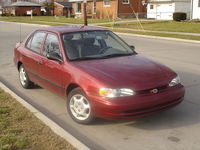
A 1999 Chevrolet Prizm.
From wikimedia.org
I drive one of their pre-crisis products myself. It’s officially a 1999 Prizm, but as my son the mechanic, who sold it to me, says, it’s really a Corolla wearing a Chevy bow tie. I’ve never been happier with a consumer decision. At roughly 107,000 miles, I feel as if it’s just nicely broken in. It still gets more than 30 miles per gallon and, in the eight and a half years I’ve owned it, has never failed to get me where I wanted to go, or needed a mechanical repair.
I have to wonder how many of the politicians who’ve hopped on the Toyota-bashing bandwagon, perhaps to satisfy the more jingoistic elements among their constituents, understand not only how many Americans are employed by this enterprise but also how salutary its effects have been in pressuring the domestic industry to pay attention to quality?
That said, it’s clear that even Toyota will have to change. I just hope it still finds a way to prosper, and stay a little lighter on its feet.
Jeff Mortimer is a freelance writer and editor who lives in Ann Arbor.
Comments
actionjackson
Thu, Mar 4, 2010 : 11:14 a.m.
When one looks at the amount of their Big Three automobiles that are produced in foreign countries it really isn't an American car. The Honda Accord is more N. American by far than the Ford Fusion. We're in a world economy and trade deficits are at all time highs.
Sarah Rigg
Mon, Mar 1, 2010 : 3:23 p.m.
My husband and I still own - and love- our 1996 Prizm, so I get where you're coming from on that one!
AAbob43
Mon, Mar 1, 2010 : 12:17 p.m.
Sadly, the instances of Americans fighting change (a losing battle) go well beyond department stores and public radio formats. Healthcare is an example. I'm a benefits lawyer. I see the system from the inside. A New York Times or Wall Street Journal article over the weekend indicated that if Nixon healthcare reforms had been adopted, we'd be trillions of dollars ahead; if Clinton's proposals had been adopted, we'd be $500 Billion ahead (these numbers are from recollection, but are surely close.) Yet people battle to save "what they have", not knowing that it will inevitably erode if we don't act to change the system. We have a largely employer-based system, but employers just can't bear the cost increases any longer. It's sad what a reactionary and fear-ridden country we've become. Not dynamic in the least. To fear change is to deny reality.
PeteM
Mon, Mar 1, 2010 : 10:27 a.m.
Jeff, As a life-long Ann Arborite, is it okay if I hold on to a bit of nostaglia for your "Dump the Dope" contests back in the 70s? I think that I won, or came close enough to get in the paper at least, back in grade school. This was an aside at the end of your column, but I want to comment on the Toyota issue. While I don't doubt that there is some xenophobia involved in the response, I also think that some of the folks glorying in their comeuppance are responding to the image of infallibility that they projected. The quality differences between domestic and Japanese makes and models has been small for years (admittedly Toyota still generally is at or near the top), and yet there was a perception in the media (and in good old A2) that buying anything other than a Toyota or Honda made you a sucker. My own experience includes my wife's 2002 Oldsmobile, made by a now non-existent division, which has had only brake work after 180,000 miles. It's true that many Americans' jobs (including a neighbor of mine) are tied to Toyota, but that number is still a small fraction of the jobs and retirement incomes tied to the Big Three. I would suspect that the number of Ann Arborites employed directly or indirectly in the domestic auto industry (especially Ford) is close to the number employed by U-M. Given that reality, it strikes me as ironic when a proud locavore drives her/his Accord or Camry to the Farmer's Market in part to keep their spending "in the community." Sorry for the rant -- I liked and agreed with your column and hope and expect that Toyota will recover -- but the last section struck a nerve. Pete