

Polar bears make Churchill, Manitoba, an Arctic treat
The accommodation that I stayed in, called the Tundra Lodge, consisted of five very large enclosed wagons hitched together, with metal grate decks between them. The place often shakes; high frequency shaking resulted from people walking down the hall or sometimes from strong wind gusts. Wider sways in the entire structure came when bears relieved their itches by use of the wheels and frames of the wagons. And on one occasion, the shaking came from a crude but ultimately successful attempt to repair the drain pipe from the kitchen sink using only a front-end loader, since it was too dangerous to get out of a vehicle to perform repairs on the exterior of the lodge.
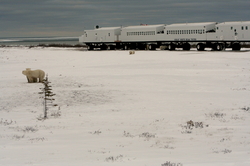
The Tundra Lodge near Churchill, Manitoba
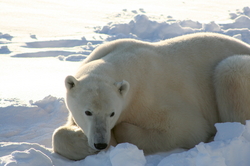
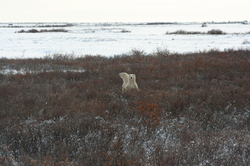
Churchill is called the Polar Bear Capital of the World, and if you get there at the right time of year, it exceeds all of the expectations that hang on this name. The reason why it is the polar bear capital stems from the habits of polar bears, coupled with the physical site of Churchill. Polar bears depend on sea ice as a platform from which to hunt seals. For about four months of the year, there is no ice on Hudson Bay and the bears do not eat. However, they know that because the fresh water that flows into the shallow bay from three rivers near Churchill raises the freezing point of the water, this is the first place to freeze in the fall and thus the first place where food becomes available. So Churchill is the place where the polar bears gather in anticipation of prey, and the tourists gather in anticipation of polar bears, with a small number of other arctic creatures thrown in — arctic fox, ptarmigan, snowy owl, and arctic hare, all of which, in my experience, required greater luck for a sighting than the polar bear. The northern lights can also often be seen there.
Churchill also played a major role in the early history of Canada. It was one of the main ports for the fur trading operations of the Hudson’s Bay Company, which, according to one of the chapter titles of An Illustrated History of the Hudson’s Bay Company by Peter C. Newman, is “the company that became a nation.” During the time of the cold war, the Churchill area hosted a base for joint operations of the Canadian and U.S. military, and its airport, despite having a tiny terminal that serves only chartered flights, has a runway long enough that it is listed as the 15th alternate site for space shuttle landings. Research facilities near town host work on polar bears and other arctic wildlife, and formerly operated a rocket range for use in study of the aurora (northern lights). Much of the activity in Churchill in current times revolves around its port, which still ships grain from the Canadian prairies around the world, as well as tourism. The freighter Ithaca, which broke a rudder in a storm and ran aground in 1960, still sits just offshore.
I am a traveler who usually prefers not to have a rigid travel package. However, to get the best experience in Churchill, I decided it was necessary to get a complete package. So I held my nose, paid the asking price, and got the best food and drink: rack of lamb, filet mignon, excellent soups and salads, unlimited beer and wine, and, in keeping with Manitoba tradition, breakfasts that included Red River Cereal. I also got a small cubicle with walls and bed made of particle board, and toilet and shower (of inconsistent temperature) down the hall. But I was simultaneously safe and surrounded by polar bears 24 hours a day, with daytime outings on the enormous tundra vehicles, which keep to marked trails to minimize impact on the local ecosystem. Also note that beds are available at 7 feet long, but the tundra vehicles are not that tall. Overnight stays for one night en route in each direction were at the Fort Garry Hotel in Winnipeg.
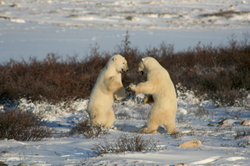
Young male polar bears spar when in close proximity near Churchill. Serious fights occur during the spring mating season.
Many travelers are expert photographers with high levels of skill and equipment. I came back a better photographer than when I went.
To learn some of the options in tourism in Churchill, see: EverythingChurchill.com Nathab.com Churchillnaturetours.com Frontiersnorth.com Greatwhitebeartours.com Seanorthtours.com Tundrabuggy.com Nature1sttours.ca Wapuskadventures.com Hudsonbayheli.com
Brent Lofgren is an Ann Arbor scientist and is the author of The Itinerant Chorister series on AnnArbor.com. He can be reached at ininchor[at]gmail.com. Factual contributions were made by Leah Okin-Magowan and Rinie van Meurs. Photographs by Brent Lofgren, with photographic coaching by Rinie van Meurs, Steve Rimer, and Alek Komarnitsky.