

Pondcast 6: Teaching science terms to tots; invertebrates identified
Alex Szumko chips through the ice at Black Pond to collect a water sample and measure the depth of the pond.
Sunday, Feb. 7, 2010
1:10 p.m.
24.5°F; -4.2°C
In Week 6, we headed out to the center of Black Pond to collect another water sample and take a depth measurement with a sturdier and longer measuring device - in this case, a bamboo pole and a tape measure. I was able to shove the pole down to a depth of 2.3 meters, which does go through 14,000 years of collected leaves, wood and anything else that has fallen into the pond during the millennia after the ice age. I could have gone a bit deeper, but I needed to be able to pull out the pole.
How thick would 14,000 layers of leaves and other vegetation be? Until we hear otherwise, let’s assume that a red or white oak leaf, which are most common around the pond, are 250 micrometers, also, microns (μm) thick - 0.25 millimeters (mm). We would need four oak leaves stacked on top of each other like pancakes to give us a thickness of 1mm. So, we get a maximum vegetal layer of 3,500 mm or 3.5 meters deep.
Where did the missing meters of vegetation go? Obviously the leaves did decay over time. The most common decomposers of leaves are bacteria and fungi. Fungi do their best work during the dry phase of a vernal pool’s annual cycle. Bacteria enjoy damp environments and do their work soon after the spring thaws occur. I would imagine that the water temperature in a pond would affect the rate of bacterial decomposition.
Soil, the fruit of the decomposers, would be then nourishment to the trees that initially produced the leaves. Sort of like a third-party cannibalism of the plant kingdom. Plus, the bacteria are eaten by other organisms and up the food chain until some critter leaves the pond.
Recall that pond detritus is the organic matter floating around in the pond, which includes small pieces of leaves and parts of dead animals, mostly invertebrates. We know that our ostracod (seed shrimp) and copepod (cyclops) friends we met in previous weeks eat detritus. But another consumer of detritus are the Oligochaetes (ah-lig-oh-keets) or aquatic earthworms.
Last week, I incorrectly identified midge larvae. These 5 mm long white lines squirming in my sample jar were actually Oligochaetes, aquatic earthworms. The red threadworms are also Oligochaetes in the Tubifex family. Tubifex worms like to burrow into the leaf litter and stick their bodies out to eat.
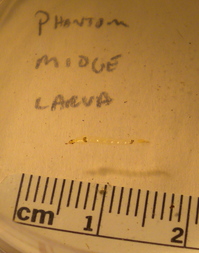
Phantom midge larva, collected from under the ice at Black Pond, Feb. 7, 2010.
Stefan Szumko | Contributor
Back in the lab (my basement), Jameson and I looked at our old samples. Again, I may have made a mis-identification. Our amphipod (scud) appears to have disappeared. It apparently metamorphosed into a fly and escaped when I opened the jar. Unfortunately, I was unable to get a focused picture of this green fly, which promptly flew away after my second failed attempt to digitally capture it. Bummer. I knew I should have immediately taken a few minutes to observe the pseudo-amphipod when I saw that it had grown a bit and was swimming faster. Chalk it up to experience. Maybe I’ll find it in a cobweb in a dark corner behind the washer? We can only hope.
But with Jameson, it was a delight watching him observe the organisms and start to teach him the proper names of these "bugs." A three year old is primed for learning language. My philosophy is, if you teach a child to talk like a baby, he'll talk like a baby. If you teach a child to talk like an adult, then you can have some great conversations. Jameson is featured in the second half of this week's pondcast.
On top of the pond, Alex and I observed the usual mammalian tracks: human, dog, cat, squirrel, raccoon and mouse. Yes, Pond Rover is back. Ann Arbor is home to at least three species of squirrels: red squirrel, gray squirrel (with the black variety of gray squirrels) and eastern fox squirrel. It should be noted that an eastern fox squirrel was observed adjacent to Black Pond on the southwest side.
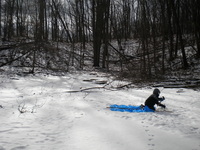
With Alex, it's been a great experience for both of us to go on a short hike, make some observations, and then wrap it up with sledding. As an 8 year old, he is learning how the world fits together and make connections of his own. So, I've been attempting to get him to share more about what he sees and what he's thinking while at the pond. As a budding scientist/engineer, he's at the age where he wants to use the tools of the trade. It's been a treat watching him develop his abilities.
Next week, we'll see what effect the big snow had on the pond and revisit our invertebrate friends from the pond. I'll try not to let any more get away.
Stefan Szumko is a middle school science teacher by trade, an outdoor environmental educator by calling, and a homedaddy by choice. Stefan can be reached at slugwhisperer@gmail.com.