You are viewing this article in the AnnArbor.com archives. For the latest breaking news and updates in Ann Arbor and the surrounding area, see MLive.com/ann-arbor
Posted on Thu, Mar 11, 2010 : 9:28 p.m.
Pondcast 9: Spring has sprung and wild owls are mating
By Stefan Szumko
Black Pond, March 4, 2010
Stefan Szumko | Contributor
Week 9 Pondcast
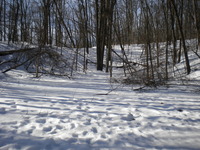
Week 9 of 2010 was another week with little to see on top of Black Pond - it was still frozen and covered with melted and refrozen snow.
Jameson and I went out on Tuesday morning, March 2. We arrived earlier than we have in the past, at about 9:30 a.m., and were delighted to hear - but not see - several species of birds calling. Spring was in the air.Â
On the trail, Jameson, being closer to the ground, was able to spot several winter midge flies. Â
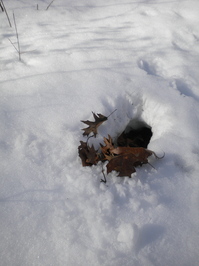
The mysterious hole to the west of Black Pond, observed on March 4, 2010.
Stefan Szumko | Contributor
Although most of the tracks were unrecognizable due to melting snow conditions, we did see raccoon footprints heading out from under the floating boardwalk. We also observed a mysterious hole a few meters west of the pond. Tracks were melted, but we could see claw marks in the snow. My junior assistant was ready to go, so I could not look for trace evidence as to what creature created this ephemeral landmark.
On Saturday evening, March 6, Alex and his friend, Theo, joined me at the Leslie Science and Nature Center’s annual Owl Prowl program. There were more than 50 other people in attendance.
We started the evening watching Kendra Pyle, a raptor volunteer feed the resident owls. These birds were all injured, rescued by humans, and taken to the River Raisin Raptor Center. Due to their injuries, these birds of prey could not survive in the wild, or else they would quickly become prey to other animals. But because public education about these and other raptors will help ensure the survival of their habitats, they have found a home at the science center, in several enclosures (note - not cages) to keep them safe. The rehabilitated raptors can be visited for free during daylight hours.
After the feeding session, we headed into the Nature House to see a presentation of live resident owls, given by Raptor Specialist Jessie Spalding. Spalding introduced us to the various adaptations of four species: the great horned owl, the barred owl, the eastern screech owl and the saw-whet owl. We learned that the most common owl in Black Pond Woods and urban environments is the eastern screech owl (ESO). Even as an adult, this tiny owl can fit through a hole the size of a toilet paper tube. Eastern screech owls nest exclusively in tree cavities located two to six meters above ground, sometimes using those abandoned by woodpeckers. So if you have a dead tree in your yard, consider leaving a tall stump if you’d like to eventually attract a family of screeching owls.
Heading outside after the presentation, we were met by science center naturalist Lauren LaRoca who led us on an Owl Prowl hike. At several points in Black Pond Woods, adjacent to the Leslie Park Golf Course, she played a recording of an Eastern screech owl calling. Unfortunately, none called back. Several reasons for a lack of response might be: we were out too early and the birds had yet to become fully active, the night was bright and owls are food for larger owls, it might be a bit early in the owl breeding season which kicks into high gear in the next few weeks, or any owls present in the area might have been out of hearing range of the recording. But it was a memorable adventure anyway.
For you “night owls," try this: Open a window near your computer and play the call of an Eastern screech owl. If you’re lucky, you might have one call back.
Join us next week as we scour the pond for the annual salamander migration and mating frenzy and find more aquatic macroinvertebrates.
Stefan Szumko is a middle school science teacher by trade, an outdoor environmental educator by calling and a homedaddy by choice. Stefan can be reached at slugwhisperer@gmail.com.
Comments
A2K
Fri, Mar 12, 2010 : 11:51 a.m.
Cool write-up, I enjoyed the owl-info links as well :O)
spm
Fri, Mar 12, 2010 : 7:59 a.m.
I've heard owls at Stinchfield Woods and Bird Hills within the past week. They're out there hooting away.


Comments
A2K
Fri, Mar 12, 2010 : 11:51 a.m.
Cool write-up, I enjoyed the owl-info links as well :O)
spm
Fri, Mar 12, 2010 : 7:59 a.m.
I've heard owls at Stinchfield Woods and Bird Hills within the past week. They're out there hooting away.
tmacek
Fri, Mar 12, 2010 : 12:29 a.m.
Great job - looking forward to salamanders.