

Pondcast: Week 1 of documenting Black Pond in Ann Arbor
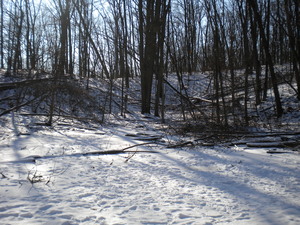
Black Pond - January 3, 2010
Stefan Szumko | Contributor
Here's the introduction to a project I've contemplated for several years and now have many of the resources and knowledge to begin - a weekly study of Black Pond with digital documentation. It is my goal to document the seasonal changes and organisms found in this natural resource to use a reference for other ponds worldwide and those who visit them.
Pondcast: Week 1 - Jan. 3-5, 2010 - Black Pond, Ann Arbor, MI
This week at Black Pond, we observed: duckweed (frozen in ice), moss (on logs and boardwalk), tracks (human, dog, squirrel, mouse). Freezing temperatures and snow present. A layer of ice below the snow (depth unknown - probably less than 3cm).
14,000 years ago, as the continental glaciers melted, a long pile of dirt, sand, pebbles, and rocks that is, today, the land underneath Ann Arbor. This pile is called a moraine.
Apparently, this glacier wasn't one straight-edged, 2-mile tall wall of ice. It was actually like an oversized blob of water, like when you spill a glass of water on the floor and it spreads out in several fingers in different directions. These fingers of ice/snow are called lobes.
The main portion of the glacier was up somewhere near Pontiac, MI and the fingertip of the Huron-Erie Lobe stretched down south to Defiance, OH. Hence, the name of our set of hills, the Defiance Moraine.
At the latitude: 42° 18’ 18” N and the longitude: 83° 43’ 48” W, in the north side of Ann Arbor, between Traver Road and Pontiac Trail, a big block of ice fell off the retreating glacier. The ice block landed on the side of the moraine and was covered by sediment. Eventually, the ice block melted, leaving a bowl-shaped 40m x 20m crater on the side of the hill. Known as a kettle, this crater is now known as Black Pond.
There are no streams or springs that give water to Black Pond. The only source of water in this kettle pond is from precipitation. Winter snow and ice lead to spring rain, filling the pond to its maximum depth. Since it is most full in the spring, Black Pond is also known as a vernal pond or vernal pool.
Vernal pools are a unique and poorly studied ecosystem. Vernal pools are breeding grounds for spotted salamanders and other amphibians. Vernal pools of a certain size and depth are home to fairy shrimp: orange-colored, 2-3cm long, freshwater crustaceans which appear soon after the last of the ice has melted.
For 14,000 years, Black Pond has remained virtually free of human impact. True, the woods surrounding the pond were logged and possibly farmed since Ann Arbor was first settled by Europeans. There was a proposal to build a subdivision within sight of the pond. But in 1992, the Friends of the Black Pond convinced the City of Ann Arbor to purchase the Black Pond Woods with the purpose of leaving it a natural area.
For about 20 years, school groups have visited the Black Pond, guided by the staff of the Leslie Science and Nature Center (LSNC). To prevent erosion and destruction of the vegetation surrounding Black Pond, which provides important shelter for amphibians, a floating boardwalk was installed just over 10 years ago.
Today, several thousand students and adults observe the aquatic organisms found in Black Pond. With the exception of a few samples taken to the Critter House for indoor observation, the LSNC ensures that all organisms are returned to the pond and treated respectfully.
Although this video project could have begun at any time during the year, the turn of the calendar year seemed like a great place to start with the first arrival of water, in the form of snow and ice, to fill the pond for the spring season.
Here is a summary of weather observations taken at Rudolf Steiner High School, 300 meters from Black Pond.
Video Caption: Pondcast: Week 1 - Jan. 3-5, 2010 - Black Pond, Ann Arbor
URL to Pondcast: Week 1 - http://www.youtube.com/watch?v=pltClShX54o
Stefan Szumko is a middle school science teacher by trade, an outdoor environmental educator by calling, and a homedaddy by choice. He can be reached at slugwhisperer@gmail.com
Comments
Stefan Szumko
Tue, Jan 19, 2010 : 12:45 p.m.
Tru2Blu76 - I will certainly not rely on any coordinates obtained from the Internet to set the destination for any of my guided missles. I'll have to rely on human-placed homing beacons instead. The Three Sisters Lakes are wonderful in the spring when the frogs are calling. Plus the trails are nice too.
Stefan Szumko
Wed, Jan 13, 2010 : 10:11 a.m.
Tru2Blu76 - Thanks for checking up on the coordinates. I was using Google Earth to check. I'll review a topo map and see what that has to say. Thanks to continental drift, polar migration, satellite idiosyncrasies, and human error to give us such wonderful discrepancies. Does the pond you have in mind have fairy shrimp? I'm proposing an informal census of these critters to other environmental outdoor educators in Michigan in the next few weeks.
Stefan Szumko
Tue, Jan 12, 2010 : 9:43 p.m.
This week looks like it's shaping out to be a pretty interesting week out at the pond. I wonder what effect the warmer winter temperatures will have on the pond?
francie
Tue, Jan 12, 2010 : 6:46 p.m.
well done! I wonder what week two brings?!?!?!
Suki
Tue, Jan 12, 2010 : 9:33 a.m.
Thanks for the fascinating history lesson on the formation of Black Pond Woods. I live about a mile away and only discovered it this past summer. It's now my favorite place for a hike on a beautiful day.
auntpooky
Mon, Jan 11, 2010 : 6:13 p.m.
What a great project! For those of us who can't always get out in the woods as often as we'd like, this seems like a great way to watch a special place change through the seasons. I'm looking forward to many more pondcasts in the future! :)
Stefan Szumko
Mon, Jan 11, 2010 : 3:35 p.m.
Thanks, Betsy. Have you any ponds or ephemeral pools you like to visit near you?
Betsy M
Sun, Jan 10, 2010 : 11:59 p.m.
Thanks, Stefan for your fun video. Your enthusiasm is contagious! We'll be following the project and look forward to seeing what's new at Black Pond.