

The Experience Economy: paying for the experience
Does it ever strike you when you pay for your coffee that you could have made the same thing for pennies on the dollar yourself? If so, welcome to the experience economy! Join us this week as Kathy Macdonald discusses the emergence of a new experience economy.
Wikimedia Commons
In our tough economic times, how can Starbucks survive? That question points us to a principle Joe Pine and Jim Gilmore described in their book: "The Experience Economy." They trace our economic progression from an agrarian to an industrial to a service economy — and finally to the emerging experience economy.
Let’s take that cup of coffee as our example. A century ago, you would buy the beans (a commodity in the agrarian economy), roast them, grind them and finally brew them. For a few pennies you had your cup of morning joe.
Then someone had the great idea of roasting, grinding and packaging the coffee and selling it as a packaged good (welcome to the industrial economy). We paid a bit more for the convenience.
The next leap came with businesses began providing the “service” of brewing the coffee for you (welcome to the service economy), and busy folks gladly paid even more for the same cup of coffee they could have brewed themselves.
And finally: Starbucks. Today we have outsourced the entire chain of events for the coffee “experience” at high-end coffee houses — and we are willingly to pay considerably more.
This progression repeats itself.
Think ice cream! Make it yourself, buy it by the quart, get it scooped at Baskin-Robins — or have the Cold Stone Creamery “experience.”
Think birthdays! Once Mom made a cake from scratch, and then Betty Crocker sold easier mixes. Of course, store-bought cakes were even easier. That leads to today’s birthday “experience” at a place like Dave & Buster’s — maybe even skipping the cake!
We value experiences and are willing to scrimp to enjoy them.
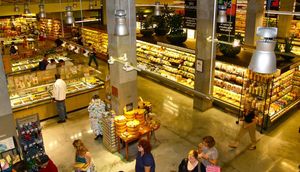
Now think about Whole Foods. The book’s principles explain why Whole Foods is able to survive, even though shoppers pay a lot more for a cart full of groceries — in the midst of tough times.
The title of the book by Joe Pine and Jim Gilmore includes the subtitle: Work Is Theater & Every Business a Stage. I am old enough to remember when companies struggled to define quality. Today they struggle with how to stage great experiences.
Yes, every business is a stage and those that recognize this will leave the others behind. Yet, just as every staged performance is not equal, the same is true of business experiences.
Pine and Gilmore discuss the four realms of a great experience: Entertainment, educational, escapist and esthetic. The realms are a result of two important dimensions: the level of guest participation (passive to active) and the kind of connection there is between the guest and the activity (absorption to immersion). Their bottom line is that great experiences have elements from all four realms.
For years, grocery shopping was mundane — but not at Whole Foods! Just walking around a Whole Foods is entertaining. You can sample food, interact with knowledgeable staff and watch food being prepared.
The education element is obvious. Every display is a mini-Wiki of food facts and food origins.
Ever time yourself in a Whole Foods? It’s easy for shoppers to lose track of the time, a sure sign of the escapist realm. You can even stop and eat before finishing your shopping!
Finally, the esthetic realm. Whole Foods is a feast of sensations. The stores are designed to be multiple places within one place. You walk into their flower shop, and pass next into the sights and smells of fresh fruits and vegetables, then it’s the sensations of a fish market — you get the idea.
Now think of your local run-of-the-mill grocery store. Sterile straight rows of shelves, stocked with neatly stacked goods and the smell of — well, it’s often void of smell. Sensations, education and entertainment are all missing. The goal becomes getting in and out as quickly as possible, instead of having a great experience. The only escapism here is getting home.
An evening at Whole Foods just might replace an evening at now-defunct Borders. Hmmmm.
Where have you see the four experience realms appear in your daily life?
Where have you seen this progression in your life?
What experiences do you value in your life?
What experiences do you value enough to pay more for?
What does this say about what we value?
Kathy Macdonald is a business consultant whose company Macdonald Group helps companies cope with with our rapidly changing culture. She is guest writing for Dr. Wayne E. Baker and can be reached this week at Our Values or ourvaluesproject@gmail.com or on Facebook.