

The mystery of the down-pointing hand
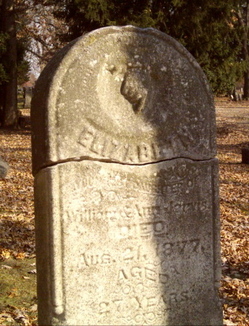
"That hand is pointing down. Do you think that means they thought she was going to..."
We stared at the mysterious symbol that darkly suggested that the person it signified, one Elizabeth from the Jarvis family, was headed for the nether regions.
More exploration and a bit of research uncovered the answer to the mystery of the down-pointing hand.
Elizabeth’s grave did seem to have a downward-pointing hand, but the finger looked short, as if it were curled a bit, or pinching something against the thumb.
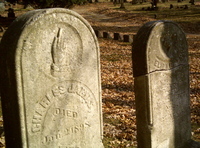
Her grave stood beside another stone with a hand pointing upwards. We left the area confused.
It seemed unlikely that her large gravestone would appear so close to the others, in what was a well-known Ypsilanti family that had produced a former mayor.
Would such a prominent family display a large gravestone shaming one of their members with a finger pointing “below”? It seemed unlikely.
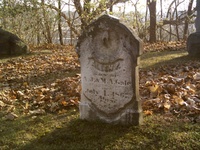
Another grave in a different section of the serene cemetery displayed a similar symbol, yet lacked any additional clues.
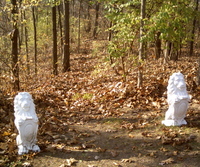
Along the way we spotted the lions that guard a path extending back into the woods.
The lions were freshly painted white.
Behind them, the path's leaves were tousled; someone had traveled the path.
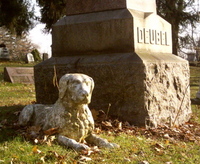
Another cemetery animal is the Deubel dog nearby, lying forever faithful next to its master's large grave.
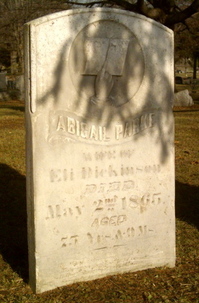
We saw other examples of hands in the cemetery, such as this one at left, pointing at a book meant to signify the Bible.
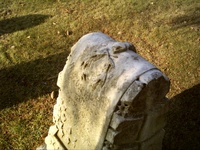
Another example, at right, appeared as a small hand holding a scroll unrolled down the front of the grave bearing information about the deceased.
This unusual design was not duplicated anywhere else in the cemetery. A modern grave nearby showed praying hands. As we were leaving, finally we saw it.
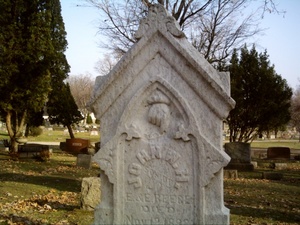
A grave for “John W. H.”, son of E. and E. Reese, who died at age 15, showed a down-pointing hand, with the same foreshortened index finger. But—what was that? A chain, so faint from erosion it was barely visible—only the low afternoon sun brought it out. The hand was holding a broken chain, which later research revealed signified the chain of life, or the bonds of marriage, broken by death.
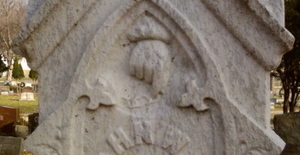
Research also revealed that the downward-pointing hand, without chain, does indeed exist as a gravestone symbol—but signifies not damnation but only a sudden death, or the finger of God coming down to select someone to take to heaven.
Elizabeth was not stigmatized with a bad symbol on her grave. Her family chose a motif to show their sadness at her leaving so young. Her grave stands proudly, with silent dignity, in the Scovill plot. Visit and see for yourself—the low fall and winter sun provides excellent slanted light that brings out beautiful details in Highland’s graceful old stones.
Laura Bien is the author of "Stud Bunnies and the Underwear Club: Tales from the Ypsilanti Archives," to be published this winter. She also writes the historical blog "Dusty Diary" and may be contacted at ypsidixit@gmail.com.
Comments
Laura Bien
Sat, Nov 14, 2009 : 11:41 a.m.
The Judd cemetery is one of my favorites. I will definitely return there to look for the sideways hand to photograph it for my files; thank you for the tip! Plus you get a view of the underground house next door, if I'm thinking of the right one. If I remember correctly, there is one enormous ornate stone there for some man's...maid? or domestic, or what have you. Very mysterious. I have to go back and check that out.
Let's Live Intelligently
Sat, Nov 14, 2009 : 10:38 a.m.
And don't miss the stone in the Judd Cemetery, where the Saline-Milan Road intersects Judd Road: it's hand doesn't point up, and it doesn't point down -- it points sideways, toward Saline. "Go thou there, and do likewise!" "Let's Live Intelligently" was the title on an old printed songsheet I had many years ago, but have lost track of. The song was written a hundred years ago, by a woman in Ypsi. "Let's live intelligently; we can succeed...." (I don't remember any more of it.) Try that on your piano! ---Wystan
Laura Bien
Fri, Nov 13, 2009 : 11:26 p.m.
That is so nicely said, Wystan: "breaking the chain of family connection." I love going to cemeteries. I think I remember this one...next to a big hill with a goat farm. I'll have to go back and look for down-pointing hands.
Let's Live Intelligently
Fri, Nov 13, 2009 : 10:45 p.m.
Laura, the cemetery on Michigan Avenue in Saline has one or two good examples of stones like this, with the finger of God breaking a ring off of the chain of family connections.
Laura Bien
Thu, Nov 12, 2009 : 4:41 p.m.
James: Yeah, it's striking, isn't it? From researching it, I find that that is the meaning of the symbol as determined by experts on the subject; Ed's good link is one example. At finding the info, I had an aha moment--of course, what family would shame itself by publicly posting an advertisement that one of its members was going below? Especially not the Scovills, given their stature in town. It's inconceivable. Pretty interesting.
ypsihistor
Thu, Nov 12, 2009 : 4:29 p.m.
I have visited this headstone many times over the years, and wondered about the meaning. Several friends told me the hand pointing down meat that was where the family expected the dearly departed to go. Still, it seemed strange that such feeling would so publicly be stated. This week I learned of another possible meaning for the hand, as "Touched by God" which seems more likely to me.
Laura Bien
Thu, Nov 12, 2009 : midnight
Black Coffee: You're very welcome. I love visiting cemeteries around Washtenaw County. If you were out in the Waterloo area may I recommend the Unadilla cemetery right on the county line. Beautiful country and an old cemetery once belonging to a vanished town. There's a guide to all the county cemeteries available from the Genealogical Society of Washtenaw County. Very useful--you can visit all the tiny old ones off the beaten path. Here's a description of the book: http://www.hvcn.org/info/gswc/publications.htm
Black Coffee :)
Wed, Nov 11, 2009 : 11:17 p.m.
Interesting my wife was very intrigued by similar headstones that she had taken photos of in the Waterloo area while we were out seeing the fall colors thank you for this article
Laura Bien
Wed, Nov 11, 2009 : 2:41 p.m.
Ooh...what a wonderful photo! Thank you! Neat! The odd thing was that in the whole huge Highland Cemetery there was only that single sole example of the hand-with-chain that suswhit photographed so nicely.
suswhit
Wed, Nov 11, 2009 : 2:38 p.m.
I took a pic of a very similar tombstone this summer in Connecticut. http://www.flickr.com/photos/suswhit/4050061076/in/set-72157621895441271/
Laura Bien
Wed, Nov 11, 2009 : 2:21 p.m.
Ed: (racks brain)...is that one of the pages I viewed when researching this topic? I think it might have been! I appreciate the link! It is a fascinating field of study. I'd love to find a good book on gravestone iconography; there has to be one out there. Archives doesn't have one at present.
Laura Bien
Wed, Nov 11, 2009 : 2:16 p.m.
sdunavan: Marriage or the "Great Chain of Being," or, life, according to what I read. As far as marriage being a chain (heh) I suppose you could view it as a necklace chain, supporting one's most beautiful and prized gem. :)
Sandy D.
Wed, Nov 11, 2009 : 2:14 p.m.
So a chain signified marriage, huh? Interesting.
Laura Bien
Wed, Nov 11, 2009 : 9:16 a.m.
Please excuse the slightly goofy spacing--had to do that to prevent the photos from smooshing all together. Thanks for reading!