

Toughest death-penalty question: Which is worse?
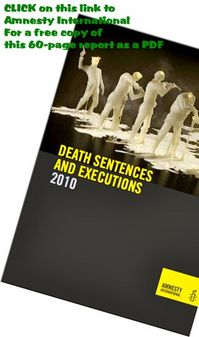
This photo posted with the article in its original location on OurValues is a link to a 60-page report from Amnesty International in a PDF file. Please visit OurValues.org to follow the link.
Editor's note: This post is part of a series by Dr. Baker on Our Values about core American values. This week, Dr. Baker is discussing capital punishment and questions surrounding it.
Which is worse?
Executing an innocent person
or
Letting murderers escape capital punishment?
For thousands of years, this has been the toughest death-penalty question. To this day, law-school students read articles on this question reaching all the way back to Genesis 18:23-32, where Abraham argues with God about God’s looming destruction of two towns. Law-school debates also cite English jurist William Blackstone’s principle from the 1700s: “Better that 10 guilty persons escape than one innocent suffer.”
But what do you think?
Errors in judgment do occur — even when it comes to the death penalty. Right now, many people believe this error was committed in the case of Troy Davis, as we discussed Monday. But the other kind of error can also happen: A murderer can be found not guilty and be set free.
How often to you think the first error occurs?
The true number of innocent people who have been executed is impossible to know. But we have widespread beliefs about the frequency of this kind of error. A majority of Americans (59 percent) think that an innocent person has been executed in the past five years, according to a 2009 Gallup poll. The estimate was even higher in the past. In 2006, 63 percent of Americans thought that, in the previous five years, an innocent person had been executed. The figure was 73 percent in 2003.
The two types of error are intimately related. If you raise the bar really high to minimize the number of innocent people who are convicted and executed, then more guilty people will be set free. If you lower the bar to maximize the number of guilty people who get the death penalty, then more innocent people will die.
How do you weigh this tough and timeless question?
How does the U.S. compare globally?
Before you read further, answer this question: How does our rate of execution in the U.S. compare with the rest of the world? Do we rank fifth, 20th — or what? What’s your guess?
Remember that most nations around the world do not have the death penalty. The U.S. allows it, but it’s considered a state-by-state matter. On Tuesday, we showed a year-by-year chart of executions in the U.S. But where do we rank compared with other countries that have the death penalty?
For an extensive report on the matter, visit this link to download a free copy of the Amnesty International 2010 report as a PDF file.
Here’s what you’ll find: Last year, China executed the highest number of people, according to Amnesty International’s report. The exact number is hard to pin down, but Amnesty says that it’s at least in the thousands. Iran comes next, with at least 252 state-sponsored executions. Third is North Korea — at least 60 executions in 2010. Fourth is Yemen — a minimum of 53.
The United States ranks fifth. We had 46 reported state executions last year. Saudi Arabia is next, with at least 27 executions. Then come Libya and Syria (at least 17 each). Bangladesh and Somalia hold places nine and 10 — at least eight each.
Alexis de Tocqueville, the French nobleman who toured early America and wrote a definitive treatise on our young nation, said we were exceptional. Exceptional, in de Tocqueville’s writing, means unique, unusual, different. One way we are different today is that we have a higher number of state executions than other Western democracies.
Are you surprised at these global statistics?
What does this comparison say to you about our system of justice?
Originally published at www.OurValues.org, an online experiment in civil dialogue on American values.
Dr. Wayne E. Baker is a sociologist on the faculty of the University of Michigan Ross School of Business. Baker blogs daily at Our Values and can be reached at ourvaluesproject@gmail.com or on Facebook.
Comments
Rork Kuick
Tue, Oct 4, 2011 : 12:39 p.m.
"The suggestion that the judicial system is faulty is neither valid nor logical." It's inerrant, and perfect in every way.
BhavanaJagat
Mon, Oct 3, 2011 : 6:33 p.m.
Why Death Sentence? The Law is already lenient. Very often, the person who could be guilty of homicide makes a plea bargain and admits guilt for a lesser crime like involuntary manslaughter. A colored person is often involved in killing another colored person. A poor person often violates the rights of another poor person. If race or class is a factor, there could be additional charges and hate crimes may invite prosecution by federal authority. Death Sentence is a penalty that is imposed as a just consequence for the action called murder. The suggestion that the judicial system is faulty is neither valid nor logical. We need to accept Death Sentence as 'just' punishment and we should remain committed to find the guilty person. There are numerous cases of murder that are not yet solved for lack of conclusive evidence. The judicial system appears to be acting in a responsible manner and is not rushing to punish individuals with insufficient proof. We have the famous O. J. Simpson case where the jury was not convinced by the prosecutor's argument.
Patricia Ramsay
Mon, Oct 3, 2011 : 3:13 p.m.
My question would be why must death be the penalty for murder? Surely serving a life in prison is enough punishment. There would be no innocent lives taken and the possibility of justice finally freeing wrongly convicted persons is a more laudable goal. We know that our justice system is flawed and often inadequately defends the poor who frequently are persons of color.
BhavanaJagat
Sun, Oct 2, 2011 : 5:55 p.m.
A LIFE FOR LIFE : "lex talionis" - This is a symbolic statement in the Greek as well as the Hebrew tradition. Retribution is not revenge. Socrates had observed, "to suffer punishment is another name for being justly corrected when you do wrong" and he "who is punished and suffers retribution, suffers justly." United States Constitution is the Supreme Law of the nation. It guarantees the Right to Life. A Right which is not protected is not a Right and a Law without penalty attached is not a Law. A penalty is imposed as a consequence to an act of wrongdoing. I appreciate all the quotes from Bible. I get repeatedly surprised when people forget to quote the relevant idea that is expressed in Bible. Kindly refer to the First Book of Moses called GENESIS, Chapter 9, verse 6 which reads as follows : "Whoso sheddeth man's blood, by man shall his blood be shed: for in the image of God made he man." It is man who would impose this just penalty for the crime called murder. The issue of executing innocent people has no relevance to this issue. To err is human and it is the intention to punish the guilty which should be beyond doubt and speculation. <a href="http://bhavanajagat.wordpress.com/2008/07/15/the-right-to-life-means-a-life-for-life/" rel='nofollow'>http://bhavanajagat.wordpress.com/2008/07/15/the-right-to-life-means-a-life-for-life/</a>