

H1N1 flu and pets - what you need to know
Although we previously thought of influenza virus as primarily species specific, the news this past week that a pet cat in Iowa tested positive for the H1N1 virus, also known as swine flu, changes that.
In October, a pet ferret was also confirmed as having H1N1. That's not so surprising, since ferrets are known to be especially susceptible to influenza. In both reported cases, the pets contracted the virus from sick owners. There is no evidence that animals can give the virus to humans.
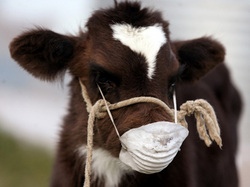
Your pet probably doesn't need a mask, but there are things you can do to help protect him from swine flu.
Symptoms to watch for include lethargy, runny eyes and nose, coughing or sneezing, loss of appetite, fever, and difficulty breathing. Should any of these conditions occur, consult your veterinarian immediately, especially if a person in the household is sick. As with all disease, early treatment is the best bet for a good outcome. Both the cat and the ferret mentioned in this article made full recoveries with veterinary supportive care.

Spud remains unconcerned about the swine flu outbreak.
Photo courtesy of Courtney Joy Moser Melville
Read more on the American Veterinary Medicine Web site and on the Centers for Disease Control's Web site.
Dr. Cathy Theisen is a relief veterinarian in Ann Arbor, with 23 years experience in small animal medicine and surgery. Comments to cathytheisen@comcast.net.
Comments
Indicat
Fri, Nov 13, 2009 : 8:29 p.m.
Thank you, Dr. Theisen, for keeping us informed!
Arboriginal
Fri, Nov 13, 2009 : 5:12 p.m.
Spud is mighty cute. He looks totally grab-able!! I bet his sides make an excellent drum!!!
Cathy Theisen DVM
Fri, Nov 13, 2009 : 12:53 p.m.
right from the CDC website: How does swine flu spread among pigs? Swine flu viruses are thought to be spread mostly through close contact among pigs and possibly from contaminated objects moving between infected and uninfected pigs. Herds with continuous swine flu infections and herds that are vaccinated against swine flu may have sporadic disease, or may show only mild or no symptoms of infection. How common is swine flu among pigs? H1N1 and H3N2 swine flu viruses are endemic among pig populations in the United States and something that the industry deals with routinely. Outbreaks among pigs normally occur in colder weather months (late fall and winter) and sometimes with the introduction of new pigs into susceptible herds. Studies have shown that the swine flu H1N1 is common throughout pig populations worldwide, with 25 percent of animals showing antibody evidence of infection. In the U.S. studies have shown that 30 percent of the pig population has antibody evidence of having had H1N1 infection. More specifically, 51 percent of pigs in the north-central U.S. have been shown to have antibody evidence of infection with swine H1N1. Human infections with swine flu H1N1 viruses are rare. There is currently no way to differentiate antibody produced in response to flu vaccination in pigs from antibody made in response to pig infections with swine H1N1 influenza. While H1N1 swine viruses have been known to circulate among pig populations since at least 1930, H3N2 influenza viruses did not begin circulating among US pigs until 1998. The H3N2 viruses initially were introduced into the pig population from humans. The current swine flu H3N2 viruses are closely related to human H3N2 viruses.
researcher1
Fri, Nov 13, 2009 : 11:38 a.m.
My understanding is that we humans are the carriers, and that we transmit the virus to the pigs. Can the vet please confirm this?
Cathy Theisen DVM
Fri, Nov 13, 2009 : 11:27 a.m.
Since only one domestic cat has been confirmed nationwide, we do not know much about whether this is an isolated event or whether we'll see more of it. The infected cat in Iowa was an adult. In general, however, young kittens with undeveloped immune systems are more susceptible to things like feline distemper virus, respiratory infections, etc. In the case of swine flu, I would observe the above mentioned precautions with all pets in the household.
Skye Black
Fri, Nov 13, 2009 : 11:21 a.m.
Great information to know! I have two kittens that are 11 weeks old and one that is older. Are my kittens more susceptible to H1N1 than my older cat?
raeckert
Fri, Nov 13, 2009 : 10:52 a.m.
Pigs are susceptible to influenza virus from other pigs, humans, ans birds. For this reason, most swine producers treat their facilities with strict biosecurity. Only approved visitors wearing infection control garments are allowed to enter. It is thought that the pig served as a "mixing pot", allowing pig and bird influenza to go through reassortment events, and creating the novel 2009 H1N1 virus. When the virus mutated, it now became possible to see human to human transmission. It has now taken another step, which is human to ferret and human to cat transmission. I'm sure the CDC will have more information as further testing is done. I'll keep posting updates as I get them.
raeckert
Fri, Nov 13, 2009 : 10:25 a.m.
If this strain of influenza came from pigs, why is it that we cannot catch it from our household pets?