

A dog's yard: Establishing boundaries for your dog and training vs. deterring
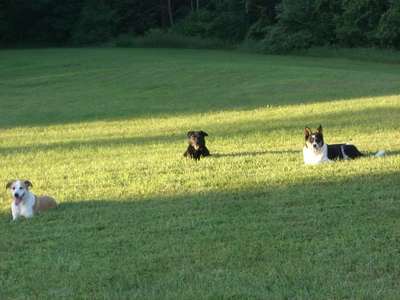
Mishi, Maddie and Patch are "staying home" while John gets the mail.
Photo by Liz Spieser
Training your dog to respect home boundary can be fun and super-rewarding! It is a tremendous gift to both you and your dog because it promotes more freedom and security in your lives. Contrary to popular thinking, you can train boundaries without the use of a physical barrier or an invisible fence (electric stimulation) system. Fences provide a certain convenience because they, in theory, allow you to “check out” of the picture sooner rather than later. This brings me back to my initial point about the difference between training and restraining.
If you mistake your effectively-contained dog for a trained dog, you risk being lulled into a false sense of security that could put your dog, the public, and ultimately yourself in danger. I've found that dog owners who become over-reliant on a containment system tend to lose touch, over time, with their dog and the boundary. Their dog may be attempting to break or successfully breaking boundary, encountering things coming into the boundary, discovering items within the boundary and essentially managing the area as she sees fit without guidance. I'll say here that I am not opposed to fences but if you rely on one and overlook training, you may end up with a dog who continues to invest energy in challenging the “system” in some fashion.
Here are some things to keep in mind if you do rely on some form of fence containment:
- When you set up your boundary be sure to include a route for public access that is outside of your dog's boundary area. The UPS driver, Girl Scout, Jehovah's witnesses and your dog will all be more secure if they don't have to manage chance encounters in your absence.
- Keep training in the picture. Don't leave all the work up to the fence. Spend time regularly with your dog walking the perimeter and defining the boundary together. Let her know that she is respecting the boundary for you, not the fence or because of a potential correction.
- If you are using an invisible fence, make sure that your dog isn't breaking boundary when you're not around and inspect your equipment often.
- Remember that fences don't always keep things out. Invisible fences offer zero external security and physical fences are not impervious either. Raccoons can climb, skunks can dig and kids can open gates. Small dogs are especially vulnerable when left unattended in a boundary due to the potential for predators like a fox, coyote or owl to pick them off. Stay tuned into your dog and yard! Don't leave your dog alone for extended periods of time.
- Inspect your dog yard daily for signs of any problems. Digging projects in process, the presence of foreign materials, damage to outdoor furniture — your dog could be getting into things you aren't aware of until it's too late.
- Keep the boundary clean, comfortable and safe for your dog! Daily poop clean-up is also a chance to spend time with your dog in the yard.
- Don't make your dog just a “yard dog” — even if your containment system is failsafe a dog still deserves a life outside of a yard! A system that is really convenient for you could become torture for your dog if it means he never gets to experience life anymore.
- Don't let your dog bark incessantly. No matter how entertaining you think this is for your dog, it is a nuisance behavior that indicates boredom, not to mention that it will drive your neighbors crazy.
- Train your dog to be accepting of guests on home boundary in your presence, with your guidance. Do not shoulder your dog with the responsibility of managing encounters in your absence unless she has been trained for a specific purpose and is equipped to handle these encounters properly.
- Post your boundary with a sign if necessary to alert outsiders of your dog's presence.
Planning and continued maintenance can greatly reduce the potential for a boundary system that ends up working against you and your dog. Use common logic and always strive for good training to replace the need for clever restraining!
John Spieser is a professional dog trainer and owner of Dogheart. He can be reached at john@doghearta2.com.
Comments
treetowncartel
Wed, Sep 8, 2010 : 11:40 a.m.
@dmccarthy, I couldn't agree with you more. People need to understand their dog's limitations. I would really love to put my dog through some shutzhound training/obedience, but I just don't have the time to do that. I'd like her to be able to understand her yard is her yard and not to leave it.If you look at John's dogs in the picture above it appears that they have this quality even when that squirrel or dog in heat is out in the road.
dakini
Wed, Sep 8, 2010 : 9:42 a.m.
Last year my dog was chased by a more aggressive and dominant breed while being walked on leash. This other dog is "trained" to stay in the yard. I struggled to keep my dog away from the other dog, while my dog struggled to get out of her collar so she could run away. Both getting caught by the other dog or running away could have endangered my dog's life. While it's legal to have a dog off leash in an unfenced yard, I believe an owner has to know the personality of their dog. If, despite extensive training a dog still leaves the yard, the dog should be contained.
Vickie
Tue, Sep 7, 2010 : 12:46 p.m.
Its great to have your dog listen to you...Fences are best just because it keeps out other peoples dogs that don't know their boundaries. Plus I can't count how many times a dog has got past their underground fencing and have come over to visit my dogs who were hard fenced. Plus the people who feel I am in the country and my dog won't hurt anyone and let them run willy nilly. Keep your dog leashed and keep them home in a secure area for them NOT for you. As a dog owner for 30 plus years it has been great for all of us.
treetowncartel
Tue, Sep 7, 2010 : 10:50 a.m.
@ John, I have a 5 month old puppy, relativley new to my home. Part of the yard is fenced in and another part isn't. What is the best way for teaching a dog to understand its boundaries in the non-fenced setting and preventing it from running out after dogs and people walking down the block? Is using a training lead when you are out in the non- fenced yard the best way?