

Can animals predict earthquakes? Some believe so
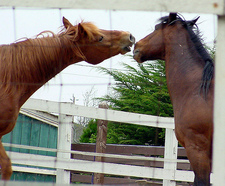
flickr photo courtesy of goingslo
A dog barks and whines for no understandable reason. A cat behaves strangely. Restlessness sets in with some horses.
It all seems fairly innocuous, right? Animals do things that we don't understand on a regular basis, so one might not think much of it — until an earthquake happens.
As I was scanning my Twitter timeline on Tuesday afternoon, I began seeing tweets about an earthquake that, as it turns out, was centered in Mineral, Va.
Numerous pet owners from across the region made comments about their animal companions behaving strangely right before the earthquake hit. This might seem easy to dismiss, but not so fast.
For centuries, humans have noted that the animals around them, both wild and domesticated, have indeed become agitated and restless prior to an earthquake.
The phenomenon has been so prevalent through the years that researchers have either seen patterns through intentional study or completely by accident. The latter was experienced by Rachel Grant, a life scientist at the Open University after studying the mating habits of toads in Italy. The toads suddenly disappeared from the area where they had previously frequented to mate. Read about Grant's experience by clicking here.
Pet owners far and wide have noted their furry or feathered friends' odd behavior in the time that immediately preceeds an earthquake, although they might not put two and two together at the time. Erratic or uncooperative behavior from otherwise predictable animals is common, and it can be hard to ignore any correlation when one looks back after an event.
Horses are exceptionally sensitive to what is going on around them, and it's largely thought to be due to their flight response.
Of course, the idea of an animal's ability to sense something like an earthquake begs for skepticism, and there is plenty of it. In a National Geographic article, both sides of the coin are examined. It's clear that there are plenty of people who strongly disagree with the notion that animals are capable of such knowledge.
After all, we human beings, with what some consider to be our superior brains, don't seem to be able to sense that an earthquake is about to happen — so how could a cow, or the family dog?
What about what some say is an animals sixth sense?
Just for the sake of argument, let's remember that, as humans, we have a tendency to ignore a lot of things around us, mainly because of our capacity for speech.
Animals don't. They pay attention to everything, believe it or not. They have to.
So, maybe our ability to talk doesn't serve us so well all of the time.
If you're an animal, it's essential to hone in on what's going on around you for so many reasons, the most important of which is preserving your life. As masters of non-verbal communication (although many species use vocal/audible cues in necessary situations), animals can pick up on things going on around them quite easily — so why not changes going on under the earth's crust?
Do they use their enhanced senses? Or, perhaps atmospheric changes occur that they pick up on.
So, can animals predict an earthquake? The jury will likely remain out on that one, simply because the ones who could tell us cannot speak.
Lorrie Shaw is lead pets blogger for AnnArbor.com. Connect with her on Google+ or e-mail her directly.
Comments
Jill
Fri, Aug 26, 2011 : 1:21 p.m.
There are many changes, such as altered electromagnetic fields and atmospheric changes, that can precede earthquakes. Animals are likely much more sensitive to many of these changes than humans (and yes, animals of all species, like humans, likely have differing sensitivities to different stimuli). Studies indicate that some animals may in fact be sensitive to changes that precede earthquakes (See <a href="http://www.ncbi.nlm.nih.gov/pubmed/19572333" rel='nofollow'>http://www.ncbi.nlm.nih.gov/pubmed/19572333</a> and <a href="http://news.bbc.co.uk/2/hi/science/nature/3030780.stm" rel='nofollow'>http://news.bbc.co.uk/2/hi/science/nature/3030780.stm</a> for examples). The idea is really not all that far-fetched...
jns131
Fri, Aug 26, 2011 : 1:14 p.m.
I read an article about animal behavior and earthquakes years ago. In California, they had noticed a lot of dogs especially, not sure about the cats, but they noticed more animals disappearing hours if not days before disappearing. I guess this flight and fight response can be attributed to it? I guess the animals are recovered but I found that interesting to note that if your animal disappears? Also, they said that an earthquake is imminent if you see no birds and the air is still. You might have a an earthquake soon if any of the following happen.
julieswhimsies
Tue, Aug 30, 2011 : 10:59 p.m.
Huh?
julieswhimsies
Thu, Aug 25, 2011 : 5:32 p.m.
Thank you for the thoughtful post, Lorrie. I am a skeptic. Horses are extremely sensitive to motion, sights, and sounds. Their "fight or flight" response has been essential for the species to survive. Having said that, I know, that at my horse's barn, all of the horses were in their stalls sleeping or eating. The owner of the barn was there at the time, as well. None of the horses reacted in any way. The barn owner felt nothing, as well. If there was a tremor, at ALL, these horses would have reacted in a BIG way!