

Can human body language be misleading to dogs - and does it inhibit the process of training?
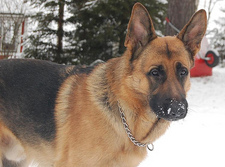
flickr photo by jutuzga
If you've shared life with a dog for any length of time, it's likely that you have discovered that they are in tune with what you're doing — even looking for non-verbal cues as to what might be happening in the household next.
This comes in quite handy: in training canines, we need to have them pay close attention to us, right?
As far as puppies go, they might seem to be a little spazzy, but as the weeks go by they naturally establish that bond with us and really look to us for not only their care, but in helping them to understand what is expected of them when it comes to living in the family unit.
Even dogs who are older and join the family later go through that process.
But are the lines of communication getting crossed when it comes to the way that your pooch behaves, sometimes? And, who is more to blame — the human, or the dog?
After reading a recent study, it solidifies what good trainers, behaviorists and other dog professionals already know: We often dilute our "language" when communicating what we want from our pets, leading to an outcome that we don't want.
It's no secret that canines are food-motivated. That's a boon to anyone working with them — especially during during training — and it's essential in positive reinforcement methods of training, methods preferred with most trainers and behaviorists today, and that's a good thing.
I use treats (and non-verbal communication) as a way to reinforce the good behavioral habits that I want them to keep having, and more.
The study, titled Do Dogs (Canis lupus familiaris) Make Counterproductive Choices Because They Are Sensitive to Human Ostensive Cues? published this month in the journal PLos ONE, was conducted in a simplistic way but yielded interesting results.
Researchers had 149 people bring their dogs into the psychology laboratory at the University of Milan in Italy. Sarah Marshall-Pescini, who lead the study, and her colleagues set up a series of experiments in which dogs had a choice between two plates — one with a single piece of food on it and one with six pieces. Other experiments had dogs choosing between equal-size portions.
Here's why I find the study interesting: left to their own devices in this situation, the majority of the dogs demonstrated that they would make the obviously better decision (choosing the larger portion of food).
But once a human stepped in and started tinkering with the choices (like staring at one of the plates of food for brief periods, or remarking how good one specific portion looked, or pretending to eat a little off of one plate), then stepping away, the animal would often choose the one indicated by the human — even if were a less-desirable choice.
That outcome suggests that the animals are cuing in to human actions and are influenced by our input. Read more on the study by clicking here.
Sure, dogs are motivated by a tasty treat, but they are also highly motivated by our interactions with them, like physical touch, a highly-valued game or activity just the same. That's why these interactions work so well in training.
It's the bond they have with the human beside them in the process of learning that's more crucial for success than anything else.
My point is, the study is just one example of how easily a dog can be influenced by a human, and it really ties in with so many facets of dog behavior. It also reminds us of how important it is to be mindful of how we are behaving around our dogs and how truly intelligent they are.
Does this mean that in the ongoing process of training our dogs and setting up reasonable expectations for them that we are at the core of their success? Yes. Unequivocally.
So who has more to learn? Canines, or humans?
Lorrie Shaw leads the pets section for AnnArbor.com. Catch her daily dog walking and pet sitting adventures or email her directly and subscribe to AnnArbor.com's email newsletters.
Comments
Dr. I. Emsayin
Mon, Apr 30, 2012 : 4:58 p.m.
When traveling in a country where we did not know the language, a companion, wearing a wide, friendly smile, delicately approached a woman walking a dog to ask for directions. The dog took one look at those smiling teeth and lunged at my companion. What is friendliness to humans is aggression to dogs.
Tru2Blu76
Mon, Apr 30, 2012 : 2:55 p.m.
Great post! I love dogs but enjoy all animals and value the uniqueness of our own kind as the one which has relationships with a large number of completely different species. Of course dogs are the standout as a companion species.
Lorrie Shaw
Mon, Apr 30, 2012 : 3:26 p.m.
Tru2Blu76: I think that what you said was interesting, and it really does illustrate how important it is to do the best that we can to communicate effectively with other species. We owe it to our fellow inhabitants of the planet. Dogs are an fascinating example of how much a species can flex, morph and adapt. In keeping our eyes and minds open, I'm hoping that we can do the same as gracefully as they have. Thanks so much for adding your thoughts!
RunsWithScissors
Mon, Apr 30, 2012 : 1:53 p.m.
When I trained young horses, many moons ago, it often felt like they read my mind. Then I realized that while my brain was processing a thought (say, ask horse to canter from a walk) my body was automatically shifting to prepare for the gait change. The horse was sensitive enough to pick up on the change and smoothly transition into a new gait. This taught me that they were listening to me more closely than I to them. My dog is no different. He reads my body language and tunes into my tone of voice. Little inflections mean a lot to him. When we're working on something new I try to keep my body as neutral as possible to avoid confusion. When he fails to follow through on my instructions I ask myself, "What can I do differently to help him understand?" I recommend a great book, "Canine Body Language". I can't remember the author's name. It's nothing but pages of black & white photos of dogs with captions outlining the dogs' body language and the dynamics of their language. I feel like I can almost speak "dog" now.
Lorrie Shaw
Mon, Apr 30, 2012 : 3:20 p.m.
RunsWithScissors: Great analogy, and you're right - horses do pick up our cues so easily. Yes, that book is a really good one to read. "Canine Body Language..." was written by Brenda Aloff, a mid-Michigan dog trainer. For those who aren't familiar with it, I highly recommend it: http://www.google.com/products/catalog?oe=utf-8&rls=org.mozilla:en-US:official&client=firefox-a&q=canine+body+language&um=1&ie=UTF-8&tbm=shop&cid=1857444222597822143&sa=X&ei=sayeT5bdMe-e6QGc1viJDw&ved=0CGkQ8wIwCA Thanks for bringing that up!