

Junior high school equestrian team from Ann Arbor traning for next big competition
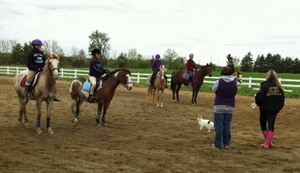
Five rider/horse pairs and one cat report for team practice with coaches Halley Sissom and Marie Seddon.
Kathy Lundberg | Contributor
This week practices started for the Ann Arbor Junior High School Equestrian Team. The Junior Team began as a pilot program of the high school Michigan Interscholastic Horsemanship Association (MIHA) in 2004 and became a formal part of MIHA in 2006.
Last year, with only two riders, the Ann Arbor Junior MIHA team won first place in Division D. This year, Ann Arbor is represented by five sixth, seventh, and eighth grade riders from Clague, Forsythe, Ann Arbor Open and Saint Thomas schools, and the team will move into Division B.
Competition will include classes in diverse “seats” (disciplines): Hunt Seat (basic English riding style), Saddleseat (a flashier version of English) and Western (as ridden by John Wayne).
Within these disciplines are classes in showmanship (handling the horse on the ground), rail classes (moving through paces in a group along the edge of the show ring), and patterns (each rider/horse individually performs a certain sequence of movements).
In addition, trail classes, performed in the seat of the rider’s choice, involve completing a set of tasks through various obstacles such as opening/closing a gate, crossing a wooden “bridge” or water obstacle, weaving in and out through cones or walking sideways along ground poles, each of which can be quite baffling to a horse who has not been introduced to these elements. Finally, teams compete in games of speed, precision, and cooperation.
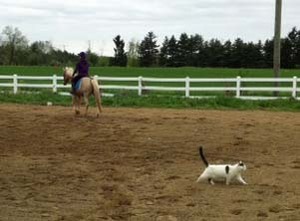
Seems like too much work for the cat, who quickly exits once the action begins.
Kathy Lundberg | Contributor
Sounds like fun, doesn't it? The challenging part is that riders do not necessarily get to choose which classes they enter. Each rider is able to participate in a certain number of classes determined by the team size, but which class they enter is determined by the coach.
The best teams are comprised of competent, well-rounded riders and horses which are willing to try something they may have little experience with in order to capture points for the team. An equestrian team win is truly a group effort.
Say the team is made up primarily of kids who love riding Western and all have great stock horses who are built and trained for the job (Quarter Horses, Paints, Appaloosas). They may win the battle and lose the war by sweeping Western classes and leaving the others “pointless.”
To avoid this, the coach may assign some kids, each of whom is a contender for first place in Western, to compete in other disciples. The horse may not be of the breed primarily associated with the discipline (saddleseat Quarter horse?) and may be using borrowed tack (bridle, saddle). The rider may wear “team” clothing previously owned by a long-graduated alumni, fitted with safety pins. The pair may perform techniques they are not very familiar with.
That rider may not win first place, but the team accumulates points by winning any place up to 8. The glamour goes to the Western rider who took first place, but the team win would not be possible without those willing to scramble to compete in other classes.
What do you need to compete on a junior high or high school equestrian team? You need a trusty horse as your willing partner at the show — one who will not get overly worried about the sights and sounds of competition. You and your horse need a can-do attitude to branch out to new things and a cooperative spirit in supporting your team members who also may be performing new skills.
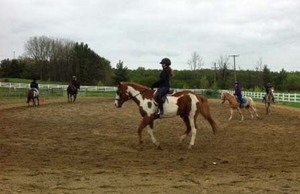
Katrina Sadis rides her Paint horse with other team members
Kathy Lundberg | Contributor
Of course, practice helps — lots. Riders need to be self-motivated, as they spend much time practicing by themselves with their horse, periodically assisted by trainers and coaches.
Parental involvement is critical, as transporting the horse to team practices and competitions is a bit more involved than grabbing a soccer ball, water bottle, and shin guards.
On the plus side, there are few sports that a parent has the opportunity to get to know their child as well as in riding. They spend time together practicing at the barn.
Instead of sitting alongside the field in the bleachers watching games with other parents (which, granted, is also fun), “horse parents” generally assist in getting horses and riders ready. Parents see their child handle many different situations, from stressful to happy, during the course of training and showing, as they interact with their horse and the myriad of other horses, kids and adults they encounter.
The hard work of these five middle school kids will culminate during the one and only all-day competition on June 4 at the Lenawee County Fairgrounds in Adrian. Good Luck, Team Ann Arbor!
Kathy Lundberg is the owner of Scio Church Stables. Email her at scs@sciochurchstables.com.