

Kids must be taught the right way to approach an unfamiliar dog for the first time
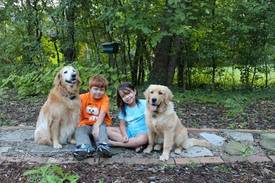
Photo courtesy of Chris Burke
Kids and dogs — a winning combo right? Not always.
When a I was a kid, in the Dark Ages, very few dogs were leashed. They seemed to stay in our neighborhood and follow us as we played .
Today’s dogs seem to have rules, regulations and restraints. Today dogs are no longer welcome at many parks. Cities enact leash laws. The world for dogs is shrinking — shrinking in the sense that they have less freedom to be dogs.
The other side of this is that dogs need to live congenially in our society, just as we have to follow the rules. Don’t drive when we see a red light, don’t run over a pedestrian in a cross walk — we learn to live within these boundaries. Often times these laws and rules are designed to make us safe.
When kids and dogs are mixed together, we don’t have written rules. Often when I am walking my dogs, a child will run up to me and ask to pet my dog. This translates to coming up to a dog, putting an outstretched hand in the dog’s face and then proceed to enthusiastically hug my dog.
Observe a few things. In the animal kingdom a greeting is not done face to face. Predators such as dogs greet members of their pack in a respectful — head lowered submissive fashion — eyes lowered. Dogs often circle each other giving the traditional greeting of butt sniffing. In nature a wild dog does not enthusiastically run up to a another dog and ask to be friends.
This human-designed way of inappropriate greeting is what our domestic dogs must follow — its one of the unwritten rules to live in human society. A child gets in to a dog’s space, and the dog is required to act in a friendly, submissive and kind fashion — no jumping, no biting, no growling.
Does this happen among other dogs? The respectful dog waits until another dog gives the signal they are interested in being friendly or not. The child needs to behave like a respectful dog.
“When you are reading dogs," says author and dog trainer Brenda Aloff…”remember that the dog does not have to be falling all over himself and you with a wagging tail and wiggling body to show friendliness. Dogs who are relaxed and quiet are being friendly and are comfortable. Sometimes people look at a dog who is neutral — so to speak — and think that the dog is being bored and unaware of what is going on around him. This could not be less true. Dogs showing neutrality are confident and happy to share their space with others — but are still very aware of who and what they are doing.”
What is the best initial greeting for a child meeting a dog for the first time? No touch. No talk. No eye contact.
Why? When a child greets a new dog, the excitement from the child bubbles over to the dog. The high-pitched squeaking sounds the child makes are the same sounds the dog's litter mates produce.
Voila! The dog has now equated a child to a litter mate, and litter mates are equal in play. When child greets a new dog, we would like the child — through body language — to get respect from the new dog.
Give the dog a chance to greet you, and do not get in the dog’s space. This is like meeting a new person and trespassing the invisible boundary of his or her comfort zone.
Next, a child should never run up to a strange dog. Always ask the person walking the dog if it is okay to meet their dog. If the person says no, it is the dog owner's prerogative. He or she knows the dog best.
Let’s take some advice from children on approaching a strange dog. Andre and Calvin Millan have learned a thing or two from their father’s methods. Here’s what they say:
- Never approach a strange dog.
- Never pet a dog — no matter how cute — unless the owner or responsible adult tells you it’s okay.
- Don’t play with a dog that is overexcited. Playful energy is good — hyper energy is bad.
- Don’t run away from a growling dog — it will only chase after you. Stay calm, hold your ground, don’t look at the dog, and wait for help.
- Lastly, practice "no touch, no talk, no eye contact" when you first meet a dog. If the dog licks you, it likes you.
In our next blog entry, we’ll look at the following issues:
When is it appropriate for a child to have a dog?
What is the best kind of dog for your family?
Finally, what are the responsibilities of dog ownership?
Any constructive comments from you will also be used in my next blog. I look forward to hearing from you!
Julia Levitt is the founder of In Harmony Dog Training (www.inharmonydogtraining.com) in Ann Arbor. She can be reached at julia@inharmonydogtraining.com or at 734-645-4707. Julia provides individual training for dogs and their owners, and also conducts dog training classes at Ann Arbor Animal Hospital.
Comments
Lily
Sun, Oct 16, 2011 : 5:17 a.m.
Hey Aunt Julia! I think that there is a very fine line between running up to a strangers dog and asking to pet it and running up to a dog just getting in it's face. Of course it's going to react poorly to the second. I think a lot of it is on the parents with the kids to instill boundaries to their children and it's also on the dog owner to make sure they let the parents and child know, in a non-threatening and polite manner, to either decline or accept the invitation. Because even if a dog owner will allow someone to pet their dog, a dog knows when it doesn't want to be touched. They're not stupid creatures. You can teach them right and now but you can't force them to like someone they have a bad "sense" about.
klma2
Thu, Oct 13, 2011 : 3 p.m.
It's not just kids that should be responsibly approaching a dog, it's adults as well. Many dogs, although not aggressive, can become excited and twist a leash, bump into someone, etc. There are extremely few ideas to keep in mind when approaching/touching a dog, it's a shame that people don't even try to be mindful. Thanks for this article, maybe some additional tips would be helpful as well. I hope people keep in mind that dogs of all ages are in different stages of socializing/training and need the exposure to people to eventually become well-adapted, and without the exposure dogs can become a liability. Stunting the socializing process contributes to the problem rather than owning up to the fact that humans are able to use their brains to be respectful. Dogs aren't just born perfect, it's a process, people should at the very least respect that dog-owners are going through the process as responsible people.
shepard145
Tue, Oct 11, 2011 : 1:23 a.m.
Kids need to run up to the dog, jump on it's back and try to ride it. Some will try to shake you off so hold on tight to it's fur or tightly around it's neck. Many owners won't know how much fun the dog is having so don't worry if they get upset and run around in circles - they will eventually pass out and leave everyone to their fun. Do not approach killer dogs like dobermans and rottweilers. They were bread to kill and while it's legal for them to kill their owners, they are not fun to ride.
Edward R Murrow's Ghost
Tue, Oct 11, 2011 : 2:39 p.m.
No sense of humor thia AM, A2.com?? Come on!! Ya gotta admit. It was funny!!! GN&GL
swcornell
Mon, Oct 10, 2011 : 7:59 p.m.
Strange, I wouldn't allow my children to run up and hug or touch another child or adult! Why would you allow them to do this to an animal?
buildergirl
Mon, Oct 10, 2011 : 7:30 p.m.
This is correct behavior and I'm shocked by peoples attitude. Ok, not that much, people are pretty stupid about dog behavior. Because really, that's what it's about. You don't expect a wild animal to live by human rules, dogs are the same, though they are trainable for our world. I foster rescue dogs and live next door to a park. I am very cautious with new dogs or dogs that are uneasy around kids or strangers. But I still have a right to walk them. I move off the sidewalk and yield the right of way if needed. My dogs are always leashed and in my control. Children are not always. What is wrong with teaching your children how to properly behave in any situation? You are not always there to watch and not everyone is going to be responsible for you or them.
Julia Levitt
Tue, Oct 11, 2011 : 11:22 p.m.
What an eloquent response-thank you-Julia
LA
Mon, Oct 10, 2011 : 7:19 p.m.
I always told the children to put out their hand to the dog, palm up. Let the dog sniff it...then they can pet him after he gets to know them. My dog usually responded by laying down and rolling over for a tummy pet (small 80 lb Lab!).
aawolve
Mon, Oct 10, 2011 : 7:25 p.m.
Hi LA- Good start, but I think a fist is better than the palm up approach, as it protects the fingers from a nip, however unlikely.
Macabre Sunset
Mon, Oct 10, 2011 : 6:24 p.m.
The responsibility lies on both sides. On the parents' side: just like you teach a child to look both ways before crossing the street, teach the child to ask before approaching a dog, and to avoid stray dogs and report them to you. On the dog owners' side: you need to accept that any dog can become dangerous for reasons you don't fully understand. Keep your dog restrained and under your full control. When approaching a stranger while on a walk, take care that you don't force them into contact with your dog.
Julia Levitt
Tue, Oct 11, 2011 : 11:23 p.m.
What a resonable person you are to see both sides of an issue-thank you-julia
Edward R Murrow's Ghost
Tue, Oct 11, 2011 : 2:29 p.m.
Seems like common sense, MS. Not a lot of it in evidence in this discussion. GN&GL
Woman in Ypsilanti
Mon, Oct 10, 2011 : 5:59 p.m.
@Jordan I think your response is a good example of why there is often so much conflict between parents of young children and dog owners. The thing is that it isn't just about the safety of your kids. It is about the dog too and the dog's owner. You might not mind constantly being required to tell people that they must move slowly as they approach your skittish dog but many people prefer it if children don't invade their personal space without asking first. If you can't control your children enough to prevent them from running up to strange dogs, maybe you shouldn't bring your children downtown? That sounds obnoxious doesn't it? Well it sounds just as obnoxious when you suggest that dog owners, who might not want to have to deal with kids, should be the ones staying home.
treetowncartel
Tue, Oct 11, 2011 : 2:55 p.m.
Actually, dogs are part of society, their domestication years ago, along with other animals, allowed us to advance to the point where we could grow thing and own stores to sell those things in.
Woman in Ypsilanti
Mon, Oct 10, 2011 : 7:59 p.m.
@Jordan. It isn't ONLY about the safety of your children. And although dogs don't own stores, buy products, eat in restaurants, pay for parking, etc, their *owners* do. And I find the "kids will be kids but you had better have complete control over your dog because I can't be bothered to control my children" attitude that many people have to be very disturbing and downright rude. Sure, I agree with you that people should not bring dogs known to bite into crowded situations. But it is not unreasonable to expect the parents of children to keep control of their children and to keep their children from annoying other people or their dogs. And from a safety point of view, it might not be a bad idea either. I mean no matter what you do, people will bring dogs that are likely to bite into public spaces for a variety of reasons. Maybe they really are the sort of horrible person who just doesn't care about other people's safety. Maybe they are in denial about their particular dog. Maybe their dog has never bitten a kid before but your kid decided to run up to it in a way the dog perceived as an attack? You just don't know. Unless you think dogs should be banned everywhere (and I would fight against that tooth and nail), you have to accept that a very small percentage of dog owners are not safe just like a certain percentage of *people* are not safe (actually statistically your children are in more danger from you than they are from random dogs). Teaching a child proper dog manners and having control over them is just good sense even if you don't actually care about being considerate to dog owners.
Stupid Hick
Mon, Oct 10, 2011 : 7:03 p.m.
By and large, kids don't own stores, buy products, or pay for parking. Adults do. And how I wish more adults would teach their children how to behave before bringing them to restaurants! Downtown is not a child's playground. Other people's pets are not your child's playthings. Adults need to control their children and their pets.
Jordan Miller
Mon, Oct 10, 2011 : 6:39 p.m.
It IS about the safety of kids. That's our society. Dogs don't own stores, buy products, eat in restaurants, pay for parking... people do. That's why we have a downtown. I love our dog. But if she bit my son, or anyone else, just for trying to pet her, she would have to go. It isn't a matter of "controlling" your children. Ann Arbor downtown sidewalks are crowded. If you bring a dog downtown then you have to acknowledge that the dog will have human interaction, no matter how much you choose to avoid it. It does not sound as obnoxious to say that people who don't want other people in their personal space, or in their dog's space, shouldn't go where there are lots of people. Just like if you don't like loud music, don't go to a rock concert.
EyeHeartA2
Mon, Oct 10, 2011 : 5:47 p.m.
Juliea; I understand what you are saying, as we have a dog (a traditionally "scary" one) and kids. But, here's the thing, little kids will do what they do. Your (and my) dog need to put up with it. They need to put up with kids messing with their food, giving them hugs, pulling their tail, all that. They can express displeasure (bark, growl), but they better not go any farther. Besides, I don't want the "other Juliea" ending my pet (or yours).
Jordan Miller
Mon, Oct 10, 2011 : 4:04 p.m.
I don't understand what you're saying. It's not okay for a child, who is excited by your dog, to run up and ask if he/she can pet your dog? I've taught my son to always ask a dog owner to ask before he pets or gets close to his/her dog. But my son is seven, and he is excited. A five-year-old would be even more so. If your dog is so dangerous that it might bite a child that runs up and asks to pet it, you should not be walking your dog anywhere near children. That is your responsibility. I have a dog. She is a rescue and she is skittish. I always make sure to tell people, as they approach her, that she is shy and they should move slowly. But if I ever thought there was a risk she would bite someone, I would never walk her in public places. "No touch. No talk. No eye contact." If your dog really needs that kind of approach from children, please don't bring that dog downtown or anywhere near my child.
Rob Pollard
Mon, Oct 10, 2011 : 8:47 p.m.
I generally agree with "control your dog" crowd, but your response about the "run up" is just off-base. The author clearly says the kids not only run up, but they physically get in the dog's space. When you say "My son is seven, and he is excited" - fine, he's excited! Little kids get excited for tons of stuff - ice cream trucks, SpongeBob, construction tools, you name it. That still doesn't mean you shouldn't strongly, and continually, emphasize with your son (starting as soon as they can understand you, i.e, around one or two) that you need to approach all animals in a respectful way, i.e., don't run up to them. Trust me - they can understand this and act on it. For example, kids can be readily taught that under no circumstances should you walk across the street without holding an adult's hand - I've seen plenty of kids who deeply understand this rule, even when their friend is across the street, ready to play (i.e., they are "excited"). People who have their well-behaved dog on a leash and are happy to have calmly approaching people pet it after they ask can be surprised that it will snap when an out of control kid unexpectedly careens up to a dog and startles it.
aawolve
Mon, Oct 10, 2011 : 7:24 p.m.
No, it's not ok for children to run up and put a hand in a dog's face. If you can't control your child, please keep it away from my dog.