

New Department of Justice's ADA regulations narrow definition of service animals
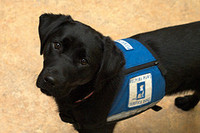
Flickr photo courtesy of pmarkham
Well-trained Seeing Eye dogs are probably the most common and were pioneers in demonstrating the role that they serve in assisting individuals who are visually impaired.
In time, service animals - typically dogs - held a larger capacity, also undergoing extensive training. These dogs, specifically trained for a variety of tasks, like pulling a wheelchair, opening doors, picking up dropped objects and so much more, go through months of training, and at great cost - upwards of $20,000.
The training is rigorous. The end result for the exceptional few dogs that graduate from programs like a small handful here in the southeast Michigan area Canine Assistants, Paws With a Cause, Assistance Dogs of America, Inc. and Sterling Service Dogs.
Since the Americans with Disabilities Act was enacted by Congress in 1990, service animals have accompanied the humans that they assist in public places. In recent years, more unexpected species, like snakes, lizards and parrots had been installed as service animals. And in some cases, these untraditional service animals are much to the dismay of the public.
In the years since dogs gained greater acceptance as service animals, other creatures, like Miniature horses were also installed as service animals.
A few weeks ago, Attorney General Eric Holder signed revisions that were made to the Department of Justice's Americans with Disabilities Act - revisions that clarify which species are considered service animals. Any part of the regulations that were ambiguous before, are no longer. Only dogs qualify as service animals.
Citing Title III of the ADA:
Service animal means any dog that is individually trained to do work or perform tasks for the benefit of an individual with a disability, including a physical, sensory, psychiatric, intellectual, or other mental disability. Other species of animals, whether wild or domestic, trained or untrained, are not service animals for the purposes of this definition. The work or tasks performed by a service animal must be directly related to the handler's disability.
It should be understood that these very capable animals are not pets, but working service animals.
These changes take effect in early 2011. For more information, visit the ADA website.
This is an issue that affects many. Your input is welcome! Please take the poll and add your comments:
Lorrie Shaw is the owner of Professional Pet Sitting as well as a regular pets contributor on AnnArbor.com. She also blogs frequently on More Than Four Walls and enjoys finding solutions regarding pet wellness and behavior as well as social issues related to pets. She can be reached via e-mail.
Comments
lgrey
Sun, Feb 13, 2011 : 6:30 p.m.
It should be made clear that not all dogs come from service dog programs. Many people with service dogs also owner train or use private trainers. Woman in Ypsilanti, psychiatric service animals are not an abuse. I believe the issue presented was the fact that the woman wanted to use a pig as her service animal. The ADA also does still allow for miniature horses in special cases.
Uses Service Animal
Thu, Oct 21, 2010 : 4:12 p.m.
As a person with a service animal cat, I wanted to comment. I could not afford the thousands of dollars to obtain a service animal dog. Plus it took HUD to fight the place where I lived at for many years before becoming disabled as they equated service animal as being non-acceptable under any circumstances and never never had any here--HUD broke that up. I was then harassed too so can you imagine how bad it would have been if I had to take the dog out walking throughout the day to relieve itself--I would have cleaned up but would have been reported constantly. In addition to what my cat does for me at home, I trained my cat to remain in my electric scooter basket and stay quiet in attending meetings. It is important to note that in March 2011 when the new regulation begins, people like me will potentially face having the places where we live tell us we must get rid of our animal or risk eviction. For those like me who cannot afford to move, this places yet another horrible burden on us. The idea of service animals was to allow those who are disabled, and we are disabled IN MANY WAYS, to become independent.
mkm17
Sat, Aug 28, 2010 : 4:02 p.m.
As a puppy raiser for Leader Dogs for the Blind in Rochester, MI, I find this article very interesting! I agree, though, that the pendulum seems to have swung too far in the other direction. I know a little about service monkeys, and it seems they should be covered in the revised laws.
Woman in Ypsilanti
Tue, Aug 24, 2010 : 2:16 p.m.
I think it says a lot about how our society considers mental illnesses that people would consider it an abuse to have a service animal to treat a condition such as anxiety.
aes
Mon, Aug 23, 2010 : 4:43 p.m.
This explanation can be found on the ADA site (http://www.ada.gov/qasrvc.htm) Q: What is a service animal? A: The ADA defines a service animal as any guide dog, signal dog, or other animal individually trained to provide assistance to an individual with a disability. If they meet this definition, animals are considered service animals under the ADA regardless of whether they have been licensed or certified by a state or local government. Service animals perform some of the functions and tasks that the individual with a disability cannot perform for him or herself. Guide dogs are one type of service animal, used by some individuals who are blind. This is the type of service animal with which most people are familiar. But there are service animals that assist persons with other kinds of disabilities in their day-to-day activities. Some examples include: _ Alerting persons with hearing impairments to sounds. _ Pulling wheelchairs or carrying and picking up things for persons with mobility impairments. _ Assisting persons with mobility impairments with balance. A service animal is not a pet.
bunnyabbot
Mon, Aug 23, 2010 : 2:58 p.m.
I think the reason for the more narrow definition is to make it more easy for business/workplace/etc to be compliant with the guidelines. It is reasonable that places welcome service dogs, it is unreasonable to accomadate everyones "service" animal, especially farm or exotic. I forgot to mention, I met a lady with anxiety issues that wanted to get her potbellied pig certified b/c it kept her calm (she had turettes syndrom as well) this thing was over 150 pounds! She took it into a friend of mines store on a stroll, woman with children ran out the door, this was right when the whole swine flu thing was happening, she was asked to leave. additionally, with all the people with anxiety who would like to take Mr Fluffy with them whereever they go it might be too easy to get some doctor to call it a service animal (or whatever the process is), service dogs only, for the purpose of what people have to accept in order to be compliant with the ADA seems reasonable.
CountyKate
Mon, Aug 23, 2010 : 2:10 p.m.
I think we're going from too broad to too narrow. The helper monkey sounds reasonable, as they are intellilgent animals that can be trained to perform many different tasks. And I've read of cats that can tell when a person is going to have a seizure or when a diabetic is in danger of an insulin crash. But, beyond that, I have trouble envisioning how a snake or lizard or horse (no matter how small) or goat could be seen as a service animal. Still, I think AG Holder might have wanted to look into this a bit more before making such an arbitrary change.
Ignatz
Mon, Aug 23, 2010 : 1:38 p.m.
Monkey link: http://www.monkeyhelpers.org/
bunnyabbot
Mon, Aug 23, 2010 : 12:59 p.m.
it might be that dogs are now only on the list due to the possible "abuse" of labeling any animal as a service animal. A snake or parrot might calm someones anxiety but I don't see what else they could possibly do, especially a snake, to help someone with a physical need, they could be viewed as being used as a "blankie". As for a mini-horse, I have heard of them doing much of what a dog can do, however I think that generally speaking businesses and places can accomodate service dogs but cannot be expected to accomodate every kind of animal. I've also heard of service goats, although again, they don't do things like open doors or lead the blind, they just calm nerves. I think dogs are generally considered "clean" animals, no one wants to walk into the produce section or a restaurant and have a goat, mini-horse, snake, monkey or parrot hanging around. I think some people would be offended by seeing these around food and it could put an undue hardship on a business to put the rest of customers at ease that the place was not cotaminated. I for one wouldn't want to eat around any of these, but as I have a dog at home I am used to that. Most people have either had a dog or know someone who has had a dog so they are not surprised to see them everywhere, and people are aware of service dogs and also know these dogs go through a lot of training and these dogs are well taken care of and are going to be healthy, vaccinated and free of diseases. I cannot say the same for others reactions to a lizard.
SonnyDog09
Mon, Aug 23, 2010 : 12:46 p.m.
If you read one of the linked articles, it said that one dude has an iguana as a "service animal" because it makes him feel better. This is the sort of thing that the rules are being tightened to prevent.
Lokalisierung
Mon, Aug 23, 2010 : 12:44 p.m.
Helper monkees!
Ignatz
Mon, Aug 23, 2010 : 12:11 p.m.
I've read where monkeys have been trained to help those with certain levels of paralysis.
Sandra Samons
Sun, Aug 22, 2010 : 11:11 a.m.
It would have been helpful if the article had offered some information about what other species had actually been trained to do as service animals and why this change to exclude them was made.
Lorrie Shaw
Sat, Aug 21, 2010 : 1:36 p.m.
A poll was added.