

'Music for Cats' aims to help cat owners create an optimal home environment for their pets
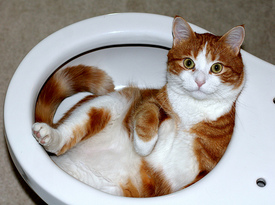
Does this cat look relaxed and content to you?
flickr photo by recubejim
In an age where more and more humans are willing to do what they need to keep their pets happy, there never seems to be a lack of ideas and research that goes into making it happen.
Sure, some people think its crazy, but considering how much we've learned about canine and feline behavior in recent years, they're thriving in many ways because of our efforts.
Case in point: the environment that we create for them. That environment consists of several things to keep pets physically comfortable, but let's remember that auditory input is important, too.
Outdoor noises and being alone can be bothersome for pets, resulting in unwanted behaviors like excessive barking in dogs. These factors can also cause a pet to become unsettled and anxious. Creating a noise buffer helps some pets, even cats, avoid being stressed and can even help enhance good behavior.
I posed the question, "Do you leave the television, radio — or even white noise — on for your pet while you're away?" in a recent piece about a cable television network launched for dogs, and, as it turns out, 62 percent of readers here on the pets section said that they do that regularly.
In the comments, readers noted what kind of programming seems to work best in their households.
A recent article on MSNBC examined the preferences of the kind of music that animals have, and one very interesting aspect has emerged: animals really don’t care for the same music that we do.
So what do they like?
Charles Snowdon, Hilldale Professor of Psychology and Zoology at the University of Wisconsin-Madison, has discovered that animals enjoy what he calls "species-specific music." That is, music that is created using the pitches, tones and tempos that are indigenous to their specific species.
Animals have vocal ranges and heart rates that differ from our own — two physical attributes that seems to affect the way that they process sounds.
For that reason, they aren't wired to enjoy the same auditory input that we do. This is especially true for cats.
Snowdon, along with cellist and composer David Teie used their work with tamarin monkeys to study what it is that cats like and dislike, and they hoped to create songs for the species and go from there.
Felines were a natural choice to begin with, since their size is generally the same breed for breed, unlike dogs, making it easier to hone in on what works. (The size of the animal, along with their heart rate seems to influence which auditory ranges are acceptable.)
The result: Music for Cats.
In sampling some of the songs, you’ll notice that they have a decidedly classical/new-age/nature quality to them.
Available for purchase, there are categories of songs to help encourage interest and curiosity, relaxation or an overall sense of well-being.
Could this — along with other modalities — help households with cats that are experiencing hostility toward one another, or are exhibiting behavior problems like marking and spraying?
My guess is yes, it's entirely possible.
In my experience with cats, the environment that they are immersed in accounts for a high percentage of their behavior, especially when changes occur — like when families are away on vacation, or if there's a move to a new home. The environment acts as their center, unlike canines; they are more centered by the familiar people in their lives.
Studies done by researchers like Snowdon can only further our understanding of felines, and how we can best help them.
Lorrie Shaw leads the pets section for AnnArbor.com. Catch her daily dog walking and pet sitting adventures or email her directly and subscribe to AnnArbor.com's email newsletters.
Comments
JMA2Y
Mon, Apr 16, 2012 : 1:15 a.m.
I know this was a month ago but I just read the article-when my cats were kittens, I played "Go to Sleep Little Baby" from the "O Brother..." soundtrack. It soothed them to sleep. To this day when I sing the song, it soothes them and one at least curls up on my lap. However, when I sing loud, raucous songs, or classical/opera pieces with high notes, or even when I sing "Soft Kitty" from "Big Bang Theory" (Sheldon's song), they come up to me, sniff my face as if to say "What is that awful sound?", and one of them usually bites me.
Renee S.
Wed, Mar 21, 2012 : 2:16 a.m.
I just played the three samples for our cat. She was completely uninterested and left the room. My husband, on the other hand, liked it.
seajeanie
Tue, Mar 20, 2012 : 3:12 p.m.
Yes, our fearful rescued feline definitely prefers "Pachelbel Ocean," to the point that I play it for him all night, when he is up yowling and cannot seem to sleep. He appears to have been an old house cat that had been dumped and is still terrified much of the time. At times I find him asleep in the morning, huddled against the main speaker. It seems to be the only thing that gives him any real peace, that and the rescued kittens we have in the home. He enjoys them too.