

Pittsfield Township asks residents to pick up pet waste to protect Malletts Creek
2009 Water Quality testing in the Middle Huron Stream Monitoring Program reveals that Pittsfield's main waterbody, Malletts Creek, has the second highest level of E. coli (animal waste bacteria) of 10 local streams.
While the Huron River Watershed Council & Middle Huron Partners are further investigating possible sources of high E. coli counts, Pittsfield Township is urging residents to pick up their pet’s waste outdoors.
Studies have shown the cumulative impact of waste from all the pets, livestock, wildlife and resident waterfowl has significant impact on water quality and may cause human health risks, according to the township's Web site.
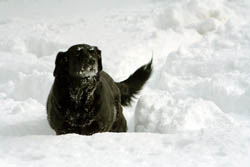
Pet waste left on sidewalks, roads, driveways, parks and yards can mix with rainfall and snowmelt and travel to storm drains and surface waters causing pollution, contaminating drinking water supplies and increasing risk of disease.
Pet waste should be removed daily from your yard. When going for walks with your dog, bring along a plastic bag and scooper.
How should you dispose of it? No solution is perfect, but here are a few suggestions the township offers:
- Flush solid waste down the toilet. Do NOT flush leaves, sticks, debris or cat litter down the toilet!
- Dispose of solid waste and used cat litter in the trash, sealed securely in a plastic bag. While this transfers the problem to a landfill, it does protect the larger watershed area from potential pollution.
- Keep cats indoors or train outdoor cats to use a litter box.
The township also suggests not feeding wildlife or waterfowl. Flocks of birds deposit large quantities of waste in and around surface waters, impacting water quality. Geese also love open lawns near water. Consider a natural buffer of wildflowers and shrubs if you live near a creek or other body of water.
If you have horses or other livestock and stockpile the manure, feed and bedding waste, keep it sheltered from the weather and away from drinking water wells or other nearby surface waters. Do not allow rainfall, snowmelt or other surface runoff to mix with the stockpile.
On the positive side, the phosphorus levels in the area’s watershed are continuing to drop, according to studies by the University of Michigan and the Huron River Watershed Council. This may, in part, be due to fertilizer ordinances enacted by Pittsfield Charter Township, City of Ann Arbor, and other municipalities, the township said.
Comments
Wolfgang
Wed, Dec 16, 2009 : 8:26 a.m.
If I was that dog I would sue for slander
Vernice
Wed, Dec 16, 2009 : 8:21 a.m.
Ummmm....what's that dog in the picture doing? Can't a dog get some privacy?! How humiliating. And who's snapping the shot?
BrianR
Tue, Dec 15, 2009 : 11:37 p.m.
http://www.epa.gov/safewater/contaminants/ecoli.html and http://www.schulich.uwo.ca/ecosystemhealth/education/casestudies/walkertonmed.htm#sources
Captain Magnificent
Tue, Dec 15, 2009 : 7:40 p.m.
oh, sure. I'm supposed to believe some society of microbiologists. Some people will believe ANYTHING THEY READ. People, you need to wake up and start thinking for yourselves!
mrk
Tue, Dec 15, 2009 : 6:45 p.m.
Regardless of whether pet waste contributes to this problem, pet waste lying around is obviously a problem in itself. Pick up after your pets.
Smiley
Tue, Dec 15, 2009 : 6:29 p.m.
http://aem.asm.org/cgi/content/abstract/70/1/377
Captain Magnificent
Tue, Dec 15, 2009 : 5:36 p.m.
There are no scientific studies that link fecal waste to E. coli! I suspect that the township is blaming this on animals because they can't participate in the debate. Sure, it's easy to win a debate with an animal but I for one don't think it's very fair.