

Engage your dogs in socialization activities to avoid boredom and behavior problems
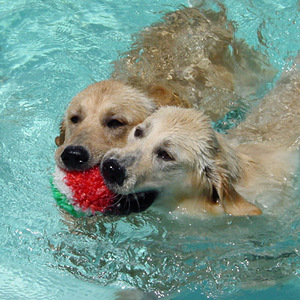
Photo courtesy of Reliable Pool Solutions
“We give our dogs time we can spare, space we can spare, and love we can spare. And in return, dogs give us their all. It’s the best deal man has ever made.” —Margery Facklam
Everyone deserves to have a relaxed, confident and well-behaved dog living in his or her home. I call this the well-balanced dog. What happens to our dog when their buddies — its friends, its pack — leave for work every day or go on vacation?
A dog is a pack animal, and it is very difficult for them to be separated from their pack. (In their world, we humans are their fellow pack members). In nature, this situation does not occur. But we expect our dogs to be alone for eight hours a day — sometimes more — and then have a calm dog when we return home.
It is important to look at this from the dog’s perspective. They are cooped up alone all day. They have nothing to do and are not allowed to relieve themselves for eight hours. Here’s what happens. They chew your favorite rug. They counter surf — and they bark at passersby, both animal and human. Can you blame them? They are bored, bored, bored!
My trainer, Cheri Lucas, reminded me: “It is unnatural for a dog to go crazy when a seeing another dog. When we see people going in and out of the grocery store, do we start screaming and waving our arms at the other person?”
This, Cheri says, this the equivalent of what occurs when one dog sees another, unfamiliar dog. Then why do some dogs go crazy when they see another dog? Many dogs often live in a home where they are not exposed to other dogs. Confined and alone all day, a dog can become fearful, insecure and aggressive — and it can become overly protective of its humans.
Most dogs adjust quite well in a human world. While they may not be exposed regularly to other dogs, when they leave their home they are exposed to challenging situations, and they are expected to adapt.
For example, let’s take going to the vet and groomer. When clients ask me why their dog does not like to ride in the car, it is often because they anticipate an unpleasant experience — because this is the only time they ride in the car.
We also expect that our canine friends by some sort of magic will not bark at visitors , or jump on little children and knock them down, or pee excitedly when someone attempts to pet them. Then what happens when they do these things? They get a human screaming at them to stop!
So when dogs are not exposed to new situations and are not taught to be well behaved, we end up with behavior which, according to us humans, is not good dog etiqutte. Our dogs not only need to adapt to human restrictions, but when dogs live in an environment when they are not in contact with other dogs, it is our job to get them out to meet other dogs and have adventures they enjoy.
Going for walks on trails, taking a dog to swim in a lake, taking your dog to walk with other friends and their dogs are all good choices. On the human side, what about taking your dog along when you run errands? How about when you meet a friend for lunch?
All of the restaurants on Main Street in downtown Ann Arbor have outdoor seating. I have brought my dogs to join my family for dining al fresco many times. Or maybe swimming — you don’t have to own a Labrador Retriever for your pooch to enjoy water. My Wheaten Terrier liked water more than my Portuguese Water Dog! A kiddie wading pool is is perfect for a dog to enjoy relaxing in the pool all day.
It is important to look at the world from a “dog’s eye view” and give our canine friends some activities that are fun and challenging. It is also important to remember how adaptable dogs are, and that they will go anywhere and do anything with their pack — and you are their pack leader!
Yes indeed. Owning a dog is the best deal we humans can have.
Julia Levitt is the founder of In Harmony Dog Training (www.inharmonydogtraining.com) in Ann Arbor. She can be reached at julia@inharmonydogtraining.com or at 734-645-4707. Julia provides individual training for dogs and their owners, and also conducts dog training classes at Ann Arbor Animal Hospital.
Comments
snapshot
Thu, Jun 28, 2012 : 5:04 a.m.
Since we're talking about socializatiuon of dogs, is it proper socialization for dog owners to allow their dogs to deficate and urinate on neighborhood lawns? Is this the proper way to "socialize" your non pet owning neighbors in Ann Arbor? the response seems to be "as long as they pick it up", some don't however, and urine is hard to grab. I think it's rude and obnoxious and so does "Judge Judy". What do you think Ms. Levitt?
Julia Levitt
Thu, Jun 28, 2012 : 10:43 a.m.
Snap shot you have a good sense of humor for a very - ahumm- not so hygenic concern ! You are right - this is not a good way to ingratiate yourself in to a neighbor's good graces. This is the reason dogs are not allowed in many parks ! People do not "pick up" after the dog and soon dogs are unwanted in a park . Please everyone- please "pick up" after your dog- help give dog owners a good name ! Thanks for your comment -Julia
Woman in Ypsilanti
Tue, Jun 26, 2012 : 5:14 p.m.
I like to take my dog with me to a lot of places but I have avoided taking her to Ann Arbor because I perceive Ann Arbor as being a very anti-dog place. I sometimes see people sitting in the downtown Ann Arbor outdoor restaurants with their dogs at their feet and have wondered about that. I wonder what the law actually says about such things. Apparently the health code forbids dogs and I've wondered if the local restaurants are just ignoring the law or if the law allows for dogs in sidewalk seating. Marks Cart's has their big NO DOGS sign and seems to claim it is against the law. I've also wondered about the reactions people get when they have their dogs with them. From what I can tell from many people I know in Ann Arbor and from people I don't know in various forums, dogs at restaurants and even dogs being downtown at all is very much frowned upon. Do people with dogs encounter such animosity? I haven't in Ypsi but Ypsi is more laid back place in my experience.
Julia Levitt
Wed, Jun 27, 2012 : 10:56 a.m.
In my experience - I have not had anyone tell me I cannot bring my dog to join me when I sit outside at a restuarant on Main St. in Ann Arbor. To make sure the dogs I train are well behaved and well socialized I walk them in downtown Ann Arbor. The pet shop- Dogma is very dog friendly. Julia
Julia Levitt
Tue, Jun 26, 2012 : 3:12 p.m.
Say John- alot of folks participate in "fly ball" with their dogs. it is a lively activity for dogs and humans. Julia
LA
Tue, Jun 26, 2012 : 2:48 p.m.
Great article. It should be included with every dog/puppy adoption!! I read a quote somewhere..don't remember the exact words, but essentially: You have your work, your friends, outings to movies, dinner, vacations, music and books - but your dog only has YOU.
Julia Levitt
Tue, Jun 26, 2012 : 3:10 p.m.
Thank you for reading the blog LA. I appreciate your continued support and positive feedback -Julia p.s. excellent quote !
John of Saline
Tue, Jun 26, 2012 : 1:59 p.m.
I once had the idea for an automatic "fetch" toy for someone with some land. It would be one of those tennis-ball cannons with a foot pedal the dog could tap, and the thing would randomly adjust height, direction and power (within limits set by owner) and fire the ball, with the dog bringing it back and (maybe) putting the ball in the hopper. Then I decided the idea was so sad--a dog with no one to play with--that I didn't want to think about it any more.
Julia Levitt
Wed, Jun 27, 2012 : 12:14 a.m.
it sounds like some creative minds at work ! Julia
John of Saline
Tue, Jun 26, 2012 : 7:11 p.m.
I guess that's true. It would be fun to watch! It doesn't HAVE to imply no one playing with the dog.
Woman in Ypsilanti
Tue, Jun 26, 2012 : 5:08 p.m.
Oh but could you imagine one of those things installed in a dog park? I know some Labradors who would probably run themselves to exhaustion if they could figure out how to make it throw the ball. ;)