

The case of the grouchy mare: Horses can get ulcers, too
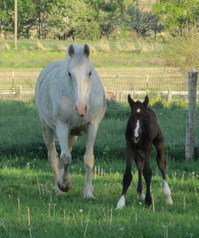
Ms. Mare and newborn foal.
Kathy Lundberg | Contributor
Once there was a beautiful, young mare who was coming along nicely in her dressage training.
She was well cared for and seemed happy about her work. She did have a nasty little habit of cribbing, but this was ameliorated by lots of fresh air, maximizing forage (grass and hay) and minimizing concentrated feeds (“sweet” feed, whole grains, and pelleted food).
Ms. Mare had a "Fed-Ex" encounter (virtual long distance relationship) with an outstanding stallion, resulting, 11 months later, in an impossibly long-legged baby boy. They spent a blissful summer together, eating grass in the sunshine. Baby grew bigger and bigger, and Ms. Mare grew thinner and thinner.
Eventually, it was time for Ms. Mare to go back to work and for her foal to spend some time with other youngsters weaning in the care of a kindly Uncle (an older gelding — “fixed” male). Neither Mom nor baby was initially happy with the arrangement. The foal put himself at considerable risk, braving tall fences to rejoin his Mom, until they were separated as far as possible on the farm. After a few days, he accepted his lot and ran off with his new friends.
Ms. Mare did not want to go back to work. She pinned her ears, kicked out and occasionally threw a buck or two. With patience, insistance and gradual accumulation of small steps of expectations, Ms. Mare was back on track with her dressage work. She was very interested in another pregnancy (as are all healthy mares) and eventually achieved another assisted pregnancy with a stallion cousin to her first sire; Ms. Mare was very uncomfortable towards the end of her pregnancy. Her feet flattened out from weight gain, she had difficulty getting comfortable, and she cribbed to pass the time.
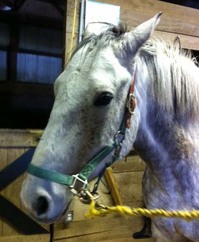
Unhappy Face
Kathy Lundberg | Contributor
A baby girl was born without difficulty, bigger and with even longer legs than her brother. Mom was happy again, and enjoyed another summer with a healthy baby frolicking at her side. The foal was gradually introduced to her several aunts (mares in their pasture), who treated her as kindly as they would their own. Eventually winter came and it was time for Mom to return to work and Baby to get her calories from another source. Ms. Mare’s owner relocated her to a barn in a different city. Ms Mare was away from her baby, her friends, and her home, spending more time in a smaller stall. She was unhappy and cribbed a lot. She pinned her ears, kicked out and just plain stopped when she was asked for more than a trot.
Ms. Mare’s owner knew there was a problem, but did not know the reason. Was it unhappiness in her new home (stalling, food, turn-out regimen)? Was it joint or musculoskeletal pain due to being out of shape post-pregnancy? Had she just matured into a cranky, lazy mare who did not want to work? Had some initial discomfort solidified into a dysfunctional behavioral response? Was it lack of consistency or some other rider factor?
Ms. Mare was sent to a trusted trainer for evaluation. At this farm she had generous turn-out, a large airy stall, in addition to lots of hay and little concentrated feed.
Consultation by a veterinarian indicated possible restriction of movement in her hocks (equivalent to our ankle joint). X-rays showed some arthritic change, and steroid injections were recommended and received. Movement improved, but attitude did not. Easiest (and less expensive) explanation not validated, her owner moved on to evaluate the possibility of ulcers. Ms. Mare was transported for upper endoscopy, sedated, and scoped. The study showed gastric ulcers, Grade 1 (1 is least, 3 is worst). She also had her teeth filed and polished while she was sedated, for good measure.
Gastric ulcers are surprisingly common in horses. For a concise review, see an article on the subject by Doctors Foster and Smith. Horses evolved to continuously graze on relatively low-calorie roughage. Hence, they continuously secrete hydrochloric acid into their stomachs to detoxify and process food. Humans, conversely, evolved to eat episodically through the day: food stimulates hydrochloric acid production. When horses do not eat, acid can build up, damaging the lining of the stomach, producing an ulcer.
Are stomach pH and ulcers related to cribbing? There is much conjecture on the subject, but it remains a distinct possibility. Perhaps Ms. Mare experienced significant stress and ulcers during her own early days and weaning, resulting in both the propensity to crib and to develop ulcers later in life. Perhaps both associations are due to another unknown factor, be it genetic or environmental.
Ms. Mare is now back in training. We will see in the ensuing days, weeks and months whether ulcer treatment will result in a happier, more willing riding partner. Here’s hoping!
Kathy Lundberg is owner of Scio Church Stables and welcomes your contact via e-mail.
Comments
julieswhimsies
Wed, Feb 16, 2011 : 11:49 p.m.
@topcat Horses may be expensive. They can be dangerous. Yes, you can fall from a horse. The dangers can be minimized by caution, experience and training of both the horse and its owner. I am 60 years old, and have had my share of falls after a lifetime of riding. But I cannot think of a greater joy, than walking out to the pasture and watching my sweet mare trot up to the gate to greet me. There is no better therapy than a kind horse. Riding is great exercise (as ALL riders know...you're not just a passenger), and more fun than you can imagine. Yeah. Horses are expensive. But they're a LOT cheaper (and in my opinion much more effective) than psychotherapy and Psychiatrists. Just grooming my horse lowers my blood pressure. After a day at the barn, I am one happy horsewoman.
Top Cat
Wed, Feb 16, 2011 : 7:45 p.m.
Most horse related ulcers belong to the owners of horses. Horses are an endless stream of problems, expenses and "fertilizer". They look nice. But if you ever fell off one and hurt yourself, they wouldn't go get help like Trigger used to.
Trumpet
Wed, Feb 16, 2011 : 1:46 p.m.
I always enjoy your stories. They are educational, interesting, and tell us a bit about a world that is very foreign to most of us. Horses are lots of work, and not easy work. For their large size, they are delicate creatures, requiring constant attention to keep healthy and fit. And, if they are also athletes, they require constant fitness training. They make having a dog seem so easy...
Kathleen Lundberg
Wed, Feb 16, 2011 : 5:53 p.m.
Thanks for your comment. I do occasionally remind my husband that life may have turned out quite differently if he had agreed to a dog in the first place. (I finally got the dog, too!)
julieswhimsies
Tue, Feb 15, 2011 : 8:27 p.m.
Ah. Poor girl. Makes sense. Here's hoping she heals soon. Her friends need her to be healthy AND happy.