

Training your 'dream dog' involves practicing consistency and clarity
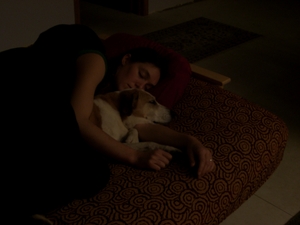
Walk with your dog in your dreams
Photo by John Spieser
As I patiently observe, it occurs to me that, I actually know the language you are speaking well, and even I can't figure out what you are really trying to say!
Where does that leave your dog?
The innocently discombobulated caretaker bounces from one command to another, maybe throws in an “eh eh!” or a “ttsss,” hollers her name three times, and, before you know it, Duchess is staring blankly back as if she were listening to Abbott and Costello doing “Who's on first?”
Yes, it's easy to laugh at ourselves and others when we get jumbled up and our communication manifests itself as something other than what we intended. We giggle and tease when politicians mix up words or celebrities fall on stage.
It is also easy to forget that many of the skills we have achieved and come to take for granted, once posed similar challenges for us.
Practice makes perfect!
When I was about 13 years old, I was reading a story that included a bit about a star basketball player. I don't remember the man's name, but I have always remembered something he said. Not a direct quote, it basically went like this: When I am on the free-throw line, ready to take a shot, I close my eyes momentarily and picture the ball swishing through the hoop, then I shoot.
His claim was that this “moment of imagery” increased his percentage of shots made.
Years later, when I was listening to an instructional tape (remember “tapes”?) on sign language, it suggested that you “imagine” a conversation in your mind as you are falling asleep. The tape professed that your mind will play it back six times after you have drifted off.
So...
When I started working with dogs seriously and, more importantly their people, it required that I get my “ducks in a row” as far as communication was concerned. Honestly I worried that I would contradict myself in the field while I was working with a dog and its owner, simply because I was mixed-up with my words/cues/body language.
In an effort to polish my own canine dialogue and become more helpful to my students, I began a personal training ritual that I hoped would hone my skills, based on the wise teachings from the athlete and the sign-language devotees.
It goes like this...
When I am ready to go to sleep, after I close my eyes for the last time, I go on one more dog-walk.
There is only one rule for this walk: honesty.
I choose a dog/s and accept all of the realities, based on my previous experiences, of the dog I've chosen. It could be my dog, a dog that I am working with, or multiple dogs.
Then, we head out...
I imagine what would happen if A, B or C occurs.
Maybe we are walking in the Arb and an off-leash dog comes bounding up?
What if I am at Bird Hills park and a herd of deer come prancing through?
Disc golfers at Mary Beth Doyle Park think my dogs are “cool” and want to say hello?
A neighbor dog walker proposes a greeting?
Construction noise is up ahead?
Feisty terrier, nose to ground hound, committed collie dog, it doesn't matter...
I roll with it as I drift off to sleep.
What do I say first? Where do I position myself? How does my dog view the situation? What do I need to have working from a training standpoint to support smooth navigation and handle well, the issues that arise?
I play it through in my mind and practice giving the proper cues, chronology and timing. I discover the pitfalls, brain storm solutions and, even though I am in the world of imagination, I don't allow myself to pretend my way out of a tough situation.
These are the kinds of challenges that my “dream quest” is sincerely exploring.
Any experienced dog trainer will tell you that consistency and clarity are two of the most important ingredients needed for a training strategy that renders a savory result.
I can tell you, from my own experience, that thinking these scenarios through and practicing your cues in your mind ahead of time, will dramatically enhance your agility when the actual moment arises.
Give it a try! Take a walk with your dog every night for a week. If nothing else, it will beat counting sheep! You may find that you are shooting quicker from the hip on your (real life) walks and, or discovering where you are lacking a logical plan of action.
At least you can say, “I have it all worked out...
in my dreams.”
John Spieser is a professional dog trainer and owner of Dogheart. He can be reached at john@doghearta2.com.
Comments
Elaine F. Owsley
Wed, May 11, 2011 : 1:17 a.m.
I learned consistency raising three kids less than 3 1/2 years apart. I guess it stuck with me because my dog has me pretty well figured out - no surprises. She watches me for clues - like, if I put on lipstick, someone must be coming, so she sits in the window to see who it is. If I put on lipstick AND earrings, she knows I'm going someplace, so she sits by the door to see if maybe she can go too. If I say she can't go this time, she goes to the window to watch for my return. When the paper came daily, I would start the coffee maker and then go out to get the Free Press in the morning and she would beat me to the door to go along. It was really bad when the paper stopped coming every day, because that caused an inconsistency and she had a hard time with it. The fact that three days a week we DO go out to get the paper has been a challenge for her.
Linda Diane Feldt
Tue, May 10, 2011 : 2:04 a.m.
When I got my very first dog, 12 years ago, I was struck by how important communication was. For the first time ever, I was aware of having to clearly say YES! to let her know what I wanted. Because just saying no wasn't communicating much of anything. Practicing noticing what I liked and letting her know was a great experience - and very challenging to do it all the time. It works with dogs, and it works with people. But it took doing dog training before I noticed it was something I need to learn and practice. It helps a lot to have another adult reinforcing me and noting when I am being confusing with my dog. But more and more, she looks at me for those cues and ideas about what to do. They are such amazing and communicative creatures. I am constantly in awe. Thanks for your column, another reinforcement for me to behave well with my dog.
Lorrie Shaw
Sun, May 8, 2011 : 3 p.m.
Wise words, John. Practice makes perfect on the human side of the equation, too!